
[ad_1]
Belu-Simion Fainaru alleged antisemitism and discrimination after the jury decided to exclude Israel from awards, new reports reveal.

New revelations that Israeli pavilion artist Belu-Simion Fainaru issued legal threats against the Venice Biennale may shed light on the awards jury’s sudden decision to step down from this year’s event.
According to the Italian news agency Adnkronos and as independently confirmed by Hyperallergic, Fainaru filed legal warnings outlining allegations of antisemitism and nationality-based discrimination shortly after the jury initially stated that it would not consider countries accused of human rights crimes, disqualifying Israel and Russia.
The women-led jury, which included Elvira Dyangani Ose, Zoe Butt, Marta Kuzma, Giovanna Zapperi, and Solange Farkas (who served as the chair), stated its intent to omit nations “whose leaders are currently charged with crimes against humanity by the International Criminal Court” on April 22. The Biennale Foundation asserted in a press statement at the time that the group’s decision “represents a natural expression of the freedom and autonomy which La Biennale guarantees.”
Dozens of pavilion artists and curators, a majority of participants in the In Minor Keys exhibition, and multiple culture workers affiliated with the Biennale voiced their support of the jury’s decision, pointing to the long-standing pressure to exclude Israel and Russia from the program entirely. However, Israel’s Ministry of Foreign Affairs took to X to lambast the “political” jury, accusing the group of transforming the Biennale from “an open artistic space of free, boundless ideas into a spectacle of false, anti-Israeli political indoctrination.”
The jury issued its abrupt resignation notice on e-flux eight days later, leading the Biennale Foundation to scrap the historic Golden Lion awards altogether this year and institute the “Visitor Lions,” decided by public vote from ticket holders throughout the duration of the exhibition. The Foundation clarified that both Russia and Israel were back in the running for the Visitor Lions in a press release.
The resignation was widely interpreted as an extension of the jury’s initial statement of intent. However, Adnkronos’s recent report that Fainaru and his legal counsel filed legal warnings with the Biennale, the Italian Ministry of Culture (MiC), and the Italian Prime Minister’s office, in which he noted his intent to pursue litigation based on antisemitism and discrimination, suggests a different reading. The Israeli news outlet Haaretz corroborated reports of Fainaru’s appeals and also highlighted a phone call between the artist and Italian Culture Minister Alessandro Giuli, who “promised that Fainaru’s work would be promoted … as part of a [MiC] initiative,” and underscored the government’s “commitment to combating all forms of discrimination and antisemitism in the country’s cultural institutions.”
Despite the Biennale Foundation’s initial assertion that the jury “acts autonomously and in total freedom of opinion in the exercise of its functions,” Adnkronos reported that the Biennale’s regulations, according to various interpretations, “do not permit such an exclusion.”
A follow-up report from Adnkronos stated that the Biennale’s legal department warned that the jurors could be personally liable for damages to Fainaru in the event of a dispute, and that they were informed of the potential legal exposure during a MiC investigation between April 29 and April 30.
In response to Hyperallergic’s inquiries, a Venice Biennale spokesperson confirmed the recent reports, but did not immediately respond to questions about jury conduct regulations.
Hyperallergic has contacted the former jury members, MiC, and Fainaru for comment.
In a recent interview with the New York Times, Fainaru said he was happy to hear of the jury’s resignation, maintaining that he “can’t be judged by belonging to a country or a race.”
The Romanian-born artist and curator co-represented Romania in the 2019 Venice Biennale, and co-founded the Mediterranean Biennale in Haifa in 2010 with Avital Bar-Shay, one of the commissioners of his solo presentation in Israel’s temporary pavilion in the Arsenale this year.
The new details emerge amid mounting political tensions at the Venice Biennale, whose preview week has so far been marked by protests.
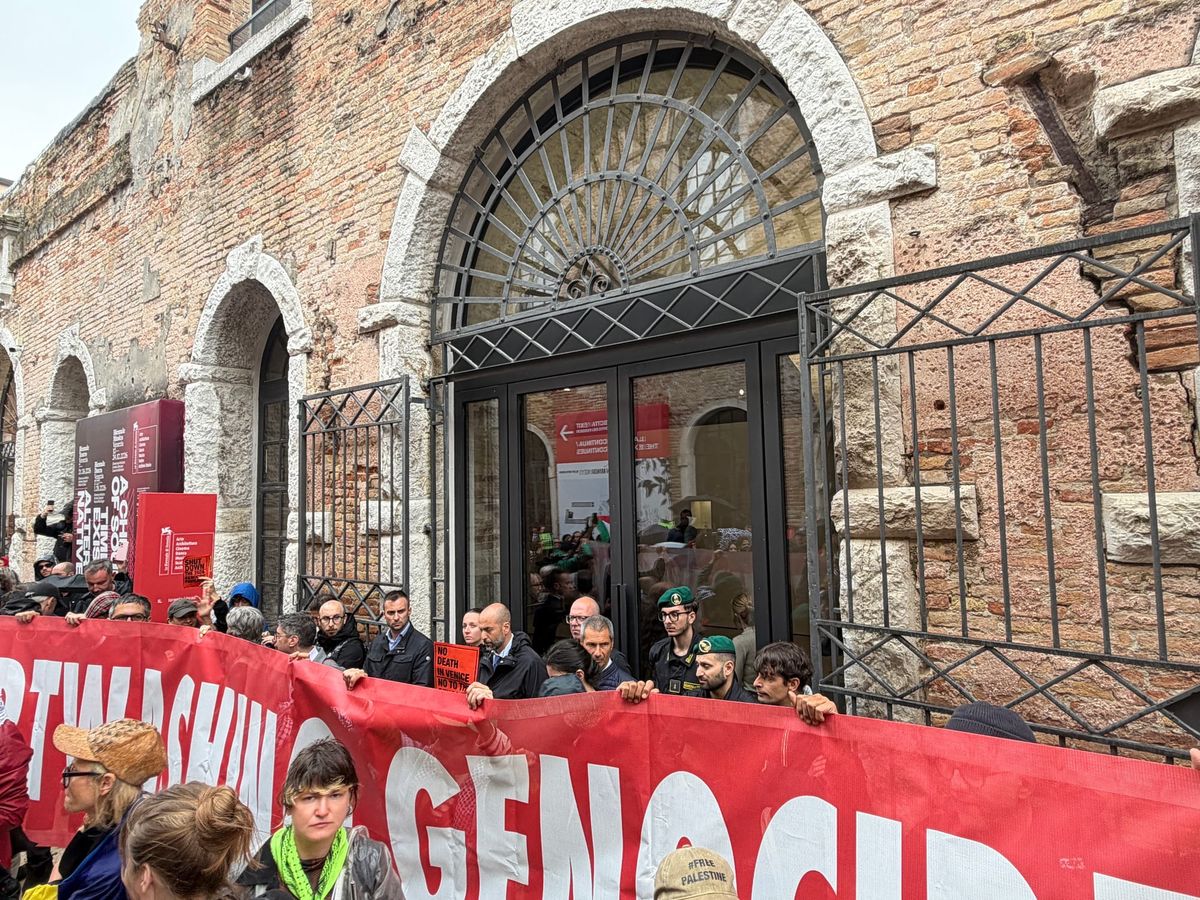
Earlier today, hundreds of activists led by the Art Not Genocide Alliance (ANGA) organized a large demonstrations outside the Israeli pavilion that temporarily blocked the entrance to the exhibition during the Biennale opening preview. Waving Palestinian flags and displaying banners that read “No Artwashing Genocide” and “No Genocide Pavilion at Biennale,” the protesters managed to shut down the pavilion for half an hour.
The action was the latest in the group’s ongoing campaign. Late last month, ANGA delivered a letter signed by 236 artists, curators, and workers involved in this year’s Biennale to event organizers, demanding Israel’s exclusion on the grounds of its continuing violence against Palestinians.
“As long as Israel exists by means of genocide, ethnic cleansing and apartheid, it must not be represented at the Venice Biennale,” the missive read.
[ad_2]
Source link