
[ad_1]
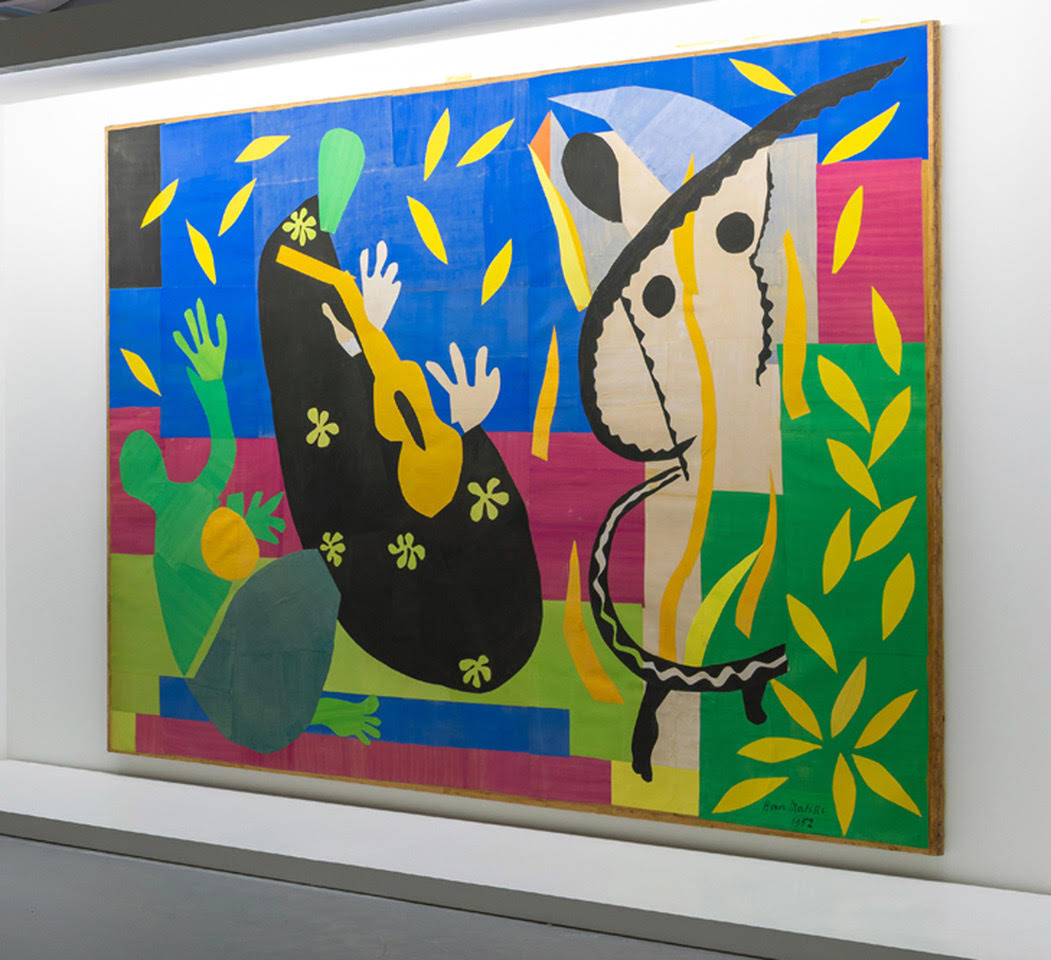 La Tristesse du roi, 1952 Papiers gouachés découpés marouflés sur toile, 292 x 386 cm, Centre Pompidou, Paris, Grand Palais Rmn, Photo© Luc Castel, 2026
By JOSEPH NECHVATAL May 6th, 2026
The last thirteen years in the creative life of Henri Matisse (1869–1954) is the subject of the Matisse 1941–1954 show at the Grand Palais in Paris. At the end of his life, bedridden and in failing health, Matisse began creating works known as papiers découpés, or cutouts: painted sheets of paper he cut into various sizes and shapes and had his assistant arrange into vibrant compositions at his direction. The show contains major examples of these beautiful post-painting refusals of the rules and norms in painting, including the great Memory of Oceania (1953) from MoMA. There is another mode of expenditure as pre-linguistic cognitive structure in this collage (the size of a major painting) concerning a memory that is full of playfulness, entertainment and free leisure, even while it raises for me the question of temporality: i.e. time as a unity of the past, the present and the future.
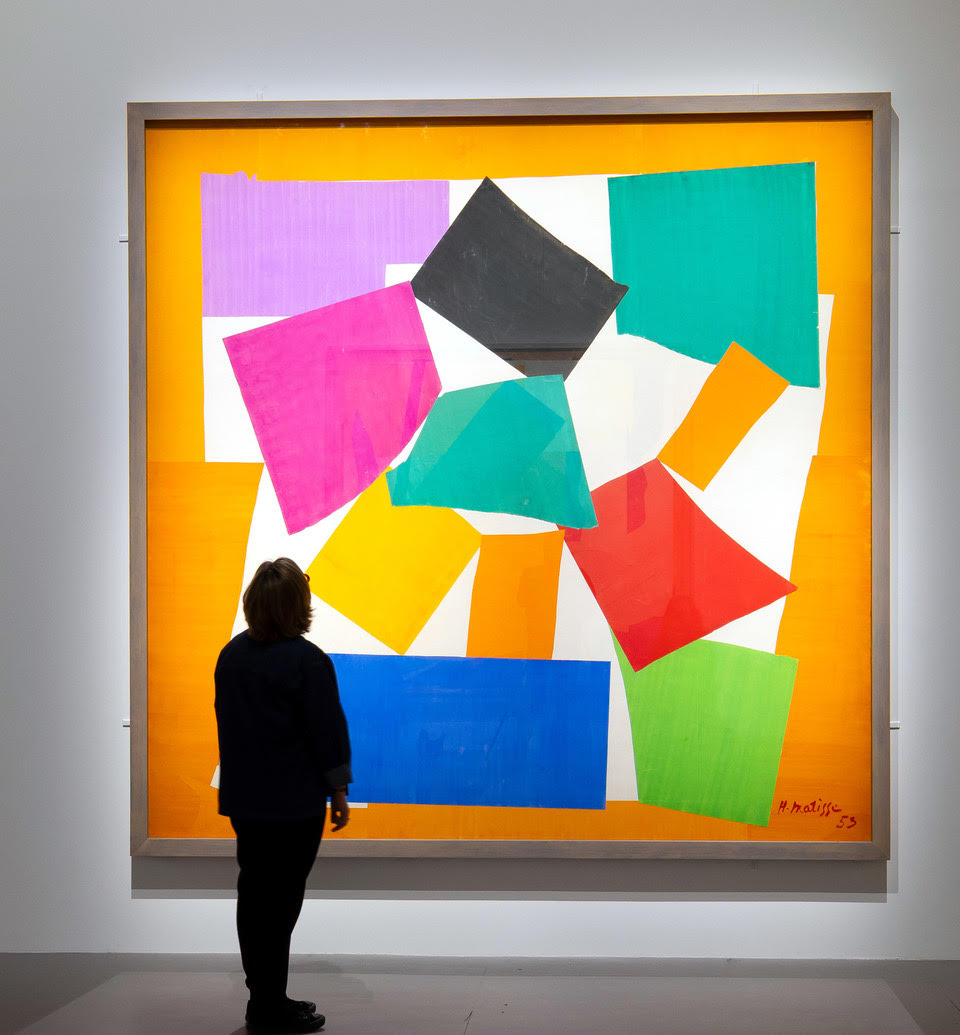 View of L’Escargot, 1953 Papiers gouachés, découpés et collés sur papier marouflé sur toile, 286 x 287 cm, Tate, Londres, Photo© Luc Castel, 2026
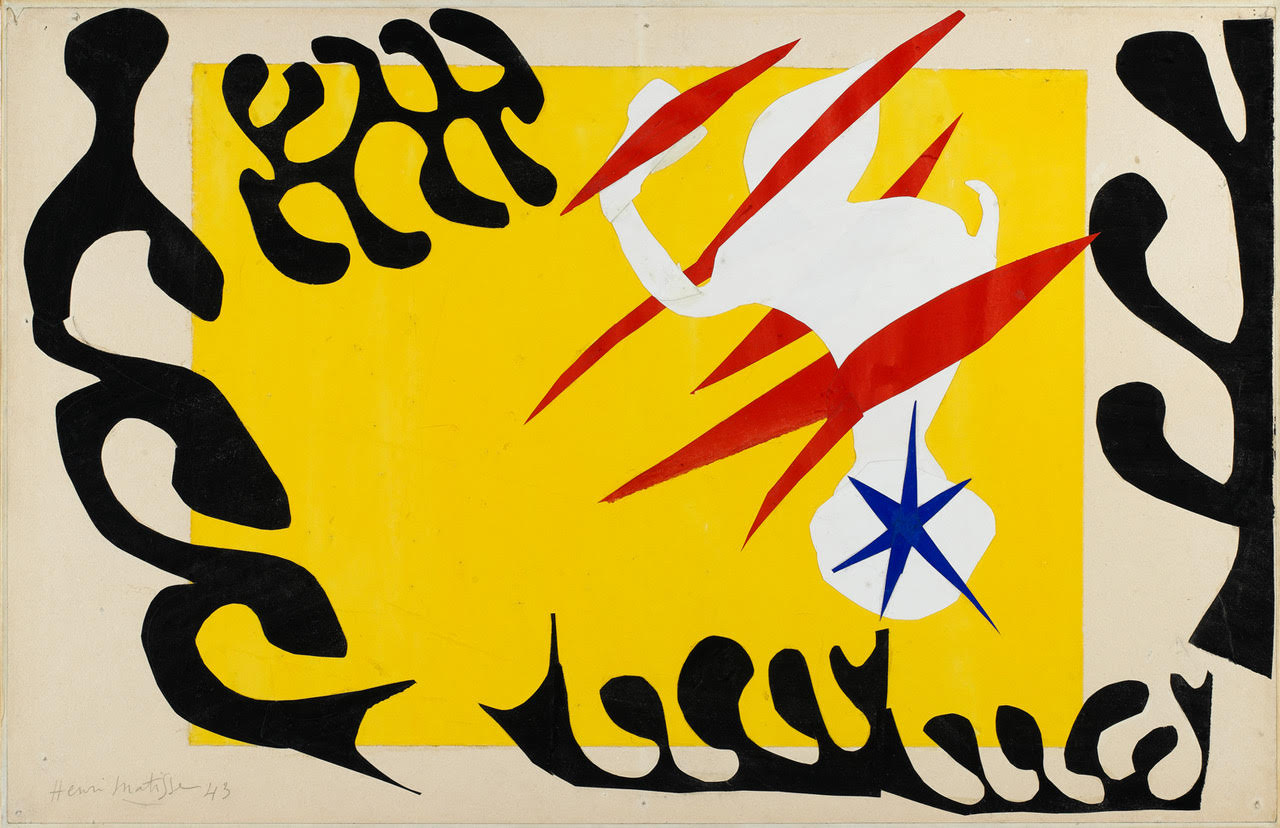 Le Cauchemar de l’éléphant blanc, fin octobre – début novembre 1943 Planche originale de l’album Jazz, Paris, Tériade, 1947 Papiers gouachés, découpés et collés sur papier marouflé sur toile 43,9 × 66,7 cm Paris, Centre Pompidou, Musée national d’art moderne Dation, 1985 Inv. AM 1985-315 (4) Photo © Centre Pompidou, MNAM-CCI, Dist. GrandPalaisRmn / image Centre Pompidou, MNAM-CC / Philippe Migeat, Christian Bahier
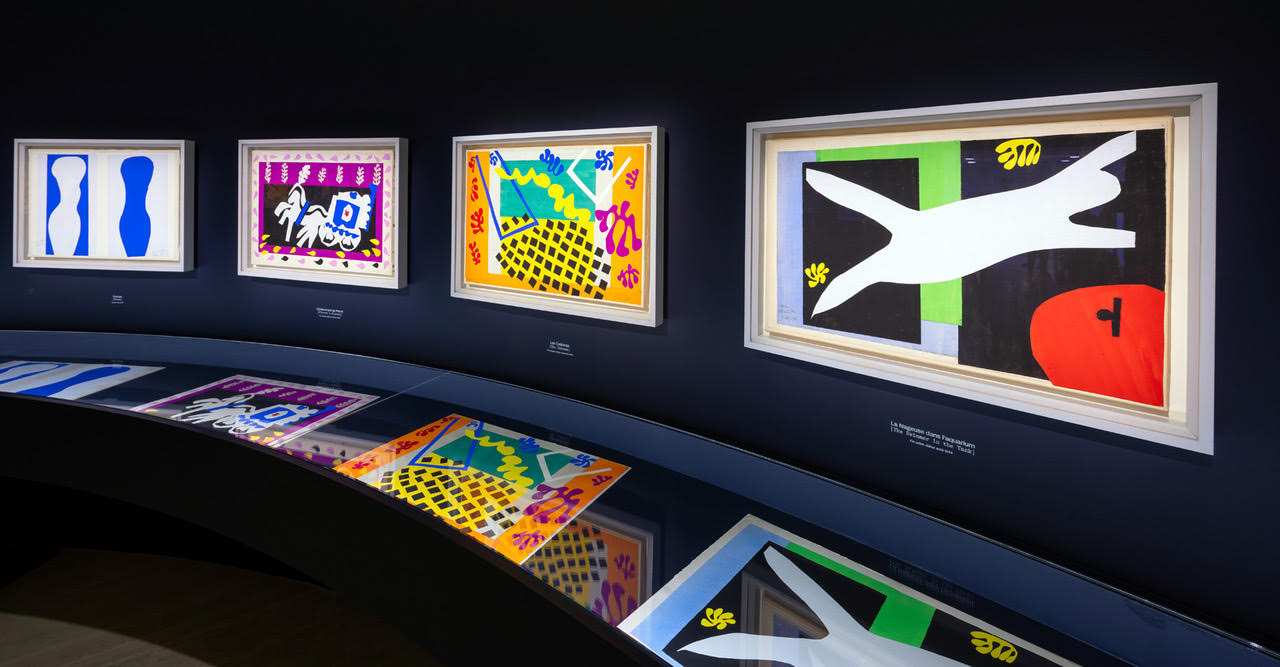 View of the Jazz section of the Matisse 1941-1954 exhibition, Grand Palais x Centre Pompidou. Photo © Luc Castel, 2026
After passing by some truly awful late paintings at the entry, Matisse’s playfulness with color pastiche and image hybridity takes off with the Jazz (1946) collages he made for a book. There is a musical metafiction based on image reduction and fragmentation at work in this colorful narrative of the symbolical and metaphorical representation of free time. One thinks of free jazz, and, inevitably of the music of Ornette Coleman.
In Jazz, time is perceived, measured, and described as visual text. Its lingual-visual signs have a large amount of metaphorical and idiomatic expressions on display and the work possess a rich palette of colorful means and ways for the book reproductions into which the collages head. This perception is made available through the installation of the original maquettes placed over the corresponding book page, that is placed in a vitrine just underneath each collage. Considering them, I felt two dominant aspects here: my color perception as time and a personal conceptualization where fragments of the book are adequately reflected as a musical score.
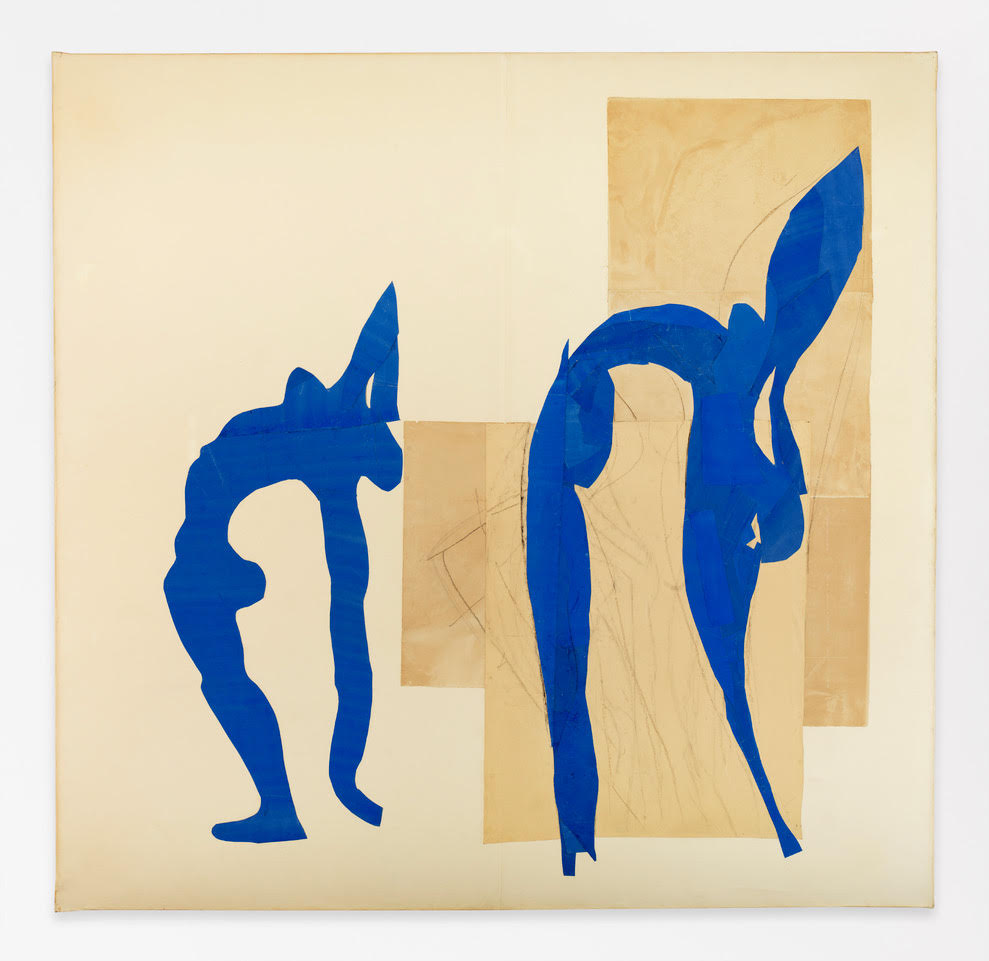 Acrobats (1952) Fusain, papiers gouachés, découpés et collés sur papier marouflé sur toile, 213 x 208,3 cm private collection, Photo© Luc Castel, 2026
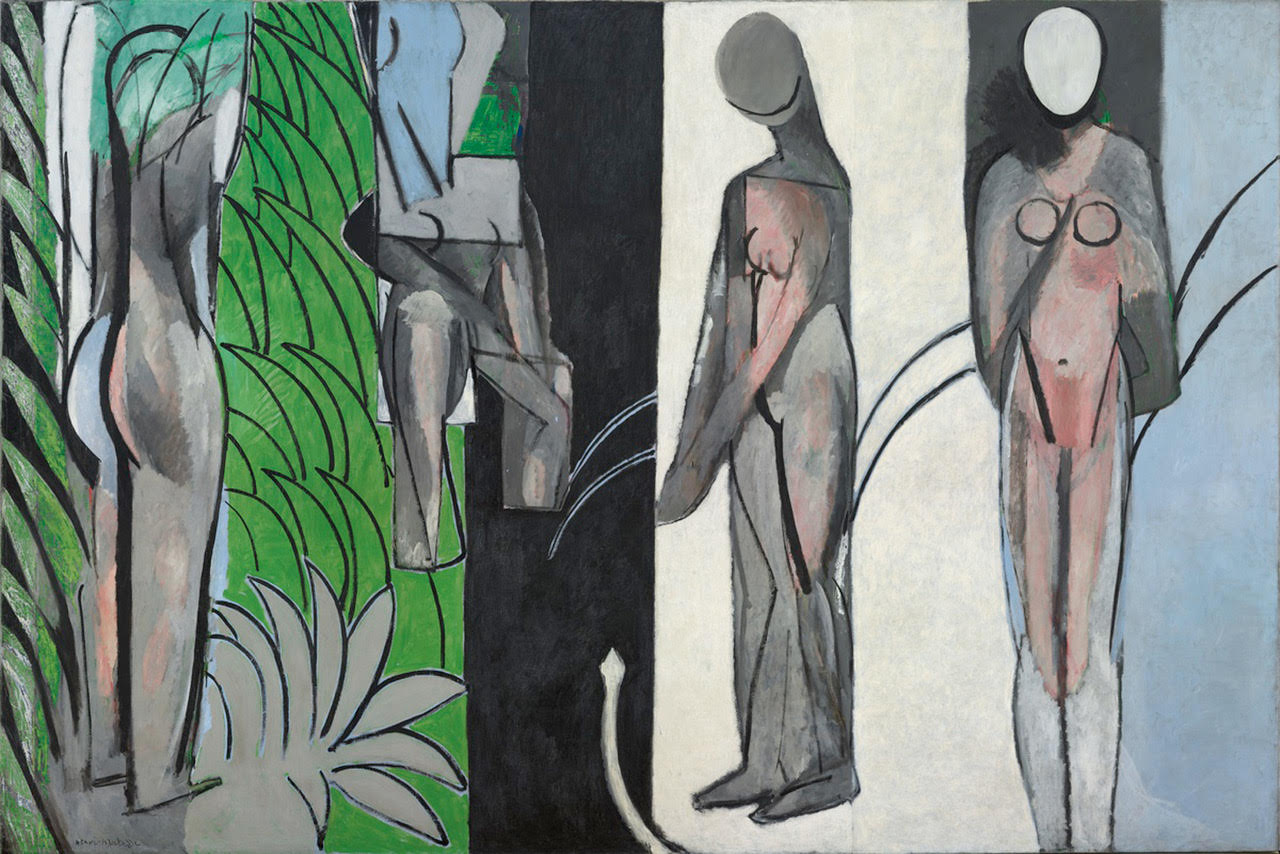 Bathers by a River (1909–10, 1913, 1916–17) Oil on canvas, 102 1/2 x 154 3/16” (260 x 392 cm) Collection of The Art Institute of Chicago (not in the exhibition)
A phenomena of bifurcation of consciousness and inadequate perception of space become the subject of Acrobats (1952), perhaps my favorite picture in the show. The title itself comprises the idea of the heterogeneity of displacement and transposition. The bending-over backwards structure of the blue figures emphasizes, for me, the importance of the now of any given point in time when seen as pure. I understand ordinary art history today through this sense of staggering perpetual (yet evanescent) newness as a thing artists use to advance their work.
In analyzing and enjoying Acrobats, I found it necessary for me to note the figures as complex and multilevel and multifaceted, which testifies to the fact that this simple picture becomes more complicated in my mind than it is on the wall, and, hence, gets various forms of expression moving as a product of my mind. In trying to understand Acrobats I resort to games and sexual experiences, but also to Matisse’s painting Bathers by a River (that he worked on during the years 1909–10, 1913, 1916–17). Bathers by a River is a huge painting about the river of time that I absorbed as a young man growing up in Chicago. So my consciousness of Matisse’s Acrobats, and its use of tumbling and bending free time, is a complex one to separate from my memories of postmodernism where there exists a view on time which represents a set of individual realities.
My personal construction of Matisse (and his time) in this show depends upon the fluidity I can enter into the Modern cultural canon, and moreover, upon my memories of emerging as an individual artist from the city in which I grew up. So in Matisse 1941–1954 I found my own attempt to provide a brief survey of time so as to outline various positions Matisse’s late works have engendered. The experimental Matisse I found here used artistic knowledge based in travel, but with no systematic study of temporal structures. I find this beneficial in that the Matisse discourse has become a staid one that requires courageous acts of artistic imagination to move.
Perhaps the full recognition of Matisse as a post-painter/painter has yet to be carried out, but, I think, Matisse 1941–1954 helps with that. For far too little attention has been given to this particular brush-less theme in late Matisse. In general, here the category of brush-less Matisse manifests as a correlation with the overall discourse of my memories of postmodern time: something to be constructed, shaped, and reproduced. But let me mention some more fundamental late Matisse principles (as I see them): the rejection of strict rules of how to construct a painting; the adaptation of a collage attitude to painting; a discourse of reduced fragmentariness; of découpé time/memory montage; of hybridity of genres; of the paradox of age in art; the playing with the history of painting, with art history and time, with intertextuality; citation; pluralism in styles of image organization. The objective of the modernist style was reduction and economy and the postmodern primary factors are activation of inter-cultural contacts, the virtual, speed, and the neglect of older norms and canons. Moreover, abstraction as a cultural category turns into a personal decorative category which finds its reflection in Matisse 1941–1954 as a salable product (you should have seen the line for sales at the bookstore).
My meditation on Matisse 1941–1954 expresses my doubt that the world of painting is generated by linier time and linier movement. Because, in my opinion, Matisse the artist did not have a clear working sequence of orderliness in thoughts and actions, just as Bathers by a River showed me long ago. But time is written left to right in our texts, which is useful for ordering events and actions of artists. The textual tale of Henri Matisse has much in common with our objective sense of time, but lacks some of the characteristics I have sketched out above about making the time of our lives whole. Not through line of reasoning, but through feeling.
By somewhat closing the time gap between me and Matisse gives him meaning. Quite often artists abandon chronological presentation in their work and thus break the logical sequence of time/space and cause/effect relationships in their story. Temporal distortion is used in art in a number of ways and takes a variety of forms, which range from fractured narratives to games with cyclical, mythical or spiral time. Likewise, Matisse 1941–1954 for me employs a way to create experiments with time. I could explore there the fragmented, chaotic, and a-temporal nature of existence within our present. In other words, Matisse 1941–1954 may be used to augment the linear progressive story of Henri Matisse with a more nihilistic post-historical experience of his work, oriented to the conceptualization of our time.
In Matisse 1941–1954, end times is presented as fundamental and normal even as indeed Henri Matisse the artist continues to be an endless source of perplexity here, mostly due to his work’s handling of tradition, scale and time as it comes to those devoted to his timeless greatness.
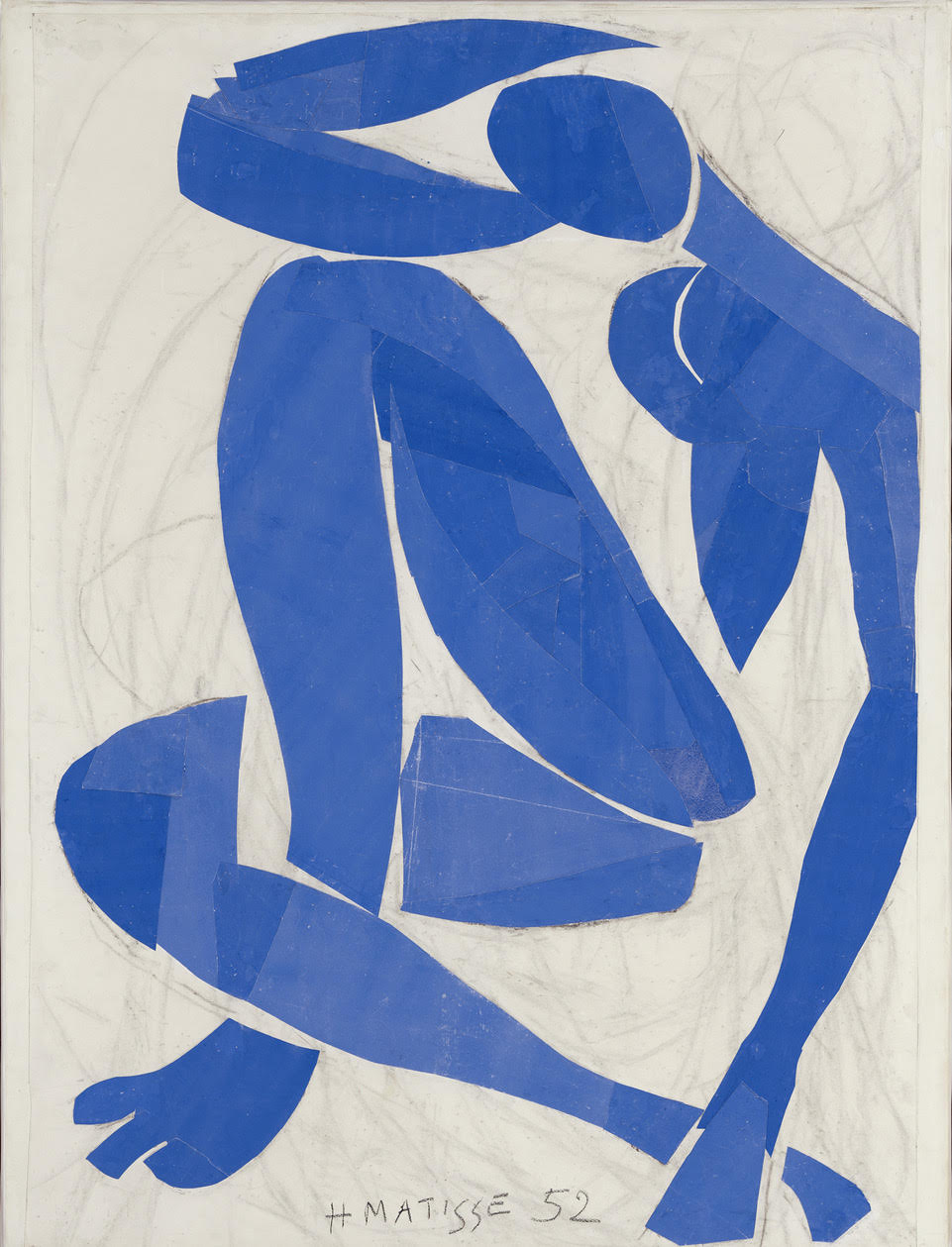 Nu bleu IV, 1952 Fusain, papiers gouachés, découpés et collés sur papier marouflé sur toile, 103 x 74 cm Don de Madame Jean Matisse à l’Etat français pour dépôt au Musée Matisse Nice, 1978, Musée d’Orsay, Paris (inv. D.78.1.57 / RF 36789) Musée Matisse Nice Photo © François Fernandez
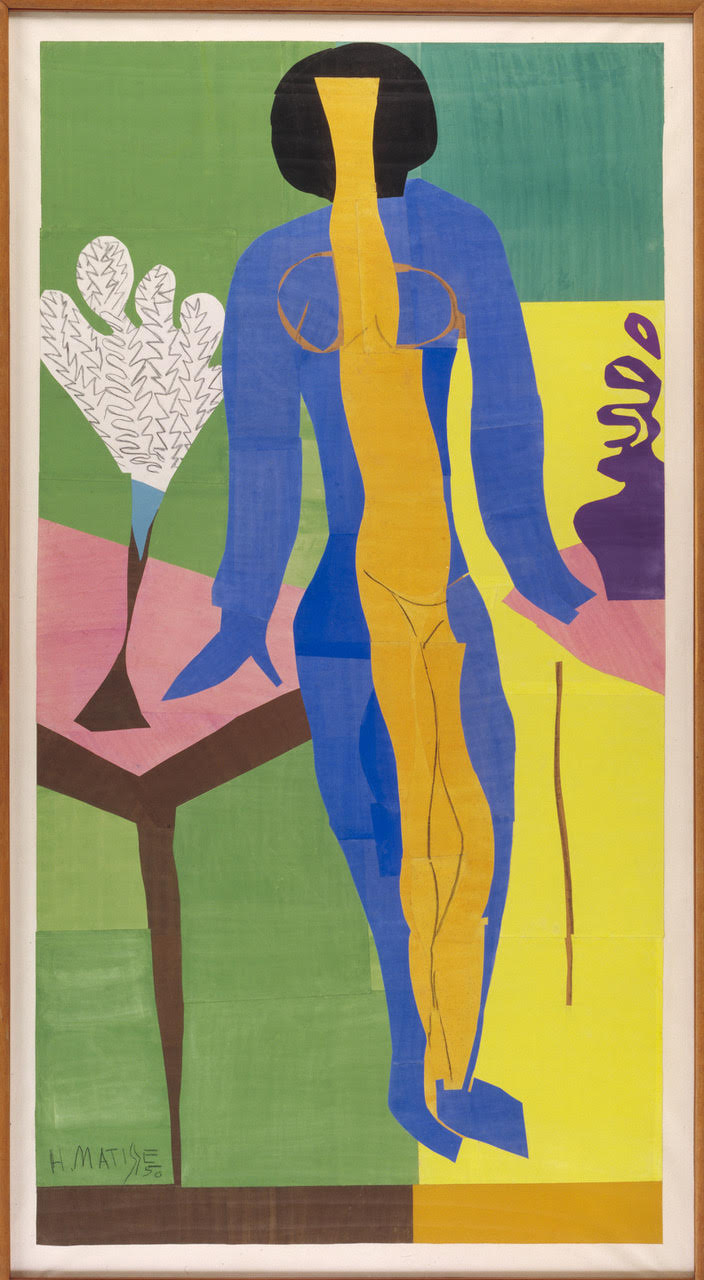
Zulma, début 1950 Papiers gouachés découpés, 273 x 152 cm Statens Museum for Kunst, Copenhague
[ad_2]
Source link