[ad_1]
As robust May flowers bloom in all directions, we embrace the vibrant energy of Primavera. Amid increasing global chaos, art endures as the ultimate stronghold of free expression against tyranny. This month, the Hessel Museum of Art presents the annual showcase of dynamic exhibitions by recent graduates of the Center for Curatorial Studies at Bard College. September Gallery features dreamy explorations in camera-less photography by Daniele Frazier and empowered mixed-media works by Lukaza Branfman-Verissimo. Art Omi features Onnis Luque’s pointed artistic investigation into the ongoing exploitation of natural resources in Mexico, while the Frances Lehman Loeb Art Center at Vassar College features a series of bright Japanese woodblock prints with political undertones that are uncannily reminiscent of current global chaos. May we indulge in the artful pleasures of this glorious month of May!
Everything That Happens Will Happen Today
Hessel Museum of Art, 3 Garden Road, Annandale-On-Hudson, New York
Through May 24
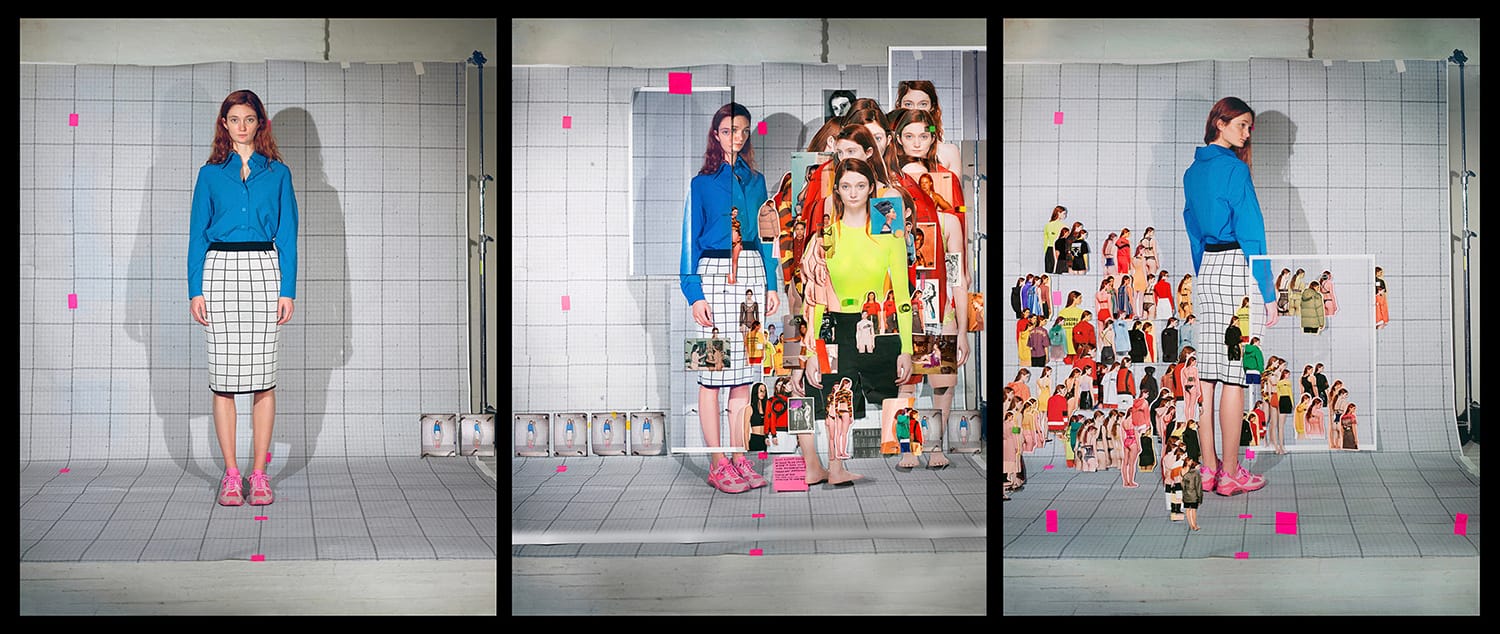
Among the most exciting art events in Upstate New York is the annual presentation by graduates of the Center for Curatorial Studies at Bard College, and this year is another doozy. Featuring 12 thesis exhibitions, Everything That Happens Will Happen Today considers the critical issues of our topsy-turvy times. The show brings together artworks by over 30 artists, including Alice Aycock, Arthur Jafa, Mike Kelley, and Ana Mendieta, among others. Ceremonial Healings of Bastet the Cat: On Halim El-Dabh’s Sonic World, curated by Alma Chaouachi, presents the archive of this Egyptian-American composer and ethnomusicologist, while part of being alive, curated by Christopher Gianunzio, considers the suffocating nature of American imagery. Useful Contaminants, curated by Grace Harmer, features a feedback-driven sound installation, and Assume Form, curated by Emily Nola, explores the interdisciplinary and theoretical work of the influential Cybernetic Culture Research Unit collective from the late 1990s.
Daniele Frazier: Night Writing
September, 4 Hudson Street, Kinderhook, New York
Through May 30
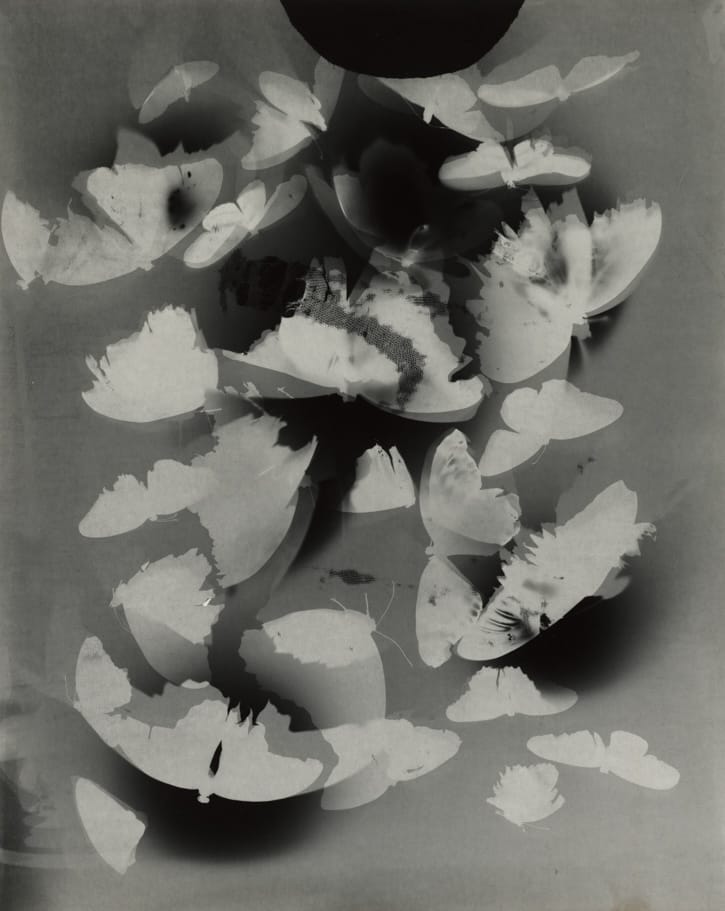
Daniele Frazier’s dreamy explorations in camera-less photography whisk us away into alternate realms. September Gallery presents her solo show Night Writing featuring recent prints and single-channel video works. Frazier’s Butterflies versus Moths 1-3 (2025) series consists of beautifully chaotic silhouettes of these winged creatures, while her Amaryllis 1-6 (2026) photogram series captures this flora in various hazy shades of yellow and green. “January 21, 2026 Icicles from Williamstown, MA” (2026) is an eight-part meditation on the power of raw organic forms, while her short video works “Lily” (2026) and “Tulips” (2026) further reflect her affinity for nature. Visitors to Frazier’s show will get the bonus experience of the concurrent exhibition Steadfast Study featuring Lukaza Branfman-Verissimo’s expressionist text-focused mixed-media works that consider the representation of Black, Indigenous, Queer, and Trans artists and people of color with disabilities.
Art Omi, 1405 Country Route 22, Ghent, New York
Through May 31
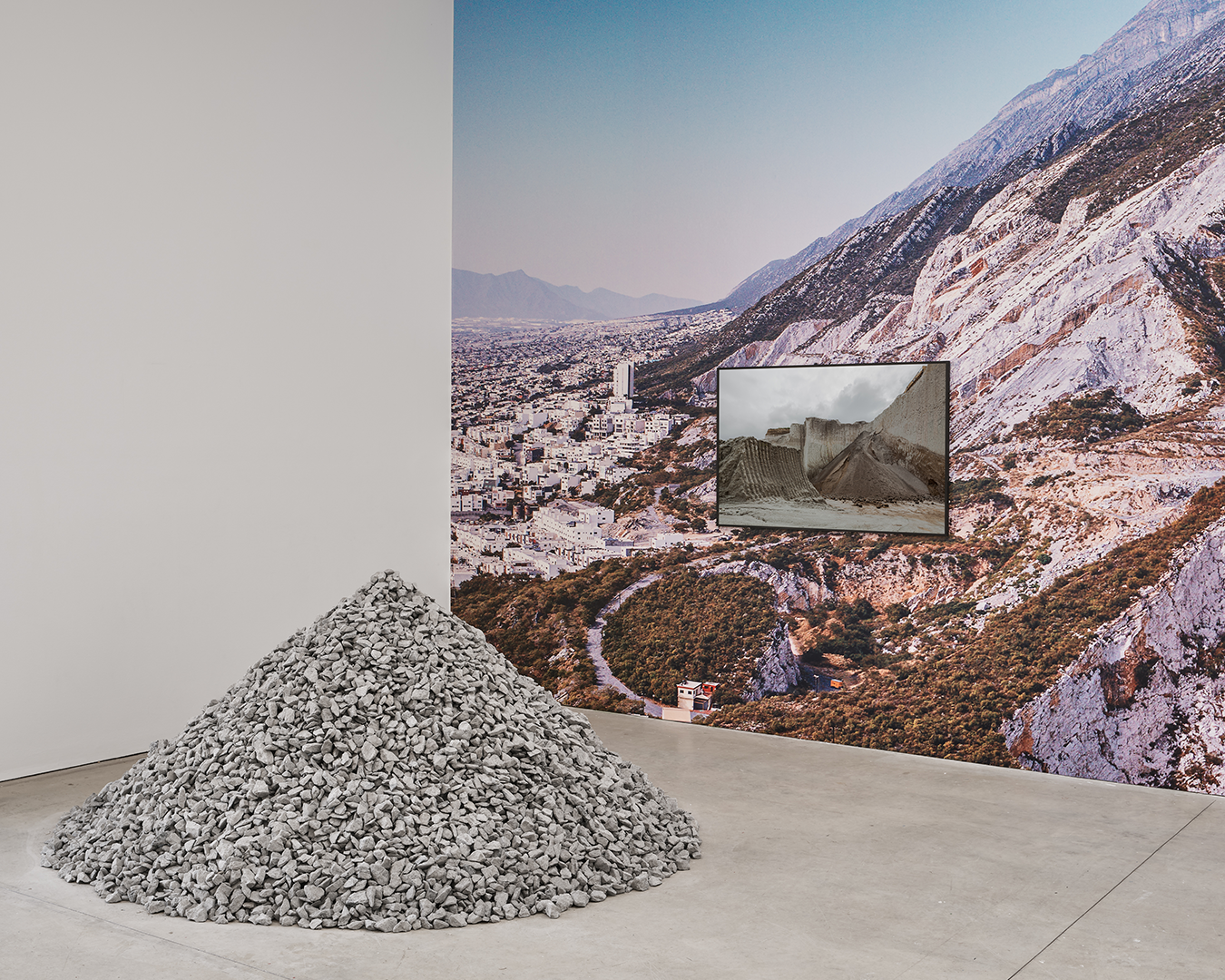
This installation at Art Omi packs a punch. From one wall to the next, the architectural photographer Onnis Luque presents environmentally conscious imagery through prints, wall graphics, and site-specific installations that detail his ongoing investigation into Mexico’s extractive geographies. One of the largest walls houses a full-bleed image of a carved-up mountainside with three overlaid images of factories and the words “progreso y desarrollo” (progress and development) in the far-right corner. Installed dynamically throughout the Newmark Gallery space, these richly hued visions of natural environs include traces of past construction projects that reveal the insecurities of our contemporary era as mankind further brutalizes the natural resources of this planet with capitalist force.
(your) body is a porous language: (our) embodied connections
Ann Street Gallery, 104 Ann Street, Newburgh, New York
Through May 31
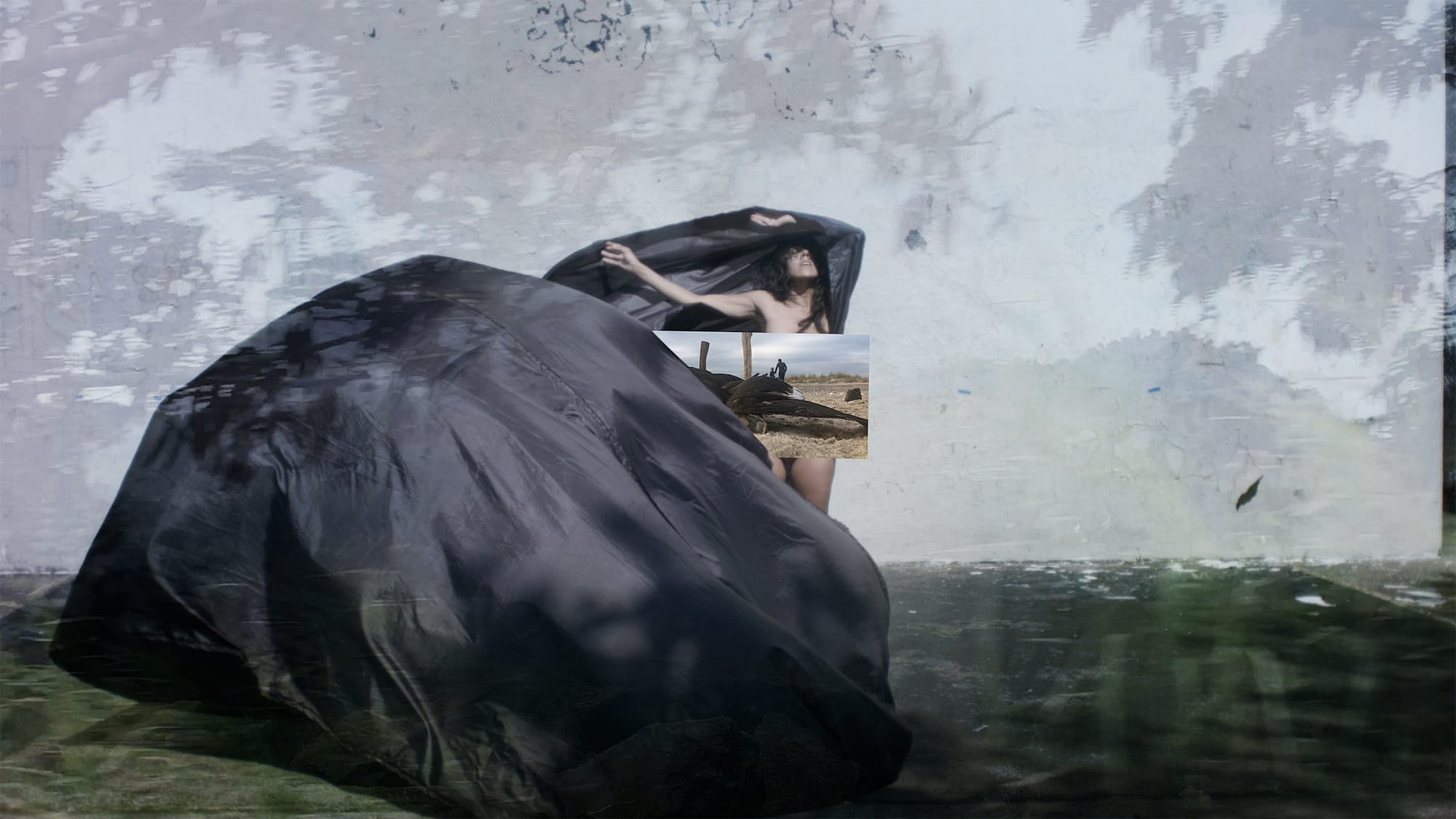
This is among the most dynamic exhibitions to see this season. Curated by Edwin Torres and featuring mixed-media artworks and installations by 14 artists and one artist duo, every work here sets up an intellectual encounter. Todd Colby’s “FYI” (2026) is one of four witty paintings with quasi-sarcastic commentary, while “Eman si pasión [Emancipation / Participation]” (1974/2016) by Cecilia Vicuña is a screenprint of red lips covered with text, with four white hands reaching outward. Elizabeth Castagna’s site-specific “49 min body-led movement drawing through 7 layers of my body for 7 min each” (2026) is a bold performative piece that embodies the sprawling frenzy of her gestures in chalk and charcoal against the wall, and Torres’s “String Totem: Mi Casa Mi Casa Mi Lengua Mi Lengua” (2026) features a suspended rock held in place by rock piles on the floor.
Koyoltzintli: How to Play a Broken Bone
Al Held Foundation & River Valley Arts Collective, 26 Beechford Drive, Boiceville, New York
Through June 5
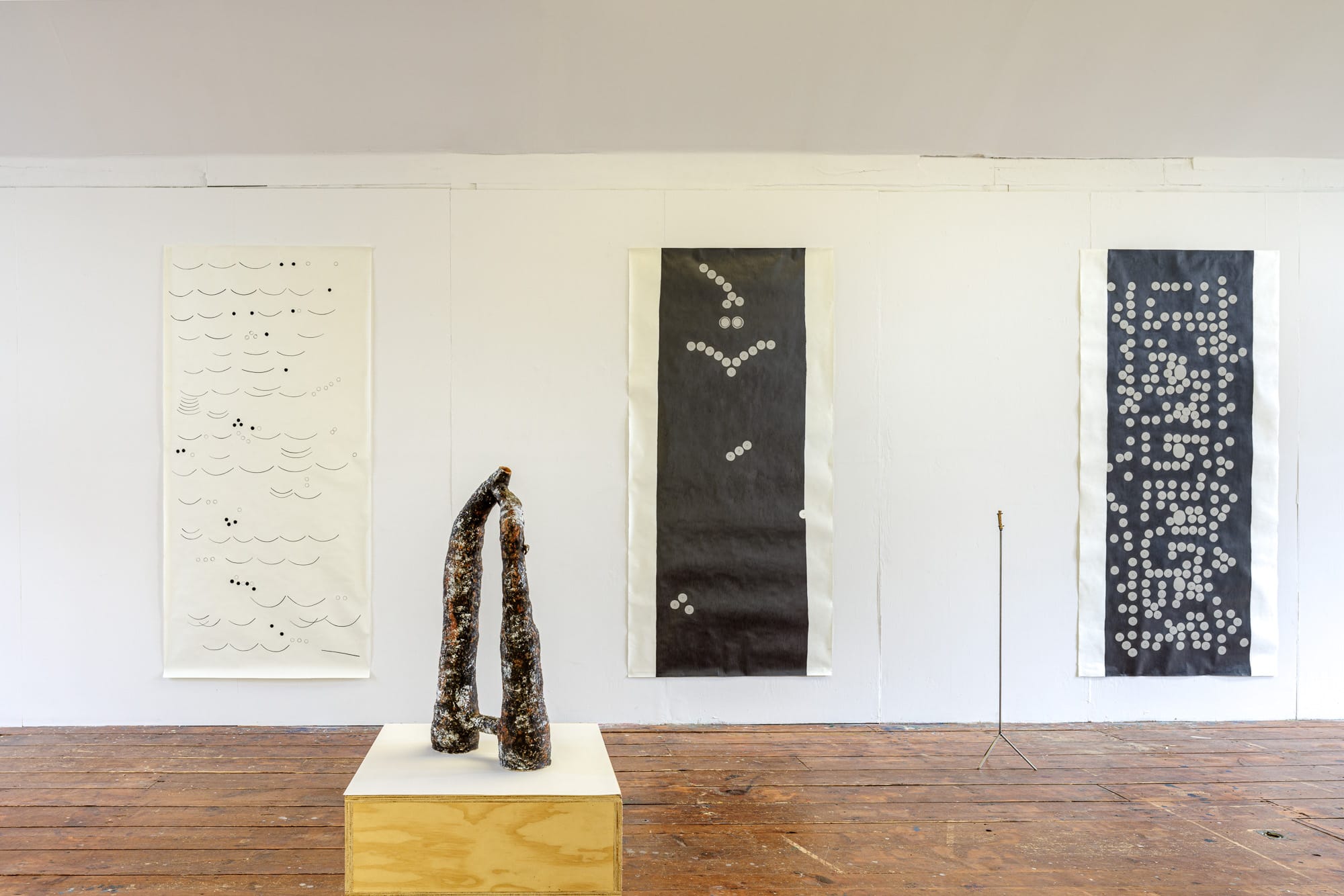
Interdisciplinary Ecuadorian artist Koyoltzintli has created a series of sacred objects born of her investigation into a small bird-bone flute from the Chancay civilization (c. 1000–1470 CE), both a sonic vessel and a medium for archival knowledge. Curated by Jess Wilcox and presented at Al Held’s former studio at the Al Held Foundation in conjunction with River Valley Arts Collective, Koyoltzintli: How to Play a Broken Bone features hand-created clay instruments, small sculptures, and works on paper. The earthen clay pieces in “Cathedral 1-4” (2026) reach upward with their strangely shaped bodies, while “Untitled [mask with shells and whistle]” (2025) depicts a small brown face blowing a horn. A series of works on paper expand upon the artist’s extensive exploration of pre-Columbian sound systems, and her large-scale triptych “How to Fix a Broken Bone” (2026) consists of two black panels with white circles humming about and a single white panel with wave-like gestures and small spheres, reminiscent of a harmonious musical score.
Bunmei Kaika: Political Landscape in Early Modern and Modern Japan
The Frances Lehman Loeb Art Center, 124 Raymond Avenue, Poughkeepsie, New York
Through June 7
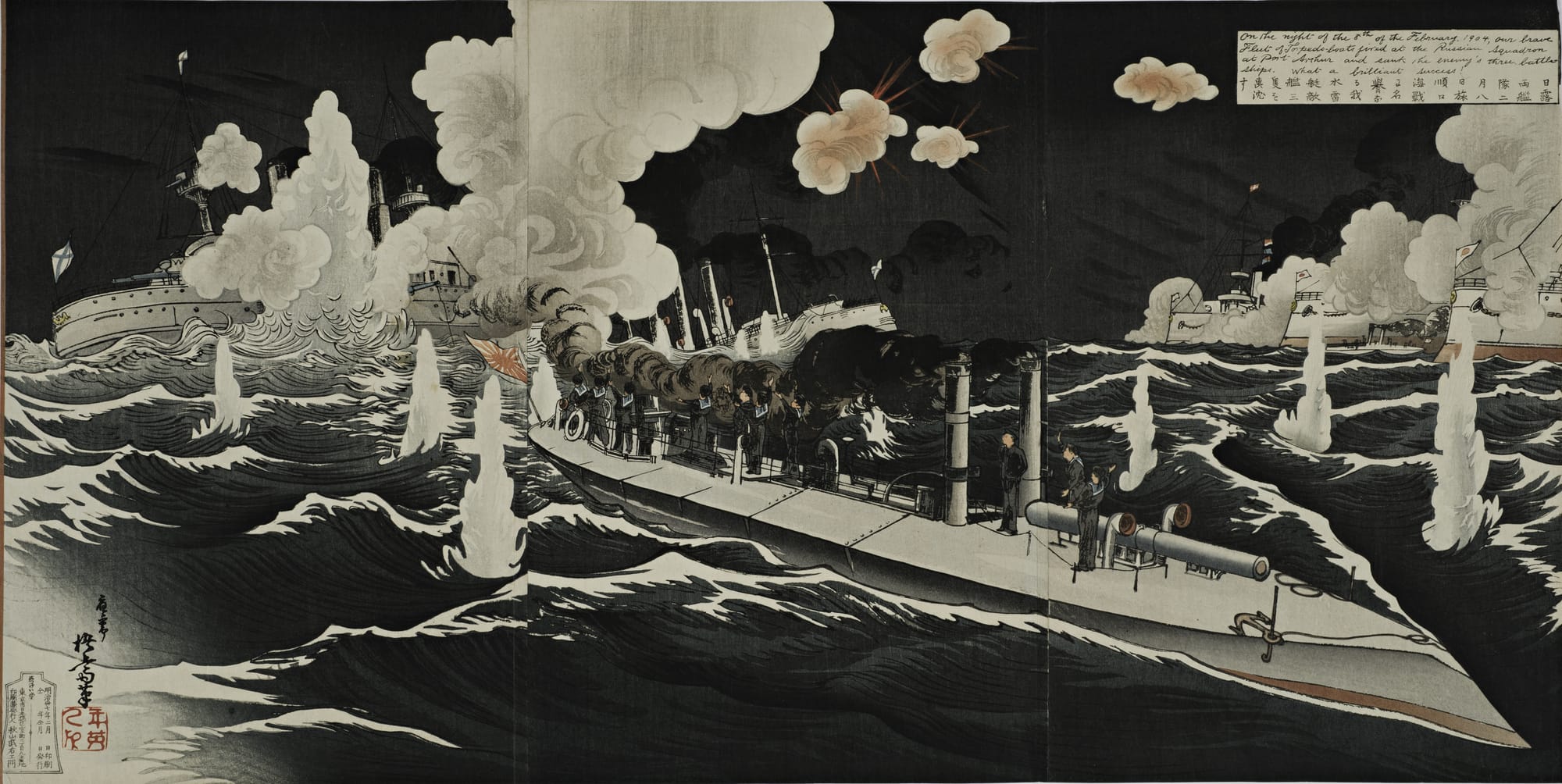
Featuring a series of aged woodblock prints (nishiki-e) that illustrate scenes both imaginary and actual, Bunmei Kaika: Political Landscape in Early Modern and Modern Japan at the Frances Lehman Loeb Art Center at Vassar College is a visual feast. The motto bunmei kaika, meaning “civilization and enlightenment,” reflects the fraught sociopolitical conditions of the era. “Rice Inflation Satire: Picture of Tug of War with a Personified Bale of Rice” (1880) by Utagawa Hiroshige III, for example, is a witty image of peasants and dandies all tugging at an oversized figure on a mountainside as angel-like figures on little clouds clobber at the latter with flat boards. “On the Belly of Calmness, the Hand of Anxiety” (c. 1864), by an unknown artist, is another satirical vision of a massive hand that reaches down into a crowd of folks; some wail and flee while others ignore the mayhem. Migita Toshihide’s “Lieutenant Commander Yamanaka, Chief Gunner of Our Ship Fuji, Fights Fiercely in the Naval Battle at the Entrance to Port Arthur” (1904) is a powerful image of war at sea, while Hiroshige’s “Asakusa Rice fields and the Torinomachi Festival” (1857) is a tranquil scene with a lone cat looking out onto fields and a distant mountain.
Out of Hand and Foot: Tanner Simon and Charles Farless
The Ruffed Grouse Gallery, 144 Main Street, Narrowsburg, New York
Through June 14
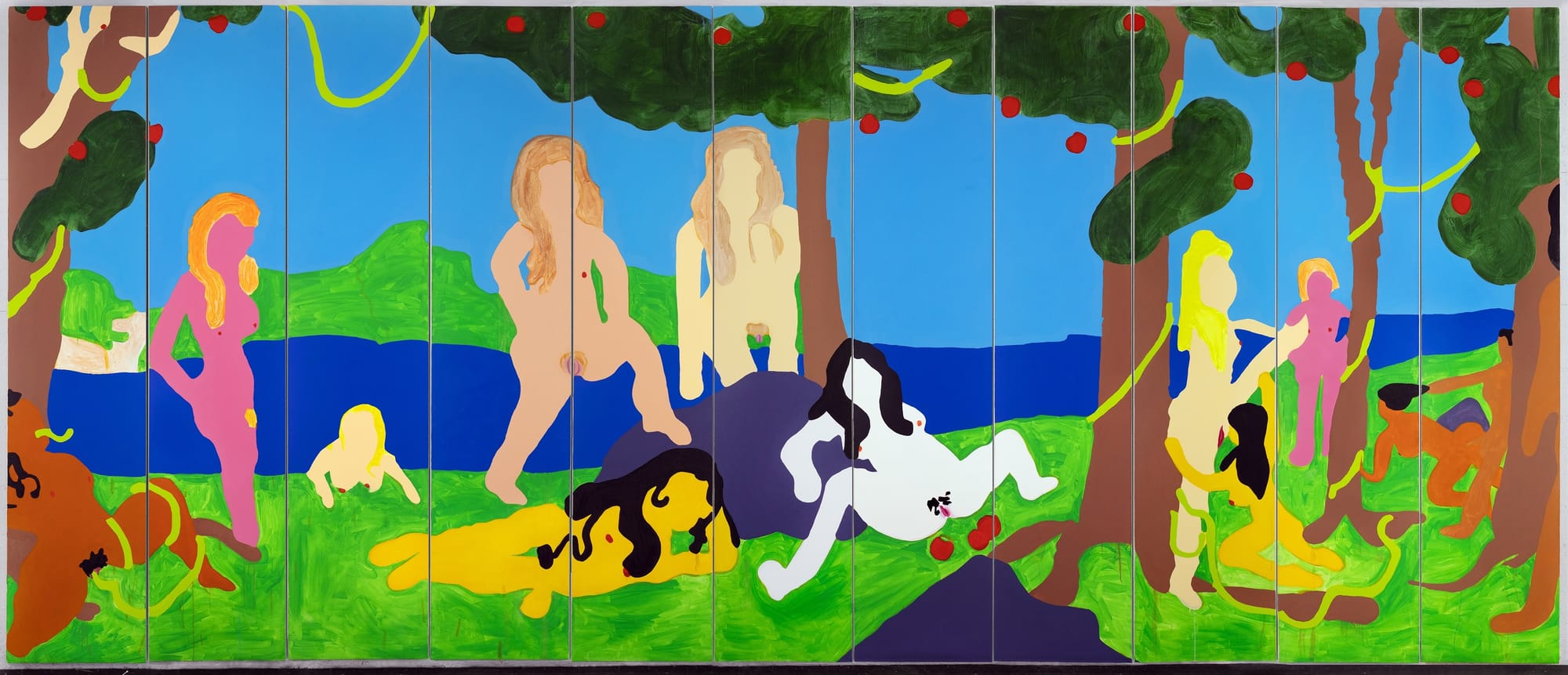
The Ruffed Grouse Gallery continues to present cutting-edge outsider art, with Out of Hand and Foot: Tanner Simon and Charles Farless being yet another compelling two-person example. Tanner Simon’s 11-panel “Cezanne Matisse Botticelli Larger Bathers” (2026) is an odyssey of pleasure featuring faceless female figures with bodies exposed as they partake in autoeroticism or sexual intrigues with others. Simon’s kinetic sock-puppet sculptures are pure glee, and “Justin Timberlake” (2025) will make you laugh out loud. Charles Farless’s sculptures of heads and small creatures made with oil paint on carved wood are equally amusing, and “Picasso” (c. early 2000s) is a fun quasi-cubist reinterpretation of the Spanish master. His “Big Mouth” (c. early 2000s) and “Little Devil” sculptures are comical visions depicting their titles, while “Family” (c. 1996), in stained wood, features three figures housed together in the body of the largest one, a thoughtful vision of love within love.
Irina Lotarevich: Indicators
KinoSaito, 115 7th Street, Verplanck, New York
Through June 14
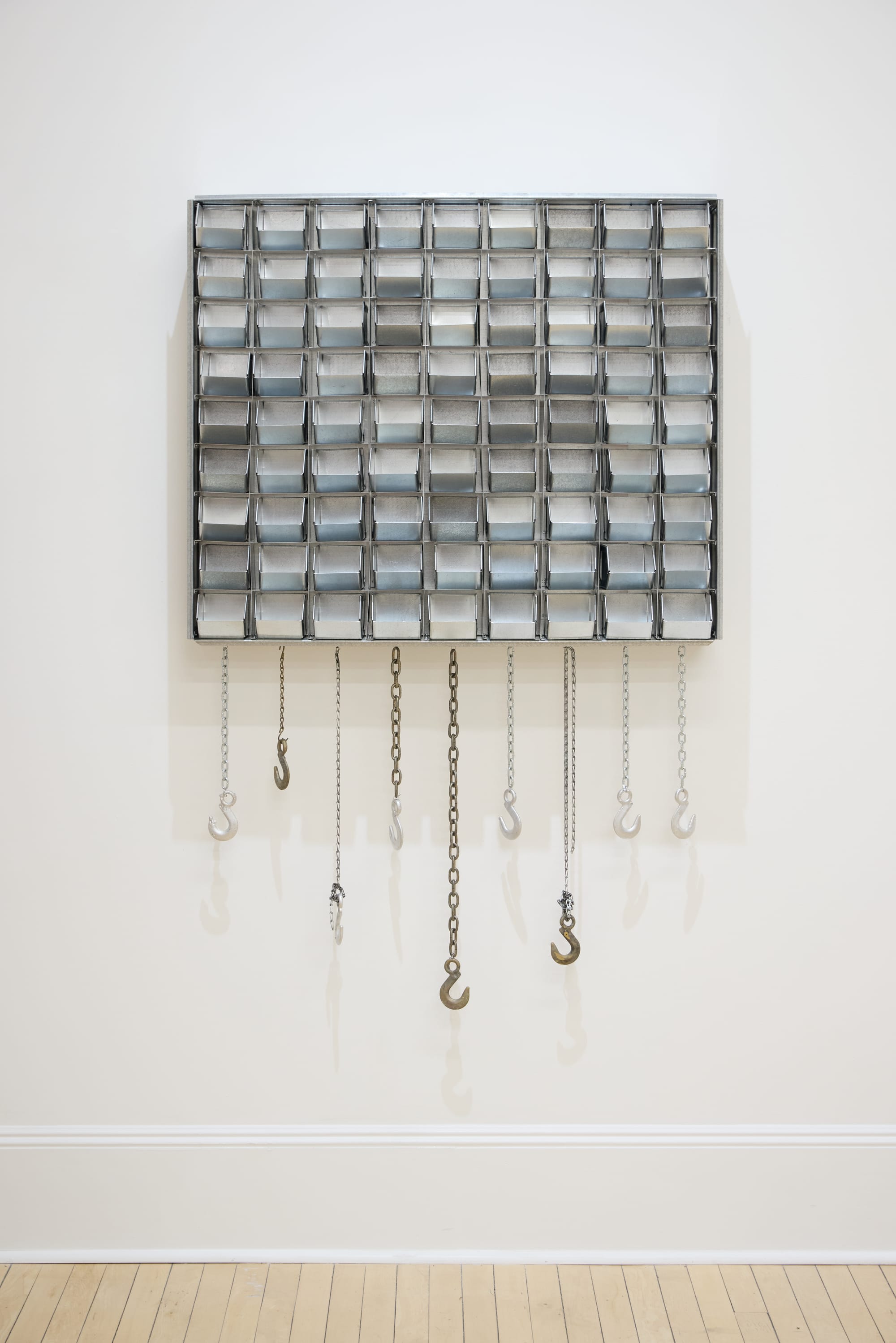
Combining elements of minimalism and sculptural whimsy with an industrial edge, Irina Lotarevich is an artist-alchemist. Her solo show Indicators at Kino Saito features a series of recent wall-mounted sculptures that are simultaneously fun and fierce. Lotarevich’s use of steel, brass, and found chains to create objects that glow with raw energy is well reflected in “Housing (Lottery)” (2025), made of mini silver cubicle-like forms contained within a square with chains and hooks hanging beneath. In “Housing Anxiety 8” (2023), a slender drawer-like shape is filled with empty keyholes and bordered by keys along the sides and bottom, suggesting that some have access while others do not. Meanwhile, “Indicators II” (2025) features four-pointed brass stars and ribbon-like brass shapes beautifully contained in a box.
Context Collective, 95 4th Street, Troy, New York
Through June 15
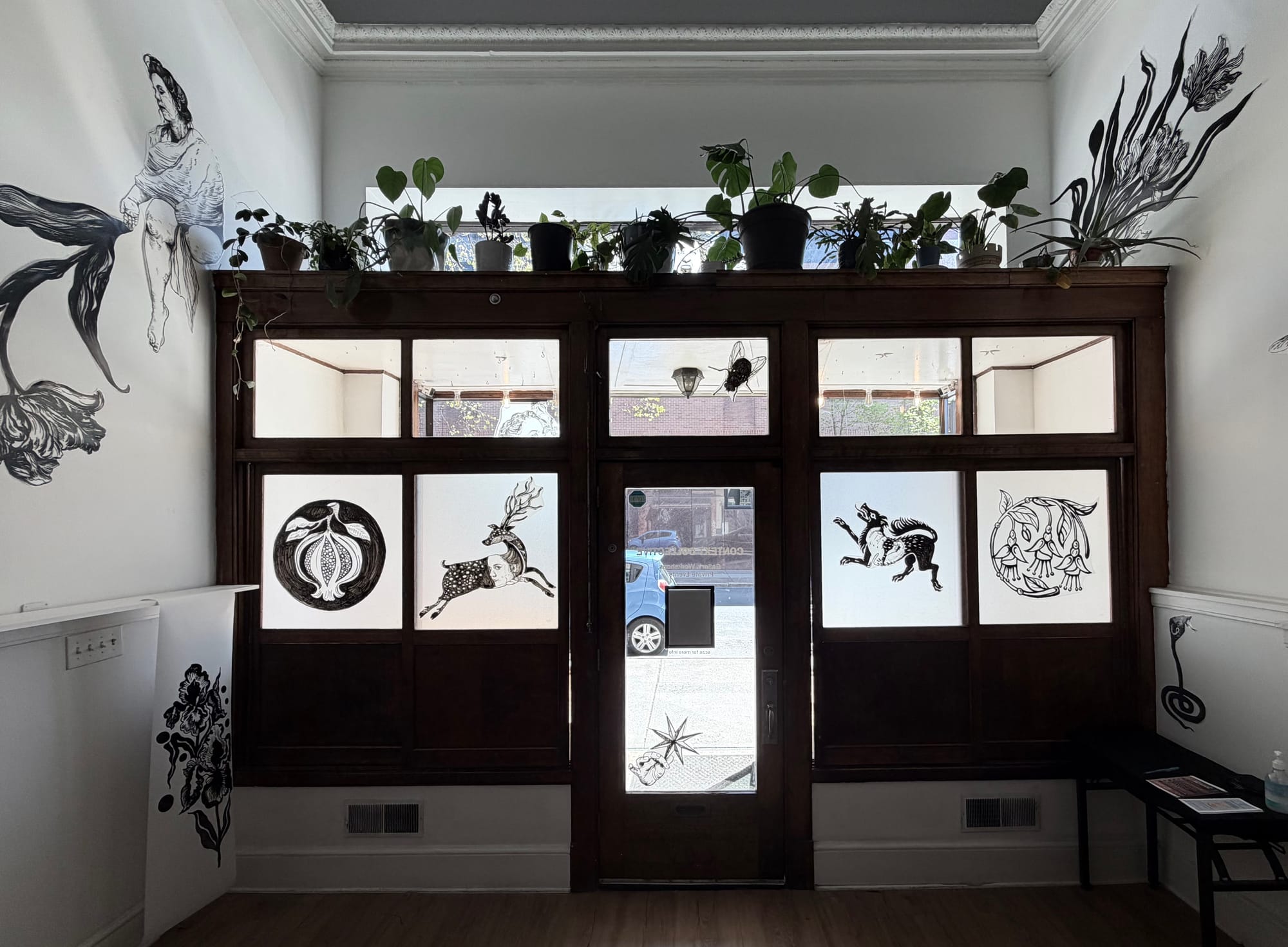
With an archetypal goddess figure (a self-depiction) at the center, Phoebe Rotter’s Bog Body at Context Collective, a luscious site-specific installation, is living mythology. Her mixed-media works on paper and mylar (all 2026) are individual vignettes, each its own stanza within this otherworldly narrative. The section titled “Reflecting Pool” contains elements of life and death in nature, with birds, butterflies, flowers, and skeletal creatures stretching across a wall, while a series of four smaller individual components, such as “Pomegranate Coin” and “Stag Self,” further illustrate notions of transformation. “Madonna of the Wasps” is an empowered vision of Rotter in a prayer stance, while smaller original drawings such as “North,” “Snake,” and “Tulip Bouquet” are also offered as temporary tattoos, giving fans of the artist a chance to sport her allegorical visions on their own bodies.
Art as Threshold
Lightforms Art Center, 743 Columbia Street, Hudson, New York
May 8–June 7
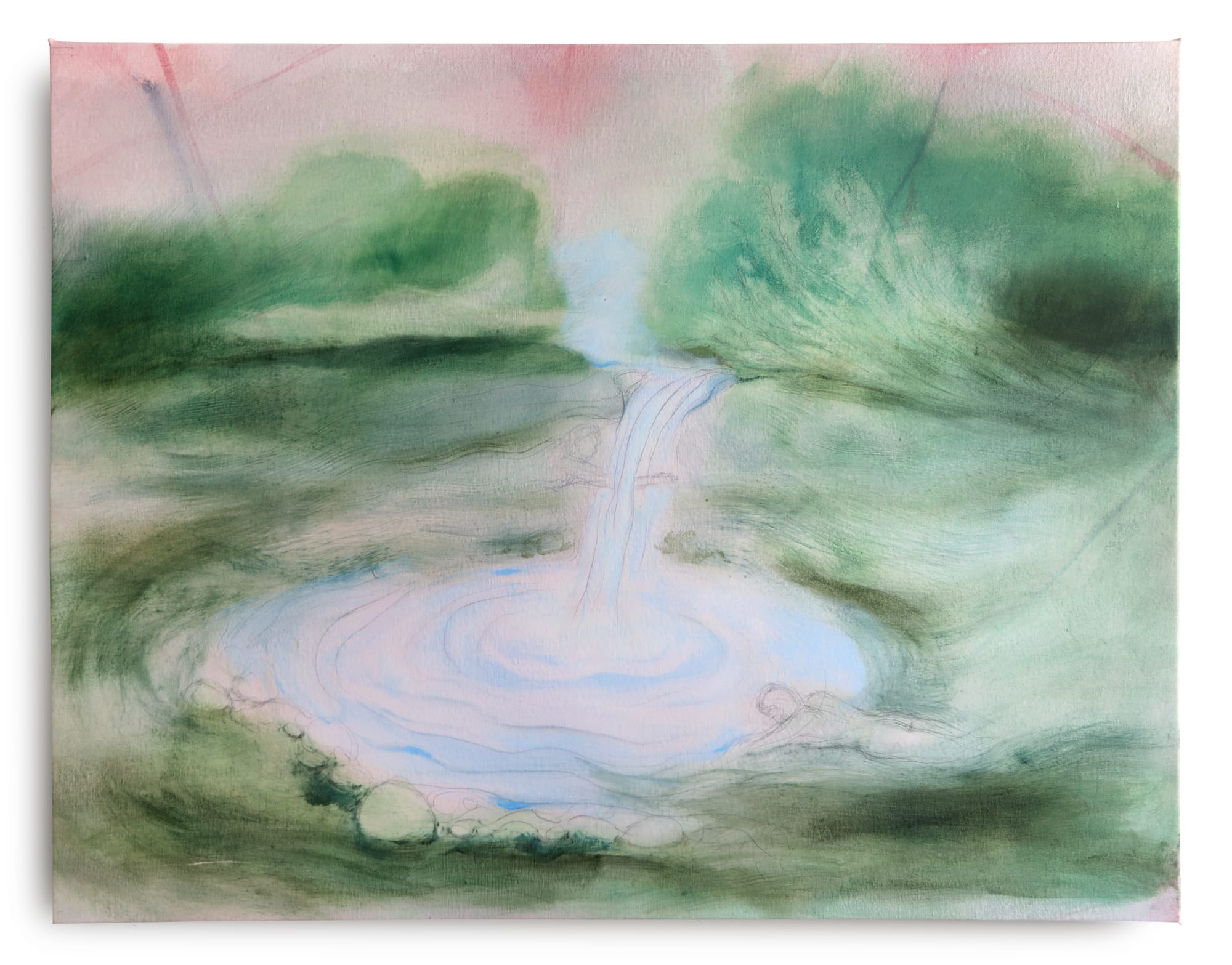
Art as Threshold is an apt title for the abstract, atmospheric visions that border on the mystical in this show, including painting, video, and printmaking. Lizzy Marshall’s “La Source” (2023) features a disjointed blue line drawing of a female form as she morphs into the faint vision of a tree and brown-green earth below. “Untitled (study of a growing seed)” (2019) by Laura A. Charlton is an abstract screenprint that glows with purple, pink, and orange warmth. Laura Summer’s “Christian Rosenkreutz” (2026) is a work consisting of blue-hued oil and cold wax on paper, in which two human profiles come together in the center, while Sampsa Pirtola’s video “Greatest of All Secrets 2” (2020) creates a hazy ghostlike vision of a transcendent realm in blue and black.
[ad_2]
Source link