[ad_1]
IT BEGAN WITH a series of found postcards addressed to a woman named Denise, given to Rosamunde Bordo in a G.I. Joe toy box. Coming from a print and visual arts background, the Vancouver-based artist has cultivated a life of letter-writing with friends, and collecting or receiving found and forgotten objects. Though she didn’t initially set out to create what she calls The Denise File, Bordo began creating artworks inspired by the postcards and crafting a serialized narrative of Denise’s life akin to the detective and mystery stories she grew up loving. Unlike her favourite childhood TV show, Columbo, Bordo’s fiction unfolds through physical space and a series of art exhibitions framed around The Denise File.
“[The detective story is] also such a popular form, that’s the other thing that interests me about it,” Bordo explains in conversation with Stir. “There’s nothing that’s special about it in the sense that it has a very formulaic structure, and it’s used everywhere.”
Bordo grew up in Montreal and left for Vancouver nearly eight years ago to attend UBC’s MFA program in visual art. She recalls moving to the city a week before the start of the program, bringing only the essentials, including the postcards. This would become the turning point in her art practice, and her relationship to materials.
“My practice hasn’t been print-based since I left Montreal, basically,” says Bordo. “Arriving with basically no art materials, I started working through finding objects and responding to these postcards and put aside making for a couple of years.”
Now, as one of Western Front’s current artists in residence, Bordo has made a return to artmaking alongside her practice of finding objects and materials, with her latest exhibition, Magic Show. She has been developing her glassblowing skills since last fall with UBC’s Brian Ditchburn. As a newer material within her practice, it is keenly felt in Magic Show.
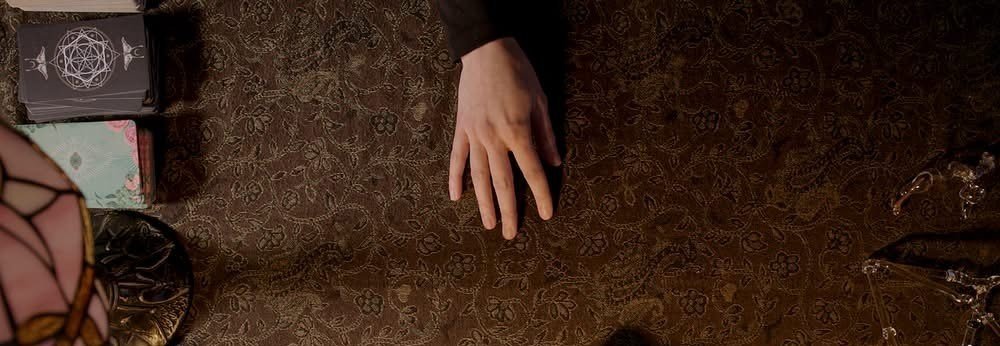
Visitors are greeted by Karmic Cleanse upon entering Western Front’s lobby—a video work with a close-up shot depicting a kind of liquid chemical process (or, in another context, potion-making). The video is shown on a translucent screen, allowing the glass and wig material behind it to overlap and interact with the video like a light box. Karmic Cleanse introduces the esoteric elements of Magic Show, alluding to magic as a performance art, and as an ingredient in occult rituals and practices. The exhibition’s introductory text invites visitors to take on the lens of the detective and the magician. Through these distinct roles, the found materials can be seen as objects that once belonged to Denise, and the installations as glimpses into Denise’s fascination with the occult.
Bordo’s glasswork becomes the centrepiece of the exhibition’s first room with Communicating Vessels, an extensive and delicate piece featuring a pentagonal design. Liquid materials like chartreuse and vodka are used to fill the vessel and enhance the glasswork with delicate colours, contrasting with the classic magic-theatre aesthetic of the red velvet fabric overlaying the table. As noted by Magic Show curator Kiel Torres in the exhibition’s accompanying essay, “As Above, So Below: A Note on Properties”, “Colour is also vital in calibrating the space to the spirit being called.”
[ad_2]
Source link