[ad_1]


Painting waves that convince isn’t easy, but Scottish artist Beth Robertson Fiddes has an eye for capturing shoreline drama, writes Roger Cox
To paint the sea, you must love it, and to love it, you must know the sea.” So said the American artist Frederick Judd Waugh, and judging by the paintings he left behind he must have loved the sea very much. Born in New Jersey in 1861 and trained at the Pennsylvania Academy of Fine Arts, Waugh specialised in marine paintings and in particular he had a knack for capturing the drama of storm surf kabooming into rocky shorelines.
In some of his works, like the atmospheric Big Seas at High Water, he brilliantly catches the way sunlight can completely transform a breaking wave by illuminating it from behind, while in paintings like Surging Against the Rocks he nails the terrifying force of the swirling currents which can be generated by swell slamming into an uneven coastline.
In terms of style, his paintings range from the impressionistic to the precise – understandable, perhaps, as he was working through a period in which the art world was in a dramatic state of flux – but in all his work any sea-lover can see that this is an artist who knows what he’s painting about. That’s because all his images have a certain sea-based logic to them – however stylised or however detailed, they always capture the sea doing something that the sea actually does, as opposed to something the artist imagines it might do, or perhaps something they might like it to do for dramatic effect.
Not all of the artists who have attempted to paint the sea have been so successful – not even the very famous ones. At the risk of upsetting half the art world, even the great JMW Turner could be a bit sketchy when it came to painting the sea in a way that made sense. His 1819 painting of the Bell Rock Lighthouse off the coast of Angus being battered by storm surf is certainly dramatic, but the way he has sea spray clinging to the tower of the lighthouse makes it look more like vegetation than water. There’s something a bit dubiously haphazard about the way the waves are hitting the rocks at the base of the lighthouse, too – the rhythms are off, somehow, and the way his waves seem to explode straight up in the air like tufts of gelled white hair makes the whole scene feel a little over-cooked.
All of which brings us to the Scottish artist Beth Robertson Fiddes, who currently has an exhibition of her paintings at the Kilmorack Gallery near Beauly. Titled Northwest, in a nod to the landscapes and seascapes of Sutherland which inform her work, it’s on until the end of this month and brings together her two great specialisms: her mountain paintings and her paintings of waves.

Much as I’m a fan of her mountain pictures (and what spectacular peaks she has to work with up there in Assynt) it’s her paintings of waves that really stand out. If old Fred Waugh were still alive today, he would very definitely identify her as an artist who both loves and knows the sea.
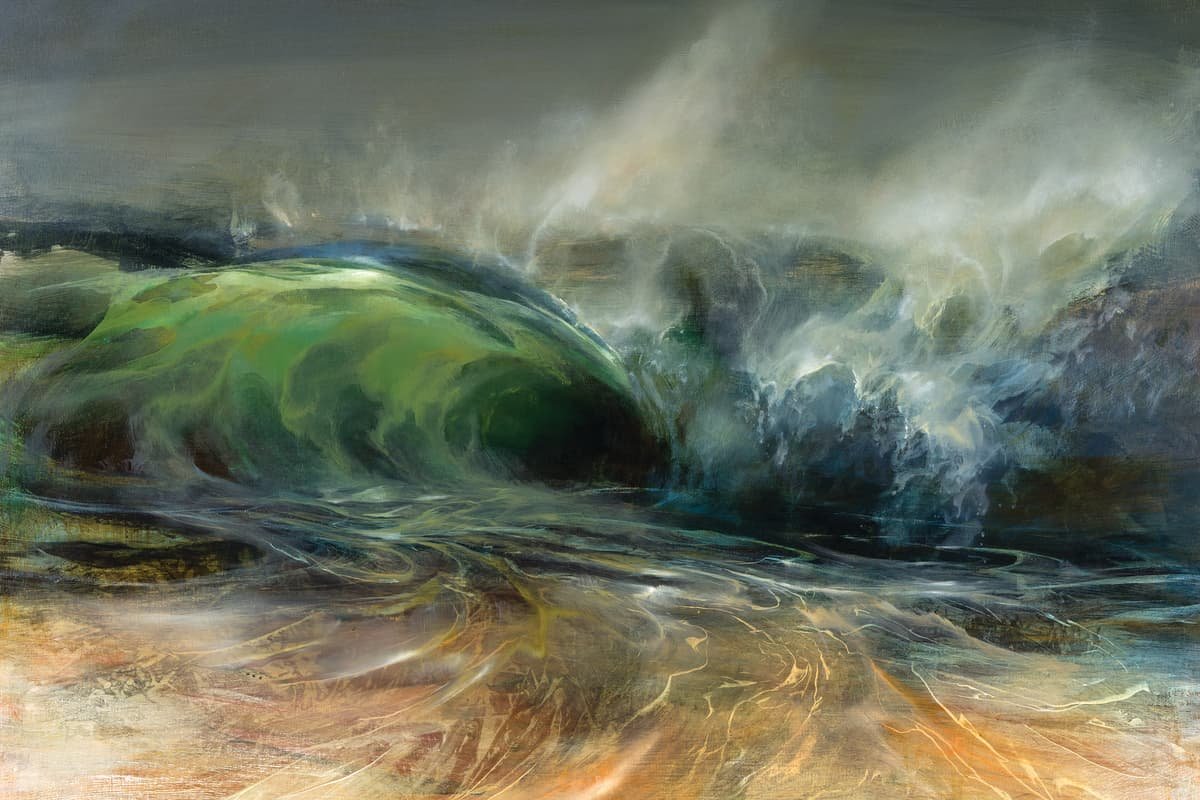
There are plenty of Scottish artists who paint seascapes, but the vast majority tend to avoid detailed depictions of waves (and fair enough, you might think, if even Turner struggled with them). Robertson Fiddes, however, is more than happy to dive right in. In a painting like Catching the Light (above), much like Waugh, she shows an almost uncanny grasp of the way in which sunlight can sometimes pass through the back of a breaking wave and make it glow, and the same painting also shows a finely developed understanding of hydrodynamics, perfectly capturing the way water in front of a wave is sucked up its face in a circular motion as it begins to break.
In an interview in The Scotsman in 2020, Robertson Fiddes spoke about the relationship between rock and water in her paintings as follows: “Two contrasting viewpoints spin around my head when I’m working. Some things move fast, like waves and weather, and I’m trying to slow the whole thing down and capture it. But the rocks have ongoing movement and life as well, the only reason we can’t see it is we don’t live long enough. Their dramas take millennia.”
Her paintings of waves hitting rocks, then, bring together these two very different timeframes – and, again, they do it in a way that makes sense in terms of physics as well as philosophy. In Rocks and Water, Reiff, 2026 (above), she paints a breaker surging up a steep, rocky shoreline. In contrast to the wave in Catching the Light, which is folding over itself as it hits a sandy beach, this one is being flung backwards as it makes landfall. In the context, though, it tracks – you can almost hear the satisfying, rhythmic whump-and-slosh as the wave hits the rocks and is then forced first up and then back.
Waugh spent much of his life by the sea. After graduating he lived first on the island of Sark in the English Channel, then later on Bailey Island, Maine, and in Provincetown, Massachusetts. Robertson Fiddes spent much of her early childhood on Tiree in the Inner Hebrides – also known as “the land beneath the waves” because of its exposure to Atlantic swells – and perhaps that explains her innate understanding of how waves work. Wherever it comes from, it’s a rare and remarkable talent.
The Scotsman’s arts newsletter is now sent twice a week – subscribe today
Want the latest Scottish headlines sent directly to your phone? Sign up to our new WhatsApp channel here
[ad_2]
Source link