[ad_1]
Lashed to the mast of his ship, Odysseus throws back his head, his beard-garlanded chin jutting towards the entrancing singers he strains to join. His men, ears plugged with wax, row on, as oblivious to the chorus that fills the air as to their king’s pleas to be freed. On two rocky outcrops, the Sirens stand, crooning the sweet promise of knowledge. One, however, is already vanquished by Odysseus’s cunning and falls, eyes closed, into the sea.
Dating from 480BC – 470BC, the Siren vase, a red-figure stamnos from ancient Greece now at the British Museum, is an early example of art inspired by literary classics, a tradition that stretches all the way from antiquity to today. Homer, by virtue of having written two of the oldest epics of Western culture, is one of the authors with the longest-lasting artistic influence, his heroes and their foes reimagined throughout the centuries. The dejected Achilles — who, in the House of the Tragic Poet in 1st century AD Pompeii, catches one last look of Briseis before she’s taken to Agamemnon — morphs, almost 2,000 years later, into the wrath-filled squiggles of Cy Twombly’s Fifty days at Iliam (1978, at the Philadelphia Art Museum, US).
From Troy also springs another of the great artistic heroes of ancient literature, Virgil’s Aeneas, a man profoundly devoted to the gods, his father, his homeland — anyone except, arguably, the woman who rescued him and offered him her love and her kingdom: Dido. That Jupiter persuaded him to desert her sounds suspiciously like an excuse, although J. M. W. Turner did his best to absolve the Trojan prince with the masterly Mercury sent to admonish Aeneas (now in Tate Britain’s ‘Turner and Constable: Rivals and Originals’ exhibition), in which the figures are puny against the vast, iridescent haze that suggests the fragility of man against Nature and, in this case, divine will.
Like Claude before him, Turner found the Aeneid endlessly fascinating. As the late art historian Anthony Bailey noted, it was the painter’s longest-running subject, first embraced in about 1798, then revisited again and again, including in the last four pictures Turner would ever exhibit at the Royal Academy, of which Mercury sent to admonish Aeneas was one: all dissolved into light and vapour, all carried inscriptions from his own poem, Fallacies of Hope, and all centred on the choice between love and destiny.
Perhaps, as Eric Shanes suggested in The Life and Masterworks of J. M. W. Turner, the artist felt some closeness to the Trojan prince, for he, too, had ‘forsworn an easy life, the enjoyment of wealth, marriage and the delights of the senses for a higher calling’.

Danae may be mentioned only in passing in Ovid’s ‘Metamorphoses’, but she was immortalised by Titian’s sultry, voluptuous depiction.
(Image credit: Alamy/ClassicPaintings)
Virgil never quite finished the story of Aeneas — the abrupt ending sees the enraged hero slay Turnus, king of the Rutuli, to avenge his friend Pallas — but Ovid soon stepped into the breach. The tale of (a somewhat passive) Trojan prince becoming a god is one of more than 250 foundational legends of Western culture woven together by the Roman poet under the guise of the history of the world: Metamorphoses. ‘No other classical author treated so great a variety of mythological subject matter,’ wrote Erwin Panofsky in Problems in Titian, mostly iconographic, and none, not even Homer, had a greater impact on art, as ‘Metamorphoses’, the current exhibition at the Rijksmuseum in Amsterdam, The Netherlands, highlights.
Granted, for some artists, Ovid was perhaps little more than a pretext to explore whatever struck their fancy. Cornelis van Haarlem seemed rather more interested in capturing the might of a bull than in telling the story of the river god Achelous fighting, in bovine disguise, against Hercules, as Ovid specialist Paul Barolsky pointed out in Arion: A Journal of Humanities and the Classics in 2021, and Correggio reworked the myth of Jupiter and Io, in which the former rapes the latter, into a picture of carnal ecstasy.
However, the prize for capturing the spirit of Metamorphoses, a poem in which desire is central, must go to Danaë, even though she is only mentioned in passing by Ovid. The princess of Argos, ‘whom Jove filled with life-giving shower’, became — after a failed medieval attempt to turn her into an emblem of purity — the perfect cover to indulge in portraying female sensuality for everyone from Correggio (again) to Rembrandt and Gustav Klimt. The Danaë Titian painted for Cardinal Alessandro Farnese — the first of at least six versions he made — was so sultry, her body voluptuous and naked, her face possibly borrowed from the prelate’s favourite courtesan, that, by comparison, even the artist’s seductive Venus of Urbino looked like ‘a Theatine nun’, according to papal nuncio Giovanni della Casa.
More than a millennium after Ovid’s death, a poet indebted to both the author of Metamorphoses (whom he often paraphrased) and to Virgil (whom he called his guide) would help shape our collective vision of the afterlife and of human emotions: Dante Alighieri. It’s the writhing, suffering mass of the damned in the Inferno that at the end of the 19th century animated Auguste Rodin’s gigantic Gates of Hell, 37 years in the making and only cast in bronze after the sculptor’s death.
About a century earlier, in 1773, Britain had seen what Dante scholar Paget Jackson Toynbee believed to be the first ‘easel picture’ of a Divine Comedy subject by a domestic artist: Sir Joshua Reynolds’s take on the grim, but deeply human story of Count Ugolino (now at Knole, in Kent). Once the most powerful man in Pisa, Ugolino was later locked up with his family and left to starve. Soon, his children and grandchildren died: ‘Over them all, and for three days aloud/Call’d on them who were dead,’ wrote Dante. ‘Then fasting got/The mastery of grief’. Reynolds imagined the family in the moment of its most abject desperation, the youngest child clutching his grandfather — yet his Ugolino sits straight and rigid, staring fiercely out of the canvas.
The Inferno scene was Reynolds’s first history painting and although Horace Walpole found it ‘admirable’, many critics panned it, recoiling more from its subject matter than the artist’s approach: ‘If the same Excellence had been employed on a pleasing Subject, it would have enchanted, as it may now terrify, the Public,’ wrote The Public Advertiser.

Suffering is writ large in Reynolds’s ‘Count Ugolino and his Children in the Dungeon’ (1770)
(Image credit: Alamy/Artefact)
If Reynolds had been the first British painter of Dante, the most prolific was the Italian author’s Pre-Raphaelite namesake, Dante Gabriel Rossetti, who created some 100 pictures inspired by The Divine Comedy and by the lesser-known Vita Nova. It’s from the latter that comes Dante’s Dream at the Time of the Death of Beatrice (1871, Walker Art Gallery Liverpool), Rossetti’s largest painting, in which the poet looks on as his beloved breathes her last. The oil, preceded in 1856 by a similar watercolour, brims with symbolism, from the poppies (sleep of death) to the red doves (love) and the flower bouquet (purity), but equally meaningful is the fact that the model for the unrequited love of Dante (the poet) was Jane Morris, the wife of William Morris, with whom Dante (the artist) had a decades-long affair.
Another facet of love to which the Pre-Raphaelite painter also applied his brush was the tragedy of Paolo and Francesca. The star-crossed couple, who remained inseparable even after death, moved every artist from Dutch-French Romantic Ary Scheffer — his picture, a version of which (1835) is at the Wallace Collection, prompted George Eliot to say she ‘could look at it for hours’ — to George Frederic Watts, who painted the lovers tenderly holding hands as the ‘restless fury’ of the ‘stormy blast of hell’ bellows around them. Rossetti, too, showed the infernal storm dancing around the couple, but as part of a watercolour triptych in which they are also seen in life, the two scenes separated by a central panel featuring Dante and Virgil. The picture, dating from 1855 and now at Tate Britain, was bought by John Ruskin and never turned into an oil painting.
The tale that, according to Dante’s Divine Comedy, had lit the spark between Paolo and Francesca was another forbidden love, this time between Lancelot and Guinevere. The Arthurian cycle — brought back to 19th-century British attention by the reprinting of Sir Thomas Malory’s 15th-century Le Morte Darthur and the publication, from 1859, of Alfred Tennyson’s Idylls of the King — was a favourite with the Pre-Raphaelites. One of the most monumental takes came from Edward Burne-Jones, who in The Last Sleep of Arthur in Avalon (today at the Museo de Arte de Ponce, Puerto Rico) showed the king, mortally wounded in the battle against Mordred, frozen in a deathless slumber in Avalon until the day he will be needed again.
Burne-Jones had begun painting the picture in 1881 for his friend, patron and fellow Arthurian enthusiast George Howard, later the 9th Earl of Carlisle. Over time, however, he became particularly attached to it, seeing himself as Arthur and the story of the king’s demise, tinged with the hope of his return, as a parable of his own art, which he perceived as increasingly overlooked, but which he wished would at some stage be appreciated again. Howard kindly agreed to receive a replacement painting and Burne-Jones kept The Last Sleep of Arthur in his studio, working on it until his own death in 1898, nearly two decades after he had first set his brush to it.
‘I must now ask why did you make the Lady of Shalott, in the illustration, with her hair wildly tossed about as if by a tornado?’
Yet perhaps the most artistically beloved of the Arthurian tales hinges not on the once and future king, but on a relatively minor figure, the Lady of Shalott, whose story was first told in a 13th-century Italian novella, then, magisterially, by Tennyson in 1832–42. Alone in her remote island tower, ‘half-sick of shadows’ as a spell forces her to see the world through a mirror, Elaine of Astolat spots ‘bold Sir Lancelot’ passing by and can’t help but look at him from her window, bringing upon herself the curse that will cause her death. William Holman Hunt, who with Rossetti had illustrated the 1857 edition of Tennyson’s poems published by Edward Moxon, painted the Lady several times, including the moment in which, hair whipping around her face, she makes out Lancelot in the mirror.
The picture (now at the Wadsworth Atheneum in Hartford, Connecticut, US) was a more sophisticated version of the original book image, of which Tennyson had been rather critical. In his memoirs, Hunt recalled the poet as saying: ‘I must now ask why did you make the Lady of Shalott, in the illustration, with her hair wildly tossed about as if by a tornado?’ When the artist replied that he had attempted to ‘convey the idea of the threatened fatality by reversing the ordinary peace of the room and of the lady herself’, Tennyson rebuffed him with a pointed ‘an illustrator ought never to add anything to what he finds in the text’. The poet died in 1892; Hunt only completed his large-scale oil of the Lady in 1905, but as Abigail Joseph puts it in a 2017 article for the Journal of Victorian Culture: ‘One suspects that if Tennyson had lived to see this painting, he would have been strongly displeased.’
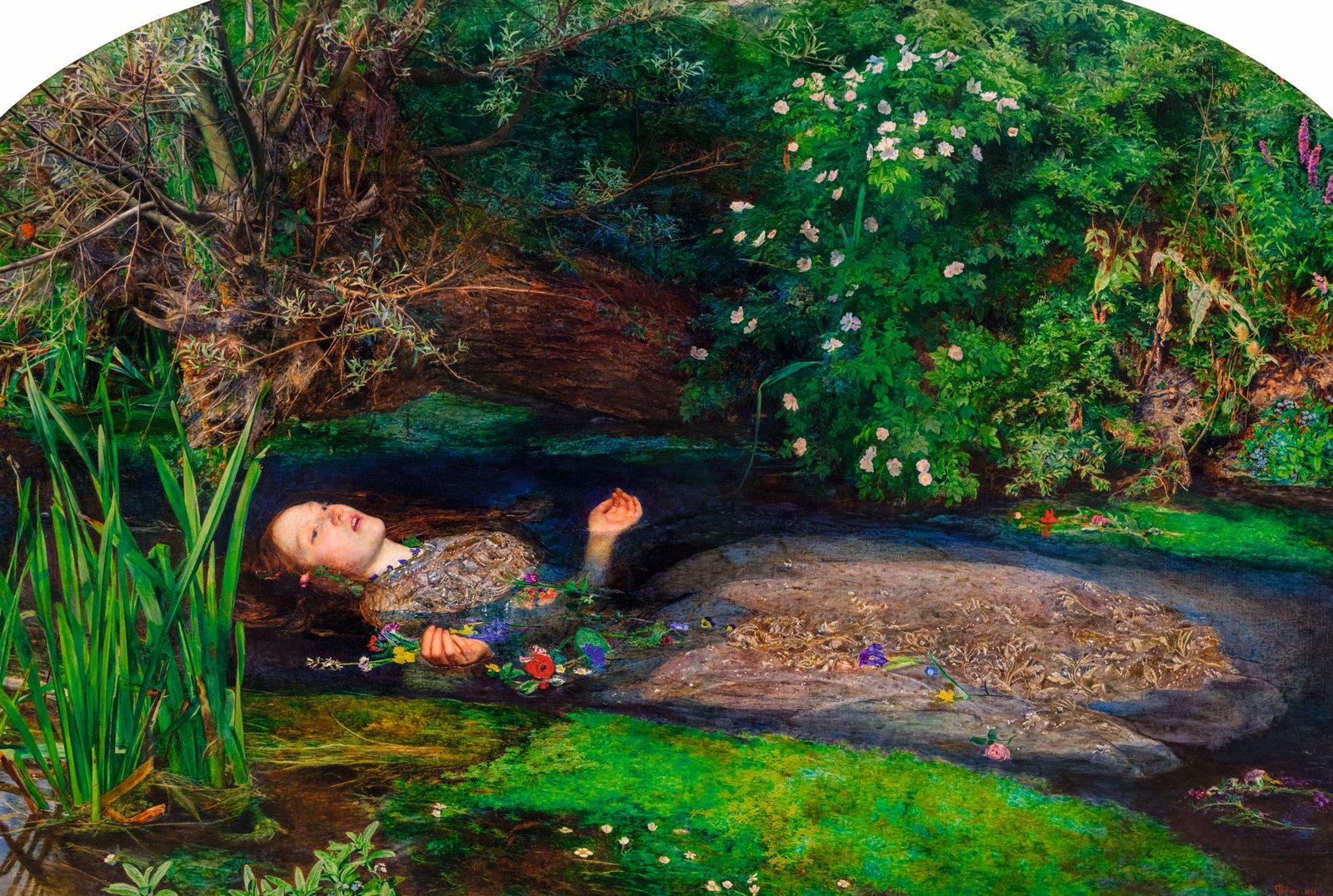
No hair blows inappropriately in John William Waterhouse’s take on the same tale, a series of three pictures painted in reverse order. In the most celebrated canvas of the trio, dating from 1888 and titled simply The Lady of Shalott (now at Tate Britain), the doomed protagonist appeared ‘robed in snowy white’ as ‘down the river’s dim expanse,/Like some bold seer in a trance,/Seeing all his own mischance—/With glassy countenance/ Did she look to Camelot’. Although best known for the Lady, Waterhouse — who, despite being born in the calendar year after the Pre-Raphaelite Brotherhood was formed, often echoed in style his predecessors — ran the gamut of literature in his work, choosing at will from Homer and Ovid, Dante, Boccaccio and Shakespeare. The Bard’s Ophelia seems to have particularly enthralled him — he painted her many times, whether adorning her hair with flowers or staring desperate from the canvas, for a series he was still adding to when he died in 1917. Yet, it’s John Everett Millais who wins the palm for the most famous portrayal of Shakespeare’s tragic heroine.
Now at Tate Britain, his Ophelia, begun in 1851, when he was only 22, shows her floating in the river, the flowers she had been entwining in a garland still in her hand, just before ‘her garments, heavy with their drink,/ Pull’d the poor wretch from her melodious lay/ To muddy death’. Doubling as the ‘weeping brook’ into which the Danish noblewoman falls was the Hogsmill River in Ewell, Surrey. Millais painted the landscape from life across five months — including all the flowers Ophelia is holding, which bloomed at different times of the year. So realistic were his pansies, daisies, forget-me-nots and poppies that, according to John Guille Millais, the artist’s son, ‘a certain Professor of Botany, being unable to take his class into the country and lecture from the objects before him, took them to the Guildhall, where this work was being exhibited, and discoursed to them upon the flowers and plants before them, which were, he said, as instructive as Nature herself’.
The figure of Ophelia was painted in the artist’s studio and standing in for the heroine was Elizabeth Siddal, one of the Pre-Raphaelites’ favourite models. Millais had her lie, dressed in a brocade gown, in a bath tub full of water, which he heated up with oil lamps. Unfortunately, Siddal, icy cold from staying still and wet for hours, became ill and, although she eventually recovered, her father insisted that Millais pay for the costs of her medical treatments.

Arthurian legend influenced many an artist, including John William Waterhouse, who painted this ‘The Lady of Shalott’ in 1888.
(Image credit: Alamy/Artefact)
Well before Millais was even born, Hamlet and the other Shakespearean tales had become central to John Boydell’s efforts to establish a British school of history painting. His Shakespeare Gallery was a mammoth project, combining the publication of an illustrated edition of the Bard’s works and a folio of the prints with an exhibition of the original pictures in London. Almost all of Britain’s top artists of the time were involved, from Reynolds to Angelica Kauffman, although William Blake, who would go on to shape our view of John Milton’s Satan and his legions was somewhat sidelined — a surprise, as he had previously worked with the Boydells and would later confess to be a Bard enthusiast: ‘Shakespeare in riper years gave me his hand,’ he once wrote to sculptor John Flaxman.
Another painter to whom the project brought some disappointment was George Romney, a man so obsessed by Shakespeare that he had made hundreds of drawings inspired by his plays. His picture of The Tempest was ambitious — but ended up being reviled for having dared to mesh two different scenes on the same canvas. The gallery was a financial disaster — Boydell went bust — yet the Bard continued to prove ready tinder for the creativity of artists, not least Edwin Landseer.
In 1851, the same year in which he conjured up The Monarch of the Glen, he painted Titania and Bottom for Isambard Kingdom Brunel’s dining room. Now at the National Gallery of Victoria, Australia, it captures the moment in which the fairy queen, drugged by Oberon’s love potion, languidly embraces the object of her love, Nick Bottom — Landseer’s mastery of animal painting is evident in the poor weaver’s asinine head and the white rabbits ridden by two fairies. The work entranced not only Queen Victoria, who called it ‘a gem, beautiful, fairy-like and graceful’, but also Lewis Carroll, who, on November 17, 1857, noted in his diary: ‘Called at Ryman’s to see “Titania” painted by Sir E. Landseer. There are some wonderful points in it, the ass’s head and the white rabbit especially.’ Might Landseer’s work have influenced the author’s zany cunicular character?
Alice’s Adventures in Wonderland and Through the Looking Glass would go on to become artistic inspirations in their own right, particularly for the Surrealists — one of the movement’s founders, André Breton, said at a 1934 lecture that ‘Carroll [was] surrealist in nonsense’. Tidbits of Wonderland — often filtered through the eyes of John Tenniel, who had illustrated the first edition of the book — are referenced in many Surrealist pictures, from Max Ernst’s portraits of Leonora Carrington as Alice to Dorothea Tanning’s Eine Kleine Nachtmusik (1943, on loan from Tate to the Dallas Museum of Art, US), in which two young girls face a giant, sinister sunflower. Both Ernst and Tanning grew up in repressive households, notes Catriona McAra in a 2011 article for Papers of Surrealism. ‘Alice becomes an interesting figure of identification in this regard. She appears sweet and wholesome, but transgresses the confines of her bourgeois nursery, through escape into imaginative, fantastical domains.’
In 2012, another artist who fled the restrictive (and, in her case, abusive) confines of her early life, Yayoi Kusama, illustrated Alice’s Adventures in Wonderland in a glorious vortex of her characteristic polka dots and pumpkins, sprinkled with floating mushrooms and giant mouths. Ms Kusama’s interest in Lewis Carroll’s books spans several decades. In 1968, the Japanese artist held an Alice happening in New York’s Central Park, in which she, ‘mad as a hatter’, and her troupe of dancers, nude except for the dots festooning their skin, performed ‘under the magic mushroom of the Alice in Wonderland Statue’. Calling the Lewis Carroll character ‘the grandmother of hippies’, she informed the public: ‘I, Kusama, am the modern Alice in Wonderland.’ Literature had morphed not only into art, but into the artist herself
[ad_2]
Source link