
[ad_1]
An artist’s studio is where the elusive alchemy of creativity meets pragmatism. Long before appearing on the pristine white walls of a gallery, an artwork is born from “blood, sweat, tears, sleepless nights, bruises, blisters, caked paint, engineering, and problem-solving.” This was the discovery of journalist Bianca Bosker, who became a studio assistant as part of her undercover journey into the art world for her 2024 book Get the Picture. Working for painter Julie Curtiss, among others, she gained a rare glimpse behind the curtain. The artistic process she discovered was “practically athletic,” but transformative in its mix of tedium and inspiration.
For many artists working today, however, mounting financial pressures are requiring ever tougher calls when it comes to scaling their studios in line with their ambitions. The quandary is felt most strongly by sculptors and installation artists like Ivana Bašić, Erwin Wurm, and Lindsey Mendick. Their large-scale, materially complex works tend to be less market-friendly than other media, yet the cost of their production is many times greater.
The sense that artists are “lucky” to be able to make art at all, as noted by Mendick, can normalize the fact that many suffer poor working conditions. It doesn’t help that, “in art school, you don’t hear much about the world outside or the complications you’ll have to deal with,” added Wurm. But in the end, each artist’s work is idiosyncratic enough that they must forge their own path toward a sustainable practice, a process of meeting competing wants and needs that Bašić calls “optimization.” A growing number of more established artists are choosing to pass on hard-won wisdom to younger generations through dedicated residencies, or simply by nurturing a team of assistants.
We spoke to artists about the hidden logistical considerations that shape their practice.
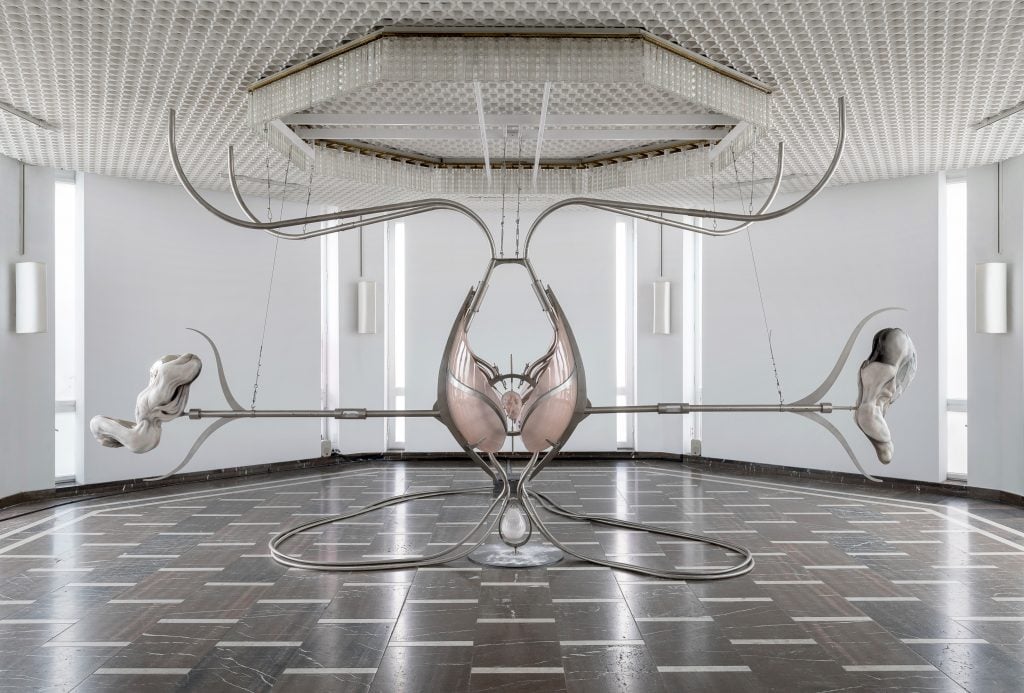
Installation view of Metempsychosis: The Passion of Pneumatics, Schinkel Pavillon, 2024; Photo: Stefan Korte
Location Based on Finances
Money has long been the principal factor determining an artist’s studio conditions, but artists today are not alone in facing a much broader affordability crisis. After decades of gentrification, there are vanishingly few corners of major cities that still offer cheap rent. As a result, even established artists are feeling pushed out of major art centers or forced to adopt radical new approaches to keep production costs down.
In little over a decade, Bašić has become a curatorial darling for distinctively wacky, cyborg sculptural installations that feel genuinely new, if not futuristic. For a solo exhibition at Berlin’s Schinkel Pavilion last year, the Belgrade-born, New York-based artist delivered a sprawling kinetic piece that appeared to breathe as it gradually pounded its alabaster core into dust. But if otherworldly art like Bašić’s feels like it emerges fully-formed from the mind of the artist, the reality could not be more different.
Bašić is one of many artists who, despite enjoying critical acclaim and the support of enthusiastic collectors, struggles to make ends meet. For some years she has maintained a studio in Dumbo, Brooklyn, originally secured via the Two Trees Cultural Space Subsidy Program. After the agreement was terminated before its expiration, her rent shot up, while new tariffs have driven up production costs. Mercifully some logistics, and costs like shipping, are taken on by galleries for commercial shows.
The frustration of having ambitions grow alongside the cost of living has pushed Bašić toward increasingly resourceful thinking. She had previously preferred to work by hand—”you have a lot of control over the outcome”—but, looking back, some works “should have been bigger but my ceiling was only so tall.” She realized instead that by “outsourcing some of the production, the studio can be smaller.” For a new work in the Taipei Biennial, which opened last month, components were made in New York and China and assembled on-site in “a total Tetris situation.” Pieces currently on view at Francesca Minini gallery in Milan were mostly made in Europe, with some handmade elements shipped from New York.

Ivana Bašić’s studio. Photo: Ivana Bašić.
Overseeing production across three continents may reduce costs, as well as the “expense to my body,” but relying on up to 10 fabricators for a project is not easy. “The logistics are hell, to be honest,” said Bašić. “I have been living in spreadsheets.” Not yet able to delegate this work, she estimates that some 60 percent of her time is spent on operations, leaving “little mental space to actually make art.” Even despite these accommodations, after 15 years working in New York, Bašić finds her current situation “completely impossible.” Early next year, she is planning to open a new studio in Berlin, only maintaining a much smaller space in the U.S. While previously, a quarter of Bašić’s studio was reserved for storing molds–the storage of finished pieces is handled by her gallery–these would be transferred to a separate storage unit.
Rising rent was the main drive behind ceramicist Mendick‘s move from London to Margate in 2020, and she hasn’t looked back. The seaside town has become an attractive alternative for U.K. artists, with its many disused buildings converted into studios and a growing gallery scene. When Mendick’s kiln broke she knew five local ceramicists eager to help. A stained glass specialist could advise on another, experimental project. “There’s a lot of people with different skillsets,” she said. “It all feels very serendipitous.”

Lindsey Mendick, Asked You Not to Hurt Me (2025). Photo: Damian Griffiths, courtesy the artist and Carl Freedman Gallery, © Lindsey Mendick.
Artist-Run Solutions
As economic pressures intensify, artist-run studios are spaces where artists can create stable working conditions that the broader ecosystem fails to provide. They can cultivate new communities and model alternative ways of working that prioritize care, sustainability, and even intergenerational knowledge. A growing number of established artists who have the means are building custom complexes from scratch, founding mini ecosystems based on community and mentorship.
On moving into TKE Studios, founded by Tracey Emin, Mendick was given the vote of confidence to dream big. “Tracey had the foresight to say, I think your career might progress and you should have a studio you grow into, rather than one you grow out of,” said Mendick. The artist has since made her name for humorous tableaux that feel generous in their detail, as in the case of Asked You Not to Hurt Me (2025), a fantastically grotesque fish counter complete with rotting lobster, cockroaches crawling over octopus tentacles, and mice feasting amid glassy shards of ice.
However complex an artist’s work may be, their unmet needs can be surprisingly simple. Unlike some of Mendick’s previous studios, Emin’s studios in Margate have windows and heating. “It makes a world of difference feeling taken care of,” she said. Though there are downsides to leaving a big city, “making my life smaller and my studio much bigger has been the best thing I’ve done,” freeing Mendick from “living in a perpetual state of crisis.”
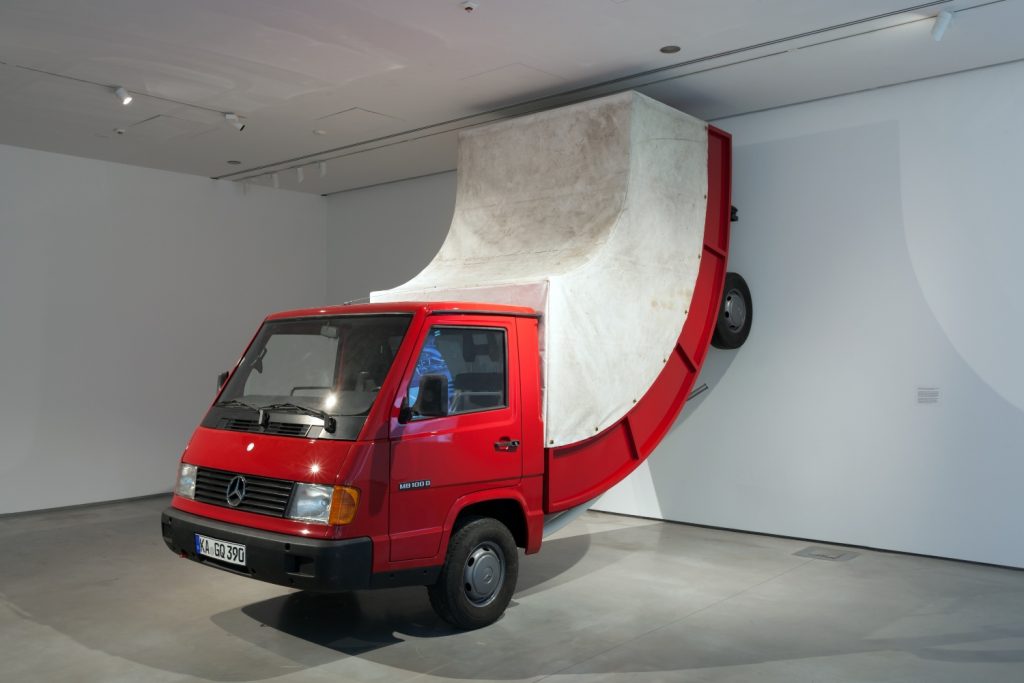
Erwin Wurm, Truck II (2011). Photo: Rafal Sosin, © Studio Erwin Wurm.
It’s been about 25 years since 71-year-old Wurm decided to leave Vienna, where running a studio had become complicated due partly to limited parking for delivery trucks. His absurdist sculptures are often installed outside, and have gained a cult following for distorting or anthropomorphizing the everyday to poke fun at modern life. To produce monumental pieces, like his Fat House and Narrow House from 2011, Wurm has converted a 12th-century country house into something of a factory. As well as a private atelier for the production and contemplation of new maquettes, he has 12 halls containing workshops for metalwork, carpentry, plasterwork, and painting, storage spaces for work at various stages of completion, showrooms, and archives. A revolving door of deliveries include incoming parts from foundries and finished pieces ready for shipping.
This sprawling complex has allowed Wurm to build up an extensive holding, making it easy to supply museum shows without relying on loans. Ultimately however, the scale of Wurm’s production also powers his creative process. “I love to work,” said Wurm. “This gives me the chance to work more and go deeper into different aspects. I strongly believe that one good idea for an artist’s career is not enough. I try to develop mine constantly.”
Assistants
One of the biggest questions facing an artist looking to scale up their production is when to hire a few helping hands. Each new employee provides a chance to offload work, including routine but time-consuming preparatory tasks, but they also bring new responsibilities. H.R. is one of many hats that most artists wear behind the scenes. This hasn’t stopped some of the art world’s top dogs from setting up veritable factories, with Damien Hirst rumored to have had, at one time, over 100 assistants. That’s a lot of spot paintings.
Wurm’s first assistant was his aunt, while still working out of his apartment. Now, he has little involvement in day-to-day logistics, having handed these over to a team of some 15 assistants. He also invites art students from across the world into his studio to learn the ropes as part of a three-month residency program. For mid-career artists, however, one or two full-time assistants are usually supplemented with freelance help on bigger projects. This was how Mendick approached her biggest commission yet, a board game-style installation temporarily installed at Kenilworth Castle and inspired by Queen Elizabeth I’s expert navigation of Tudor court politics.

Lindsey Mendick in her studio. Photo: Elissa Cray.
“If I have assistants, they’re not always going to do the boring job of just rolling out loads of clay,” said Mendick. Some work is inevitably mundane, but she aims for a collaborative process. Though Bosker did not have a daily routine while working as a studio assistant to Curtiss and others, she recalled how each work went through a predictable “life cycle,” providing “consistent rhythms.” Responsibilities ranged from stretching and priming canvases, laying down the background of a painting, or researching new directions, to setting up appointments, and evaluating health insurance options. Independent tasks melded naturally into a collaborative relationship, so that emails drafted by Bosker might be read out to Curtiss while she painted.
Artists, meanwhile, suddenly find themselves in the position of being a boss for long or short stints at a time. Mendick stressed that mutual respect and flexibility are key in offsetting the precarity of self-employment, including a lack of benefits like paid sick leave. Other times, she has had to warn assistants about nudity or other material derived from her personal life that may appear in the art. “Things are strange in an artist’s studio, so you have to make sure everyone’s okay with it,” she said. Health is another concern, including fire safety, proper ventilation, and proper protocols when working with hazardous materials or machines. Wurm has stopped working with polyester and resin altogether, to reduce the risk of exposure to toxins.
Ultimately, however, a good work relationship of this kind comes down to a good character fit, not just a set of skills. “Artists hire on feel and fire on whim,” according to Bosker. And though they are notoriously, if reasonably, particular about their vision, she found this specificity useful in avoiding ambiguity. “I felt like going into an artist studio is like crawling through their ear into their brain,” Bosker said. “It behooves you to understand whose brain you’re occupying and be a good guest in there.”
[ad_2]
Source link