[ad_1]
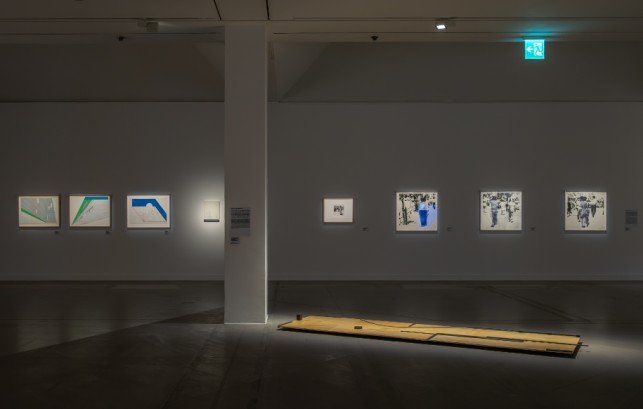
![The ″Art between Korea and Japan since 1945″ exhibition at the National Museum of Modern and Contemporary Art [NATIONAL MUSEUM OF MODERN AND CONTEMPORARY ART]](https://koreajoongangdaily.joins.com/data/photo/2026/05/13/cb82a1ee-1544-4aea-a818-3d5116769028.jpg)
The ″Art between Korea and Japan since 1945″ exhibition at the National Museum of Modern and Contemporary Art [NATIONAL MUSEUM OF MODERN AND CONTEMPORARY ART]
Despite decades-long thorny ties between Korea and Japan — a result of Japan’s 1910-45 colonial rule — collaborations between Korean and Japanese artists have continued over the years, evolving in line with changing social and political contexts.
“Art between Korea and Japan since 1945,” an exhibition jointly organized by Korea’s National Museum of Modern and Contemporary Art (MMCA) and Japan’s Yokohama Museum of Art, archives the history of this exchange over the past 80 years through the works of prominent artists from both countries.
The exhibition, set to open at the MMCA’s Gwacheon branch in Gyeonggi on Thursday, brings together about 200 pieces of artwork by 43 artists and teams, including Korean artists Paik Nam-june, Lee Ufan and Lee Bul, as well as Japanese artists Jiro Takamatsu, Takashi Murakami and Koki Tanaka.
Comprising five sections, the exhibition begins by paying tribute to Zainichi Koreans, or ethnic Korean residents in Japan, who remained in the country after World War II and likely struggled to integrate into Japanese society. Cho Yang-gyu’s 1957 painting “Sealed Warehouse,” for instance, captures the struggles of living as a Zainichi Korean through a realistic portrayal of a workplace.
The exhibition also highlights the works of Paik Nam-june, dubbed the “father of video art,” and his exchanges with Japanese artists, including Shigeko Kubota, his lifelong partner and collaborator, and Shuya Abe.
A key takeaway from the exhibition is Paik’s 1986 work “Bye Bye Kipling,” a satellite project that connects Seoul, Tokyo and New York to capture cultural events taking place in the three cities simultaneously — a direct challenge to British novelist Rudyard Kipling’s quote: “East is East, and West is West, and never the twain shall meet.”
![The ″Art between Korea and Japan since 1945″ exhibition at the National Museum of Modern and Contemporary Art [NATIONAL MUSEUM OF MODERN AND CONTEMPORARY ART]](https://koreajoongangdaily.joins.com/data/photo/2026/05/13/c15504a3-9c23-4ef8-8e22-067b18c00bf9.jpg)
The ″Art between Korea and Japan since 1945″ exhibition at the National Museum of Modern and Contemporary Art [NATIONAL MUSEUM OF MODERN AND CONTEMPORARY ART]
The exhibition chronicles how artistic exchanges between the two countries took place in a more institutionalized format following the normalization of diplomatic ties in 1965 and expanded outside the capital cities of Seoul and Tokyo to areas such as Daegu and Busan in Korea and Kyoto and Sapporo in Japan.
Portraying how artists from the two countries have worked to form a sense of solidarity over experiences of suffering, such as discrimination against Koreans in Japan and the 2011 Great East Japan Earthquake Disaster, the exhibition depicts how these artistic exchanges continue to broaden the scope of their artistic journeys in multifaceted ways.
Tanaka’s 2018 documentary, “Vulnerable Histories (A Road Movie),” is one example of a project that portrays historic events to explore the themes of identity and xenophobia, with a focus on ties between Zainichi Koreans and ethnic Japanese people.
The Korean title of the exhibition includes the term “road movie,” a film genre that centers on the protagonist’s transformation through a chain of events while traveling, referencing the artistic journey the two countries have embarked on over the past 80 years, according to the MMCA.
“This exhibition offers an opportunity to revisit historical moments experienced by both countries and the traces of artistic exchanges formed as a result,” MMCA director Kim Sung-hee said. “I hope this exhibition will serve as a chance for all to recognize the significance and potential of contemporary art in both Korea and Japan.”
The exhibition runs through Sept. 27. It first took place in Japan last year.
Yonhap
[ad_2]
Source link