[ad_1]
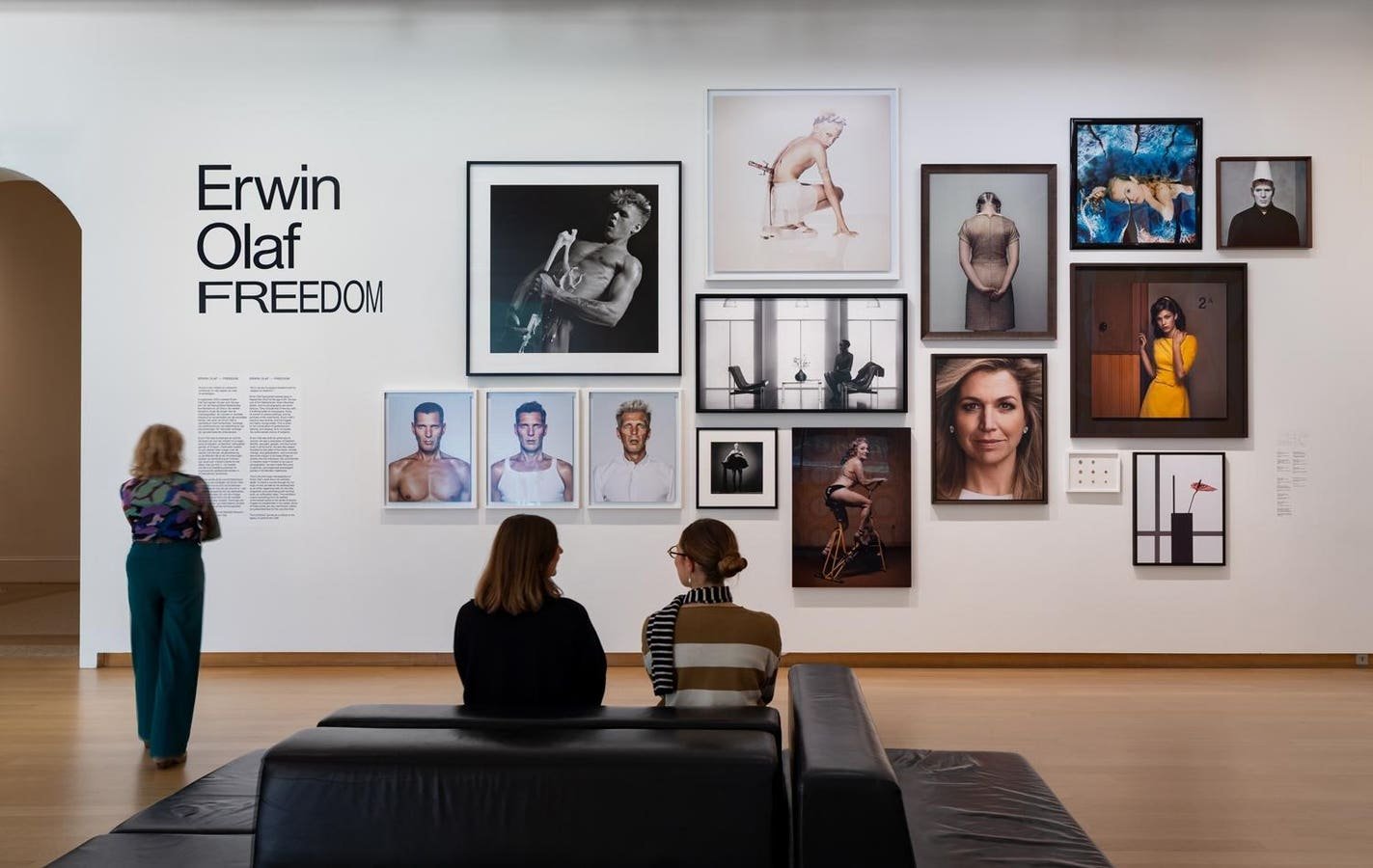
View of the Erwin Olaf — Freedom exhibition at Stedelijk Museum Amsterdam
Photo Peter Tijhuis
This fall, the Stedelijk Museum pays tribute to one of the Netherlands’ most fearless and visionary artists with “Erwin Olaf—Freedom”, on view through March 1st, 2026, the first major museum retrospective since his untimely death at the age of 64. Known for his meticulously staged photographs, cinematic lighting and charged narratives, Erwin Olaf Springveld built a world where beauty, vulnerability and resistance could coexist. Throughout his four-decade career, he used photography—and later film, sculpture and installation—as tools to confront social taboos and question systems of power. His images celebrated the freedom to be oneself in all forms, giving voice to those too often silenced or unseen: women, queer communities, the elderly and anyone who lived outside convention.
Erwin Olaf’s lifelong fight for self-expression was rooted in empathy and activism. Diagnosed with the chronic lung disease emphysema, he lived with fragility yet refused to be defined by it. He channeled his experience into new work that explored mortality, renewal and the will to keep creating. His death in 2023, just weeks after a lung transplant, was sudden and deeply felt—a loss not only to art but to the broader cultural landscape he helped transform.
“Freedom” fulfills Erwin Olaf’s final wish: to have an exhibition at the Stedelijk Museum, an institution he once viewed with ambivalence but ultimately embraced. Curated by Charl Landvreugd in collaboration with Studio Erwin Olaf, the survey show spans his early black-and-white photojournalism, groundbreaking series such as “Chessmen”, “Royal Blood”, “Rain”, “Hope”, “Grief”, “Palm Springs” and “Im Wald”, and culminates with his unfinished final work, “For Life”. Through these images, he continues his conversation with society—about identity, equality, desire and the shared responsibility to protect freedom in all its forms.
Erwin Olaf, Rain, The Ice Cream Parlor, 2004
Photo Estate Erwin Olaf. Courtesy of Gallery Ron Mandos Amsterdam
In the following conversation, Shirley den Hartog—his longtime studio manager, collaborator and founder of the Foundation Erwin Olaf—reflects on the man she called her best friend, making his dying wish come true, his deep-rooted fight for freedom and the legacy she now carries forward.
How did the idea for a Stedelijk Museum exhibition come about, especially since Erwin once had mixed feelings about the institution?
The Stedelijk is our museum of modern art, and Erwin’s biggest anger in life was that it never paid attention to his work. He was always angry about it—but it was also his biggest motivation to keep going and never give up getting there during his lifetime. Even when he was in the hospital after his lung transplant, we joked about what would happen if both the Rijksmuseum and Stedelijk wanted to do a show after he died. He said, “Tell them both yes, but cancel the Stedelijk at the last minute!” And then the next morning he called me and said, “No, that was a joke. Of course, I want to do the Stedelijk.” After he passed away, I met with the museum’s director. He told me he didn’t know Erwin’s work well, but had seen how the nation mourned him and how the Rijksmuseum had put him next to Rembrandt in its Gallery of Honor. He wanted to pay tribute to “the activist, the big voice” who fought for freedom of speech and marginalized groups. It’s poetic justice that the museum Erwin longed for finally opened its doors to him.
The exhibition is called “Freedom”. What did that word mean to Erwin himself?
Freedom, for Erwin, meant the freedom to be who you are and to say what you think—without fear or judgement. He loved that people could express their sexuality, but also their religion or their doubts. He used to say, “If we all lived in one building, with someone queer, someone Muslim, someone Christian, someone with a disability, we’d all share the same elevator—and in that elevator, you must be tolerant of each other.” That was his definition of freedom: tolerance while staying true to yourself.
Erwin Olaf, Im Wald, Auf dem See, 2020
Photo Estate Erwin Olaf. Courtesy of Gallery Ron Mandos Amsterdam
What was the most urgent question that Erwin never stopped asking through his work?
He always said, “Keep watching and listening to what’s happening around you. Don’t be lazy.” He wanted people to take responsibility for what happens around them and to react to the situation we’re all in. He also felt more than other people that life was ending. Even when he was ill, he turned his mortality into art. After his lung transplant, he made the self-portrait with his two sick lungs in the hands of his surgeon. It was taken one hour after the operation. When he woke up from his coma, the first thing he asked wasn’t “Was the operation successful?” but “Was the photo good?” That was Erwin—he put his art before everything, even his life.
The show reveals Erwin’s early photojournalism and activism. How do you think his art continues to inspire younger generations?
I think it gives reassurance. People tell me they still have the “Joy” postcard from when they were teenagers—the one with the champagne bottle. During the AIDS crisis, people sent it to each other as a message of hope. His photos told them, “You are okay.” It’s not just the queer community, but also myself. I was a bigger girl when I was young, and when I looked at his photos of bigger persons and they looked great, I was super happy. For others, like older people who modeled for his “Mature” series, it gave back pride. One woman told me, “In society, I’m not allowed to feel sexy anymore—but in Erwin’s photo, I feel sexy again.” Even if the young generation doesn’t know Erwin’s art, I want his name to be connected with being happy with who you are and to be whoever you want to be. That’s my biggest goal.
Erwin Olaf, Stedelijk Museum – Borek Šípek, Pro J.P. Prešov, Slovakia-BW, 1991
Photo Estate Erwin Olaf. Courtesy of Gallery Ron Mandos Amsterdam
You’ve worked closely with the Stedelijk’s Charl Landvreugd to curate “Freedom”. How did you decide what to include?
At first, I wanted to show everything—40 years of images! Charl helped me go back to the core. The exhibition begins with a wall of Erwin’s iconic portraits and then leads into his early photojournalism, which hardly anyone has seen: protests, ballet, nightlife, Holland in the ’80s. Those first five or six years already contain the DNA of everything that followed: his fascination with the body, democracy, the individual. You can see how his worries about freedom, populism and identity were already there when he was 18. For example, his “Berlin” series was based on his worries about democracy, and the “Shanghai” series about what happens with the individual if you have to live in a world where the population grows so fast. All these themes were grounded in his early works.
So Erwin’s preoccupations at 18 remained unchanged until the end of his life?
Yes, and it’s also a sad story because queer rights, freedom of speech and democracy are all in danger at the moment. Looking back now on what he was doing 10 or 20 years ago, it’s all still valid.
Erwin Olaf, I Wish, I Am, I Will Be, 2009
Photo Estate Erwin Olaf. Courtesy of Ron Mandos Amsterdam
You founded the Foundation Erwin Olaf soon after his passing. What drives you to keep building Erwin’s legacy?
In his will, Erwin wrote, “Shirley knows what I want.” He told me, “Make me bigger than life.” So I did. We started with five people in the studio; now we’re 16. Half of the Foundation focuses on craftsmanship—offering grants to creative vocational students who don’t usually get funding. I wanted to create a tribute to everyone in front of or behind the camera. We support mid-level students, the ones who are talented but don’t have access to grants because they’re not in higher education. The other half of the Foundation keeps Erwin’s activism alive through projects that raise awareness and inspire action. It’s about giving people a voice and not just sitting back, watching the news and worrying. We have to be proactive about the rights of transsexuals, the elderly, women, young people and refugees—everyone who’s vulnerable. Every Monday, our studio turns into a safe space for teenagers who feel different. On Fridays, we host refugees for photography workshops. We also sponsor a senior pride for elderly queer people living in elderly houses who are getting bullied and going back in the closet. If every visitor to the Stedelijk exhibition leaves thinking, “Even a small action can make a better society,” then we’ve achieved something meaningful. It’s our way of filling the hole Erwin left—and keeping his belief in freedom alive.
Finally, what do you wish people understood about Erwin Olaf beyond the images?
That he was the most honest man I’ve ever known. He made mistakes—many—but he always stood up again. His life wasn’t easy; he had to fight for everything. But he never stopped believing in beauty, courage and freedom. And I think, wherever he is now, he’s laughing that the Stedelijk is finally full of visitors coming for his show.
Erwin Olaf, Berlin, Olympia Stadion Westend, Self-Portrait – 25th of April, 2012
Photo Estate Erwin Olaf. Courtesy of Gallery Ron Mandos Amsterdam
[ad_2]
Source link