[ad_1]
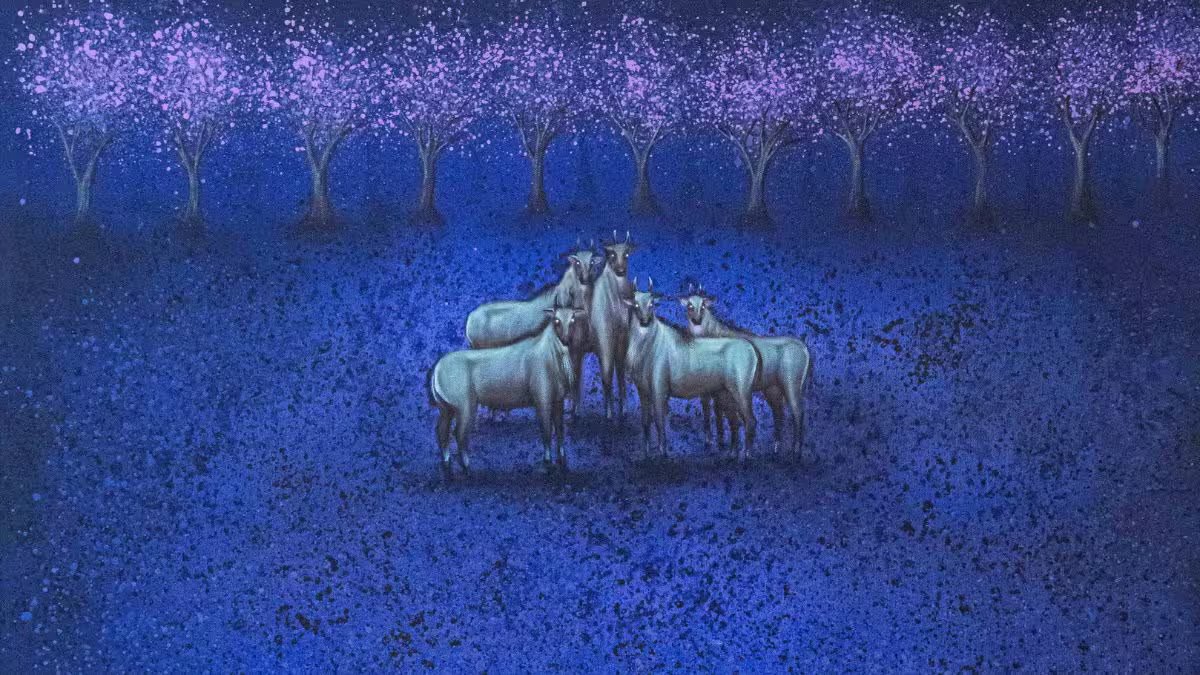
Jyoti Tyagi returned to painting after nearly twenty years away, and found that the time had changed what she needed to say. She works in charcoal, soft pastels and acrylic, layering and then eroding, building up and scraping back, making marks that look less like brushwork and more like something dragged through earth. Trees appear in her canvases, and birds, and peacocks, but they carry none of the decorative weight those subjects usually invite. “When I’m trying to etch the memories of the soil, the trees, the birds, very often those memories are dark and heavy,” she says.
Her solo show, Stories the Soil Remembers, recently closed after seven days at Shridharani Gallery in New Delhi’s Triveni Kala Sangam. Seven days is not a long run for a gallery show, and for a body of work about disappearance, the quick in and out felt sadly funny.
The grief
The phrase circulating in Indian contemporary art right now is “ecological memory,” the idea that land, water and forest exist not just as physical fact but as something carried in the body, and in how we remember things. There is an obvious gap between what a landscape was and what it has become. The Venice Biennale’s India Pavilion this year leaned into exactly this, framing its exhibition around tribal traditions and ecological consciousness. The international art world, it seems, has discovered something that artists in Delhi have been quietly working through for years.
Prayag Shukla, poet, art critic and curator, and the man who curated Tyagi’s show, has been writing on Indian art for over fifty years. He is not dismissive of the Venice moment, but he is precise about what it represents. “What we are calling ’ecological memory’ today may actually be an older civilisational consciousness returning under new conditions,” he says. “Many Indian artists, especially outside market-driven conversations, have been thinking about land, rivers, forests, displacement, and environmental fragility for decades. What international platforms often do is provide terminology and visibility to concerns that already exist locally.” The danger, he adds, is when those concerns become fashionable abstractions, detached from the ground they came from.
Shukla has written monographs on J. Swaminathan, M.F. Husain and Ambadas, artists whose relationships to nature ranged from the elemental and spiritual to the mythological and abstractly organic.
He sees a threads connecting their generation to the one working today, but also a genuine break in emotional register. “Contemporary ecological artists inherit fragments of these sensibilities, but they are also responding to a more fractured world. The emotional texture has changed.”
Living in unlikely places
Tyagi lives in Ghaziabad, which sits on the eastern edge of Delhi and consistently ranks among the most polluted cities in the country. It is certainly not, on the surface, an obvious place from which to make art about ecological sensitivity, and she acknowledges the paradox freely. “Living in an urban city like Ghaziabad makes you numb to the metamorphosis happening,” she says. “I actually had to step out of the city into the countryside to feel the depths of the impact.”
The years away from painting did something to what she is willing to say. Trees appear across her canvases as lineage, a way of tracing herself back to something older than the city pressing in around her. “The trees allow me to trace my present to my roots,” she says. Birds carry what she calls “the cost of migration, messages across civilisations.” Peacocks appear in the work too, among the recurring motifs of her visual language, though for Tyagi it is always the broader world they inhabit rather than the birds themselves that is the real subject.
Ashish Kushwaha arrived at similar territory from the opposite direction, not from urban numbness but from the slower, more personal experience of watching a place he loved change over time. He was born in 1987 and grew up in a farming family in Chhattisgarh, near Bilaspur, which sits at the edge of the Achanakmar Wildlife Sanctuary. He trained at Indira Kala Sangit Vishwavidyalaya in Khairagarh and later worked at Bharat Bhavan in Bhopal before settling at Kaladham Artist Colony in Greater Noida. His current show, Where the Sky Remembers, is on view at Palette Art Gallery in New Delhi.
The absence
Kushwaha’s landscapes are almost entirely without people, and the absence is not accidental. “I’m more interested in showing the impact of human presence rather than depicting people directly,” he says. “Humans and nature are not separate, but today we often behave as if we are above the natural world.” What remains when the figure is removed is a kind of forensic landscape, terrain that registers what has been done to it without anyone standing around to take the blame.
He works in watercolour and acrylic, though it is the watercolour he returns to most readily when explaining what the work is doing and why. Water, he says, moves in its own way, and that uncertainty is part of what gives the work its life. Watercolour as a medium sits between control and unpredictability in a way that oil does not, and for Kushwaha that quality is not incidental but essential. “Nature feels similar to me, beautiful, fragile, and never fully under our control,” he says. “So the medium feels naturally connected to the subject matter.” There is something almost ethical in the choice, a painter submitting to the logic of the thing he is trying to describe.
Both Kushwaha and Tyagi are careful not to overclaim what art can actually deliver. Kushwaha does not believe a painting stops a mine from opening or a river from drying up. “I don’t think art changes the world in a direct or immediate way,” he says, “but it can change how people see and feel.” Shukla, characteristically, sharpens this into a warning. The greatest risk, he says, is when ecological concern becomes “merely atmospheric, when environmental grief is aestheticised without confronting systems of power, consumption, and violence.” Serious ecological art carries ethical weight, and without that weight, the work risks becoming another visual trend consumed by the same culture producing the crisis.
Tyagi’s show lasted seven days, and she does not seem troubled by this. “These seven days at Triveni were very fulfilling,” she says. It is the kind of answer that closes a conversation and opens a thought, which is, in the end, what the best of this work does too.
First Published:
May 19, 2026, 12:20 IST
End of Article
[ad_2]
Source link