[ad_1]
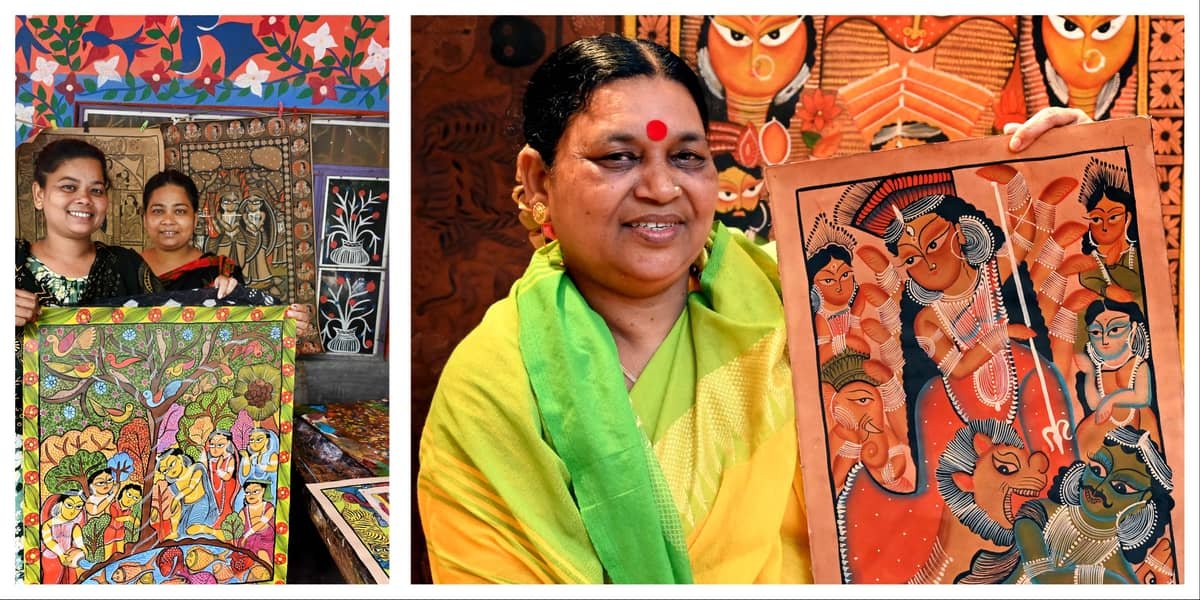
Fifty-two-year-old Swarna Chitrakar can often be found engrossed in pencil sketching her patachitra paintings at her showcases in galleries, exhibitions and art and craft fairs in Calcutta. At a recent exhibition in the city, captivated by one of her sketches, we struck up a spontaneous conversation. Pointing at the display for sale, Swarna shared that some of the artwork is hers, while others are created by her daughters.
She is particularly passionate about the theme of nari shakti, which started with her very first scroll, the Manasa Mangal, taught to her by her grandfather, and her father, artist Amar Chitrakar. “I was enthralled by Maa Manasa’s determination to carve out her space among the deities in heaven. Then came my learning of Chandi Mangal’s songs.” Among her many nari shakti pieces, Maa Durga holds a special place in her heart.
Swarna’s artistic journey is intertwined with her role as a mother to five daughters, all of whom have inherited her passion for patachitra painting, along with her grandchildren. The story of the artist and the mother didn’t end for us with the impromptu conversation. It led us on a 117km drive to her home, the vibrant Patachitra village (known as Naya) in Paschim Medinipur’s Pingla block, where her family diligently upholds their matriarchal legacy.
Walking along the mud pathways felt like wandering through an art gallery, with murals adorning the walls of mud houses and villagers absorbed in their artistic pursuits. For people aged seven to 70, art isn’t just a hobby here; it’s a way of life, anchoring their culture, identity, tradition and livelihoods.
ART AS LIFE AND LIVELIHOOD
Sonali Chitrakar, daughter of Swarna Chitrakar, warmly welcomed us. The first stop on our visit was her home. Spread across the floor was a mat adorned with various artworks, and on a small stool sat an unfinished piece titled Mother India. Sonali explained that it was a commissioned work she had started that morning. “We usually start our day around 7am or 8am, painting until about 11am before switching to household chores. We learned from our mother how to juggle home responsibilities with our passion for art. In the evenings, we pick up our brushes again around four or five and keep going until late into the night. This art is not just our primary source of income; it is sometimes our only source of livelihood in this village,” she shared.

Mamoni Chitrakar working on folklore and mythological inspirations
Patachitra, an artistic tradition borne from the patua community, has seen its artists travel as oral storytellers throughout the countryside of Bengal for centuries, with origins primarily in West Bengal and parts of Bangladesh, extending into Odisha. In Naya village, the patua community stands as a testament to this age-old tradition. They have cultivated a vibrant art hub of historical importance, preserving a tradition of painting that spans thousands of years. Sonali mentioned that the village comprises around 100 homes now and hosts about 350 patua artists who are dedicated to sustaining this age-old craft. Participation in this art spans all ages and genders. “The women tend to work longer hours than the men, despite juggling their household duties. Men often take breaks, but we women find a way to socialise while we paint!” Sonali laughed.
Soon, Mamoni Chitrakar, Swarna’s other daughter, joined us. “All five of us learned to paint from our mother, who even taught our father. She was trained by our grandfather and uncle, both of whom were renowned idol makers and patachitra artists. Our patachitra legacy comes from our mother’s side of the family, not our father’s. If we miss a day of painting, it feels as though something is missing from our lives,” she said. The two sisters then took us to their mother’s house, which was just a short walk away. Upon entering, we saw Swarna’s grandchildren gathered around the table, practising their skills on blank sheets.

Sonali Chitrakar working on her modern patachitra paintings, including Mother India and the babu-bibi selfie
“I’m so proud that my daughters and sons-in-law have all embraced this art as their livelihood. My grandchildren are also following in our footsteps, and I take great pride in encouraging them to continue. I want them to carry on our family tradition,” shared Swarna. Though Swarna’s other daughters, who live further away, couldn’t join us, Mamoni noted, “Even though they face some reluctance from their in-laws, they continue to paint when they visit their mother’s home.”
The paintings are a vibrant storytelling art form from West Bengal. The stories are presented through sequences of images on scrolls. The unique art combines the narrative scroll painting with a song, deeply rooted in the Chitrakar community’s heritage. Using vibrant natural dyes, artists bring to life mythological tales, folktales, and pressing social themes.

Babu-bibi painting
At Swarna’s home, a variety of artworks lay spread out, showcasing the family’s exploration of this craft. “In the past, we primarily focused on scroll paintings that depicted epic tales like Chandi Mangal, Manasa Mangal, The Ramayana, and The Mahabharata. Nowadays, we also incorporate modern themes on chouko patas (square sheets), alongside the oral traditions from the Puranas. These are more accessible for people looking to use them as home decor rather than traditional scrolls,” she explained as she led us through an array of paintings — featuring santhal dance, maachher biye, and bibi-babu. The themes they explore range from social and mythological to Kalighat style. One particular piece captured our attention: a babu-bibi selfie painting. “This is a contemporary theme that mirrors the society we live in. Lately, we’re making a lot of social reflections in our work. We also delve into the shadow style of Kalighat patachitra, as the artists of Kalighat are considered an extension of our community who settled there,” Sonali shared. When asked if she’s savvy with social media, she admitted: “We have Instagram accounts, but we don’t post much.”

A closer look at the Maachher Biye folklore-inspired painting
The time it takes to finish a painting varies widely — from a day to several months or even years. “It all depends on the subject and the complexity of the artwork. Smaller pieces can be done in a day, while larger scrolls may require up to a year. Sometimes we work on multiple paintings at once; we cut about 20 pieces of paper together and start working on all of them, which usually takes a few weeks to finish,” Sonali explained.
THE CHANGEMAKER’S JOURNEY TO A NATIONAL AWARD
From the beautifully intricate artwork, our attention shifted for a while to the display of awards housed in the glass showcase at Swarna’s home. Among several esteemed accolades from the state and nation, the National Award stands out — a recognition Swarna Chitrakar received at the end of last year after tirelessly applying for three consecutive years before that. “I was truly astonished when I started getting calls from friends, clients and acquaintances in Calcutta asking for sweets to celebrate. It felt surreal until the officer finally called me. Receiving this honour from our esteemed president (Droupadi Murmu) was a moment I will cherish forever,” Swarna recalled. The award was for her 130-foot Durga scroll painting. “Completing that work took me around a year and four months. It’s one of my most cherished pieces. I even painted a patachitra work on birds and animals for the president, who graciously listened to the entire explanation song when I presented it to her,” Swarna shared.
Swarna is also a receipient of The Telegraph She Awards in the Creative Art category, in 2023.
The journey of a patachitra art piece begins with the creation of its song. This melody is then set to rhythm before the painting takes shape. When the artist presents the painting, they sing the song that tells its story. “I don’t have any of my songs documented; my education didn’t extend that far. I can only manage a signature. Knowing I won’t be around forever, I’ve asked my daughters to write them down for future reference. The painting captures the essence of the song, so even if I forget lyrics while performing, I can easily recall looking at the artwork,” Swarna explained.

A Manasha Mangal pata (scroll) from Swarna Chitrakar’s collection of paintings
Her daughter Mamoni added, “Our patua community historically identified as jajabor. They faced extreme poverty and lacked a place to call their own. This art form has roots stretching back thousands of years, originally serving as a means of communication on cave walls. The evolution from guhachitra to patachitra occurred over time. The jajabor patuas travelled and shared oral stories to earn their meals. Eventually, a part of the community settled in Pingla. To be honest, we’re not quite at the level of expertise our mother has. She is the one who creates the songs for our paintings.” Swarna quickly interjected, emphasising that people often mistake her daughters’ voices for her own when they sing. “They’ve reached a remarkable level of skill. My brother, Anwar Chitrakar, who is also a National Award winner, can even compose songs in Hindi. He’s truly a master of the craft,” Swarna said.

Swarna Chitrakar’s four-year-old granddaughter, Jhilik, has also been introduced to the art form at an early age
The art form was never just for captivating entertainment, the wandering patua storytellers used it as a tool for educating people, too. Though traditionally focused on Hindu deities and myths, contemporary patuas also reflect on social issues, politics, and historical events in their paintings. Before receiving the National Award, Swarna had already established herself as a “changemaker” within her community through her innovative work as a patachitra artist. With her paintings and songs addressing critical topics such as Covid-19, Nirbhaya, and 9/11, she gained recognition for her commitment to social change. Swarna uses her art not only as a means of innovative expression but also as a vital tool for social communication. “During Covid-19, our patachitra storytelling helped many to understand the situation. The video became viral, too. We went to all nearby markets to explain the situation with our song and painting,” she explained.
She extends her responsibility in the preservation of this art form by mentoring the younger generation in her village through regular workshops, ensuring that the tradition doesn’t cease to continue with her and her daughters’ generations. “I conduct four-hour workshops for the younger generations in my village so that the art form is preserved. I dedicate the first hour to our art, while the remaining three hours focus on singing lessons, which are essential to our craft,” Swarna shared. Her contributions extend beyond painting; she also illustrated the book The Patua Pinocchio by Carlo Collodi, which adds a feather on her cap of creative pursuits with her art form.
THE MOTHER’S BALANCING ACT
Speaking of motherhood, Swarna recounted her early marriage at just 14, facing years of hardship, lack of shelter and food, and resistance from her in-laws to pursue her art. “My husband and I would go around the village selling dolls to bring back home food everyday. We were extremely poor,” she shared. She ultimately made the bold choice to return to her father with her husband and children, embracing a life of independence through her beloved art. “After my marriage, those years were extremely tough, and I had to rebuild my life from scratch. Yet, I never let my art slip away. Even in my darkest hours, it was my art that guided me to where I am today. Initially, women were not so involved in this art form. Married women till today are often discouraged to continue in this profession. My brother and I used to help our father in drawing patas when he used to fall ill. That’s how I got involved in this,” she shared, her voice heavy with emotions.
Swarna’s passion for the nari shakti theme stems not only from the puranas but also from her own life experiences. “When I was given the chance to travel to Australia to present my work, I discovered I was pregnant for the second time. A neighbourhood aunt advised me that it wasn’t worth it if the child wasn’t a boy and suggested terminating the pregnancy. That year, I opted to give birth to my two daughters instead of taking that trip to Australia. This experience sparked my song and painting addressing the issue of female infanticide,” Swarna recounted, with a lump in her throat.
Swarna and her daughters, Sonali and Mamoni, have showcased their artwork in numerous countries, including France, America, and Italy. “I particularly recall my visit to Washington D.C. where I created a scroll about the city,” Mamoni shared. Swarna balanced raising her five daughters with her artistic practice and international travels with ease. “I never felt overwhelmed as my husband took on the nurturing role while I travelled. He cared for them completely. Back from a trip, I managed everything — cooking, child-rearing, and honing my art. It never felt burdensome. I’ve ensured that all my daughters and grandkids learn to juggle their studies, household responsibilities, and our artistic heritage,” Swarna explained. Mamoni reflected on how deeply ingrained their art is in their daily lives: “We’ve been listening to our mother’s pat-er-gaan since birth. It was our ghumparani gaan (lullaby).”
THE ART FORM AS IT STANDS TODAY
As we explored Sonali’s creations, it was evident that she has a deep appreciation for the antique finish she applies to her work, all while capturing the essence of modern life. “Many people like this vintage effect. I find immense joy in this approach. Our methods are rooted in nature. We use herbal paints, and the antique finish comes from the bark of mango and berries,” Sonali explained. Mamoni guided us around her home, showcasing the trees that supply their vibrant colours for the fabric-backed papers. “The Latkan tree, with its striking red fruits, only blooms from November to February. During that time, we gather enough paint to last us the entire year and store it in coconut shells. For colours like yellow and green, we can harvest from turmeric, marigold, and various green leaves throughout the year. Some plants are cultivated by us, while our local markets also offer flowering plants from which we can extract pigments. The colours are combined with gum derived from the wood apple plant, and even the paper we use is made from paddy,” she shared. Swarna chimed in, noting that many people refuse to believe their use of plant-based dyes. She recalled how craft revivalist Ruby Palchoudhuri defended their practices, shedding light on their authentic story.
Reflecting on the current state of their village and the future of their art form, Mamoni stated: “Our situation is quite difficult these days. While we do receive some commissioned work, largely due to my mother’s reputation, numerous families in our village are struggling to make ends meet. Sometimes we miss out on potential clients because our home is located at the far end of the village, and visitors often leave before they venture deeper into our community.”

Swarna Chitrakar with her husband visits exhibitions and galleries to sell their paintings and products. This shot is from their recent visit at Kolkata Centre for Creativity
Sonali remembered the positive changes brought about by the involvement of Banglanatak Dot Com back in 2005. “The patuas were on the brink of extinction. Their arrival in our village marked a turning point. They opened doors to many connections, both nationally and internationally. They helped amplify our presence on social media, and many of our works even went viral on YouTube. Unfortunately, due to internal village politics, their support could not be maintained, and they had to withdraw. They also organised fairs where we showcased our creations, but that has since come to a halt. Even the fairs organised by the government stopped,” she reflected.
Exhibitions, galleries, and fairs in the cities have become essential for their survival in the art world today. Swarna said, “People don’t often come from Calcutta to purchase our work. We have to travel to the cities to sell. Occasionally, we’re fortunate to have connections like Ruby Palchoudhuri, who link us with foreign buyers. That makes a difference.”
Mamoni highlighted how their art form has expanded into various products — trays, kettles, dress materials, and pen stands, among others. However, their mother expressed strong reservations about these items. “While my daughters dedicate time to those products, I can’t bring myself to invest energy into creating them. They sell quickly, yes, but my main focus is on the jorano pata. I always encourage my daughters and the women who train with me to prioritise that. Back when I sold my art after marriage, a pata would go for about ₹10, but now, a small one ranges from ₹1,000- ₹1,500 to over ₹5,000 for a decent size, and people are willing to pay for it. They recognise our effort and value what we do. I stand firm in preserving the authentic practice of our art, and I believe our commitment is understood — because of people’s support, I’m here today. For me, my art is the only asset I own,” she shared, with a confident smile and a tinge of pride. A pride that can only be born from unflinching passion, perseverance and dedication, against all odds.

A painting by Swarna Chitrakar
As we walked out of Swarna’s home, the residents of the village greeted us with warm smiles and invited us to visit their homes, too. They seemed eager to share their art and stories with us, which we apologetically had to decline being tight on time. However, a glimpse of their homes through half-open doors while passing by made me realise that the mother-daughters’ story of passion and perseverance in preserving a slice of Bengal’s historic art tradition that we heard from Swarna and her daughters mirrors the reality of many families in Pingla. Like them, there are many unyielding to the challenges of everyday life, intoxicated with a passion for their art. Through their story, the trio voiced the hopes and dreams of many mothers and daughters who share their commitment.
“We’re immensely proud of our mother and everything she has accomplished through her relentless dedication. Each recognition she receives fills us with pride, and we aspire to achieve similar heights in the future. She truly inspires us,” Sonali shared, with Mamoni nodding in agreement.
Pictures: Pabira Das
[ad_2]
Source link