
[ad_1]
Visitors to Marquette University have long been able to slip inside Joan of Arc Chapel, a 15th century stone building, for a moment of meditation.
Through Dec. 20, they can also turn to another compact space on campus for a form of contemplation. In a second-floor gallery at the Haggerty Museum of Art, “Life Lines” is an art-theology collaboration that the museum is billing as “the first in a series of object labs focusing on contemplative encounters with art and religion.”
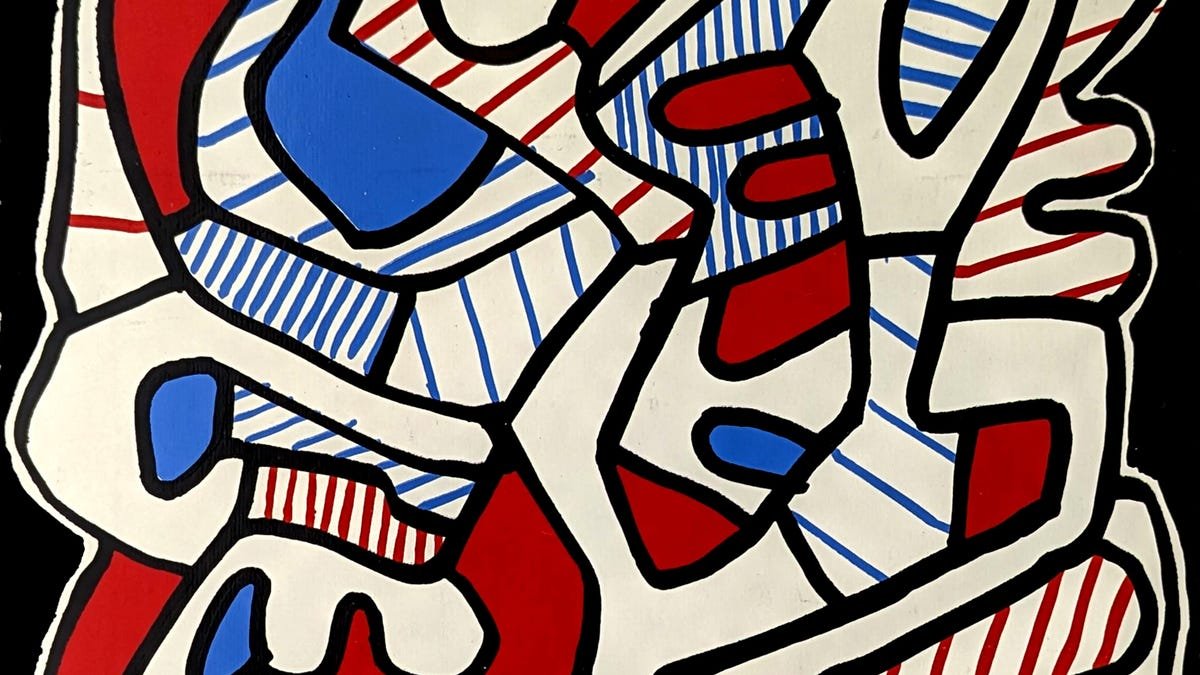
It’s not out of character for an art museum at a Catholic university to present an exhibit encouraging contemplation, particularly one at a Jesuit institution, whose religious order encourages practice of the Spiritual Exercises of St. Ignatius Loyola. But visitors to “Life Lines” may be surprised to discover the art offered here as objects for contemplation are 20th-century abstract works from such artists as Sol LeWitt and Jean Dubuffet.
Lynne Shumow, the Haggerty’s curator for academic engagement, curated the exhibit with help from graduate student intern Bridget Neugent. Shumow, whose mission includes using art to make connections with other academic disciplines on campus, teamed with familiar collaborator Fr. Ryan Duns on “Life Lines.” Duns is chairman of Marquette’s theology department. “Life Lines” grows out of past work Shumow and Duns have facilitated in presenting works of art to students for contemplative “beholding.”
To oversimplify his intentions, what Duns wants is for a student or visitor to the exhibit to spend time taking in an artwork, allowing it to speak to them rather than instantly strip-mining meaning from it.
Students in Duns’ “Contemplation and Action” course this semester are getting the most systematic practice in beholding. Duns has asked each student to select a work in “Life Lines.” They’re instructed to return to visit the artwork weekly; to sit, stand or kneel in front of it for about 15 minutes; then write a response paper each week.
There’s a familiar pattern to how those essays unfold, Duns said. During the initial weeks, students are excited about the work and have no trouble writing. Then they hit a trough and think, “this is stupid. I hate this,” Duns said. But eventually, around week eight, nine or ten, “the epiphany begins, and it’s when the art discloses itself on its terms, rather than the terms that (the students) have set,” Duns said.
This emptying-out trajectory may be familiar to anyone who’s read accounts of contemplative mystical experiences.
‘Life Lines’ includes a work by Milwaukee artist Jill Sebastian
While students in Duns’ “Contemplation and Action” course will have a persistent structured engagement with artworks in “Life Lines,” more than 850 students in an introductory theology course have visited or will visit the exhibit for some reflective exercises.
“The exhibition was also planned very much with the general public in mind,” Shumow said. Like many Haggerty exhibits, it’s a compact assemblage that still shows off the surprising depth of the museum’s collection.
Local art lovers may be surprised and delighted to discover a work in “Life Lines” by Milwaukee artist Jill Sebastian that the Haggerty has not displayed before. “MERaT”(1980) began when Sebastian, about to become a mother for the first time, wrote her thoughts about motherhood and making art on vellum paper. She cut those papers into long strips and rearranged them on museum board.
“There’s so many ways you can read into that about what is discernible, what is hidden, what we reveal, what we don’t reveal,” Shumow said.
The curator also said Sebastian told her she drew an outline of her newborn and that can be found in the artwork, too.
If you go
“Life Lines” continues through Dec. 20 at Marquette University’s Haggerty Museum of Art, 1234 W. Tory Hill St. Admission is free. Visit marquette.edu/haggerty-museum or call (414) 288-1669.
[ad_2]
Source link