
[ad_1]
It was 2020. The world was on lockdown, crying out for some good news. And of all the unlikely things, a public artwork was able to oblige.
In the wee hours of November 2, a commuter train in the suburbs of Rotterdam burst through the buffers at the end of a track during a safety exercise. The operator on board was saved when a reinforced polyester sculpture in the form of two whale’s tails prevented the train from plunging 33 feet into a waterway in a park below. The train conveniently landed on one of the tails, making for an indelible image, a media blitz, and an unforgettable story. Originally dubbed Whale Tails, the sculpture, created by architect Maarten Struijs in 2002, was quickly renamed Saved By the Whale’s Tail by local authorities.

A photo taken in Spijkenisse, on November 2, 2020 shows a metro train that shot through a stop block at De Akkers metro station, without any casualties. Photo: Robin Utrecht/ANP/AFP/Netherlands OUT via Getty Images.
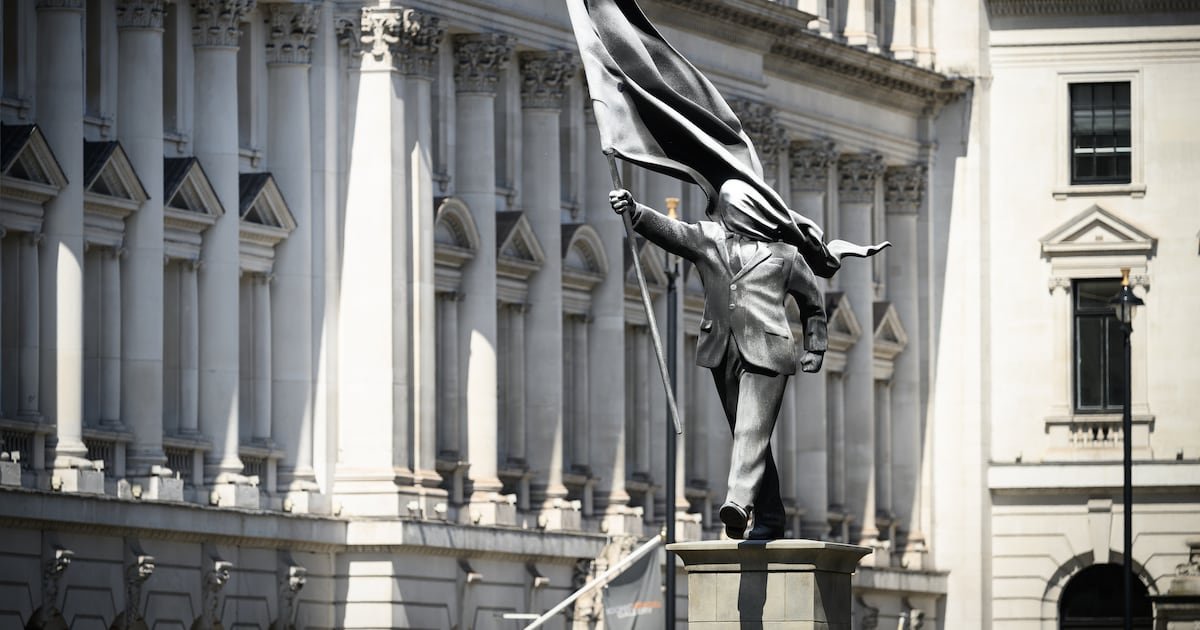
Have other artworks saved lives? Did an artwork save your life? That’s the question behind a new public art project in London by Kurdish artist Ahmet Öğüt, Saved by the Whale’s Tail, Saved by Art, being presented by the organizations Art on the Underground and New Contemporaries. Posters going up throughout the transit system will ask the public to submit their own stories of just how art has saved them to New Contemporaries’ website. The artist and a panel of judges will pick the most original and compelling submission, and that person’s story will go on view alongside a new commission by Öğüt at the Stratford Underground station later in 2025. The winner will also receive an artwork: a bronze sculpture akin to an award ceremony trophy, in the shape of the whale’s tail sculpture.
“It’s so simple but it’s so meaningful in what it’s asking,” said Eleanor Pinfield, director of Art on the Underground, in a video call. “That’s the amazing power artists bring to these situations: to format something in a thoughtful way, but wear it lightly.” Her organization is celebrating 25 years commissioning both temporary and permanent works by artists from Tania Bruguera and Jeremy Deller to Beatriz Milhazes and Cindy Sherman.
Öğüt boasts an impressive résumé; he’s been the subject of solo exhibitions at institutions worldwide, including the Van Abbemuseum in Eindhoven, Netherlands, London’s Chisenhale Gallery, the Berkeley Art Museum in California, and Kunsthalle Basel. Major international shows such as the Istanbul Biennial, the FRONT Triennial in Cleveland, the Lyon Biennale, the Performa Biennial and the New Museum Triennial in New York, and the Berlin Biennale have all featured his work.
The hopefulness of the new project might seem surprising from an artist who has made headlines for critical projects and statements. In 2020, he withdrew a solo exhibition from the Yarat Contemporary Art Space in Baku, Azerbaijan, after the museum tied it in social media posts to the ongoing war in the disputed region of Nagorno-Karabakh. Last year, Amsterdam’s Stedelijk Museum earned unwanted attention when it declined to lend his installation Bakunin’s Barricade (2015–22), a piece that incorporates artworks from the museum’s holdings into a blockade, to an activist collective, though the terms of the museum’s acquisition allowed for such a loan. He ultimately demanded the installation be removed from display when the institution declined to lend it for a protest over Israel’s war in Gaza.

A poster for Ahmet Öğüt’s project Saved by the Whale’s Tail, Saved by Art (2025), being presented by the organizations Art on the Underground and New Contemporaries. Photo courtesy the artist, Art on the Underground and New Contemporaries.
He’s also aimed to draw attention to little-known whistleblowers with a Web3 project commissioned by Artwrld: his Monuments of the Disclosed commemorates brave souls such as Marlene Garcia-Esperat, a journalist murdered for exposing government corruption in the Philippines, and Mona Hanna-Attisha, whose research revealed the water crisis in Flint, Michigan.
And his work ranges much more widely, and humor has often been part of his work, which he described in a conversation with me as aspiring to be three things: critical, political, funny. Sam Thorne, writing in Frieze in 2021, pointed out that his projects, at that time 70 around the world, “have ranged from temporary tattoos to an affordable eye-tracking system for people who have been paralyzed, from hybridized cars to a VIP lounge for art-fair interns.”
The cynic, hearing of Öğüt’s latest project, might point out that art has a better track record of killing people than saving them. The cynic would have some supporting evidence. For example, a 1991 project by Christo and Jeanne-Claude consisting of thousands of 20-foot-high, 485-pound umbrellas in California turned deadly when one came unmoored in the wind and fatally pinned a woman against a boulder. Twenty years before, a rigger at Minneapolis’s Walker Art Center died when a two-ton steel sculpture by Richard Serra fell over on him. And there are those who speculate that exposure to toxic resin caused German-American artist Eva Hesse’s fatal brain tumor, and that lead in pigments killed Caravaggio.
But screw cynicism. Öğüt is taking an unabashedly upbeat position with the new project, all inspired by the incident in Rotterdam, which, obviously, stuck with him for years. “When I hear stories like that—that’s why I’m interested in art. It motivates me,” he said.
“I was exhausted from all the bad news,” he said, “and I wanted to get back to the beginning, to a hopeful, positive mindset, to the magic art can bring to everyday life and that it did bring to my life. It enabled me to cross borders, to survive during a civil war.”

Ahmet Öğüt, Saved by the Whale’s Tail, Saved by Art (2025). Courtesy of the artist, Art on the Underground, and New Contemporaries.
Believe it or not, dear reader, after I heard about Öğüt’s project at a talk he gave in New York in February and before getting on the video call with him, I came across an example of art that had saved a life. Artist Thomas Kinkade, he of the saccharine paintings of glowing cottages, is the subject of a new documentary; it revealed a fan letter from someone who said she was on the verge of suicide before she came across his work and that it gave her a sense of peace she had never before known. Öğüt was immensely pleased to hear about it.
He, too, had in the meantime learned of a poignant example. In Alban Muja’s short film I Believe the Portrait Saved Me (2025), Albanian painter Skender Muja narrates a tale from the last days of the Kosovo War (1998–99), when government forces captured him and more than 100 of his countrymen. Upon learning he was an artist, a Serbian police commander instructed him to draw his portrait on a blackboard, saying, “If it’s good, you’ll be spared. If not, I can’t guarantee anything.” Apparently, the rendition was up to snuff: Later, Muja and his compatriots were packed onto a truck, and were fearful they would all be slaughtered when they reached their destination. But, he recalled in the film, the officer pulled him off at the last minute, saying, “The portrait you drew may just be saving you.”
Öğüt has faith that more examples will bubble up from the public.
Asked what he expects, he said, “That’s the most exciting part of the project. I have no idea. I know I will be surprised. You just surprised me now!”
In his experience, the concept has legs. “So far I’ve talked to friends, curators, and artists,” he said. “The moment they start thinking about it, they can’t stop. Each of them spends time thinking about it and sends me a message weeks later.
“I think we will have an incredible archive at the end of the day.”
[ad_2]
Source link