[ad_1]
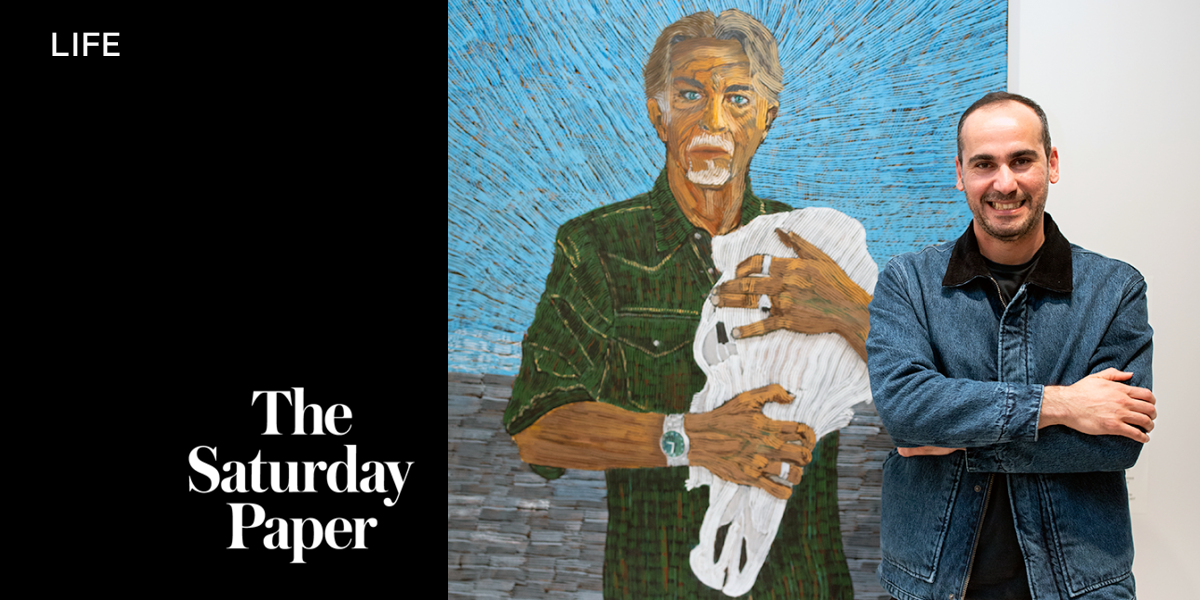
The colours are startlingly bright: blue, green and orange groups of lines overlay the same controlled arrangement in white – the precise, expressive scritches of a toothbrush. The man’s gaze is direct, eyes wide. He holds a cow’s skull to his heart as if it were a baby.
The pose radiates kindness, a driving force for the artist and activist Mostafa Azimitabar. “As a refugee survivor who suffered deeply for eight years in detention, I still love Australia because I have experienced kindness and respect from people here,” he says.
This painting is Moz’s second portrait to make the shortlist of the country’s most famous art competition, the Archibald Prize. The first was a penetrating self-portrait, KNS088, the number by which he was known on Manus Island. It is acrylic mixed with coffee and applied with a toothbrush – two of the only painting materials he had in detention – and the colours bleed and run.
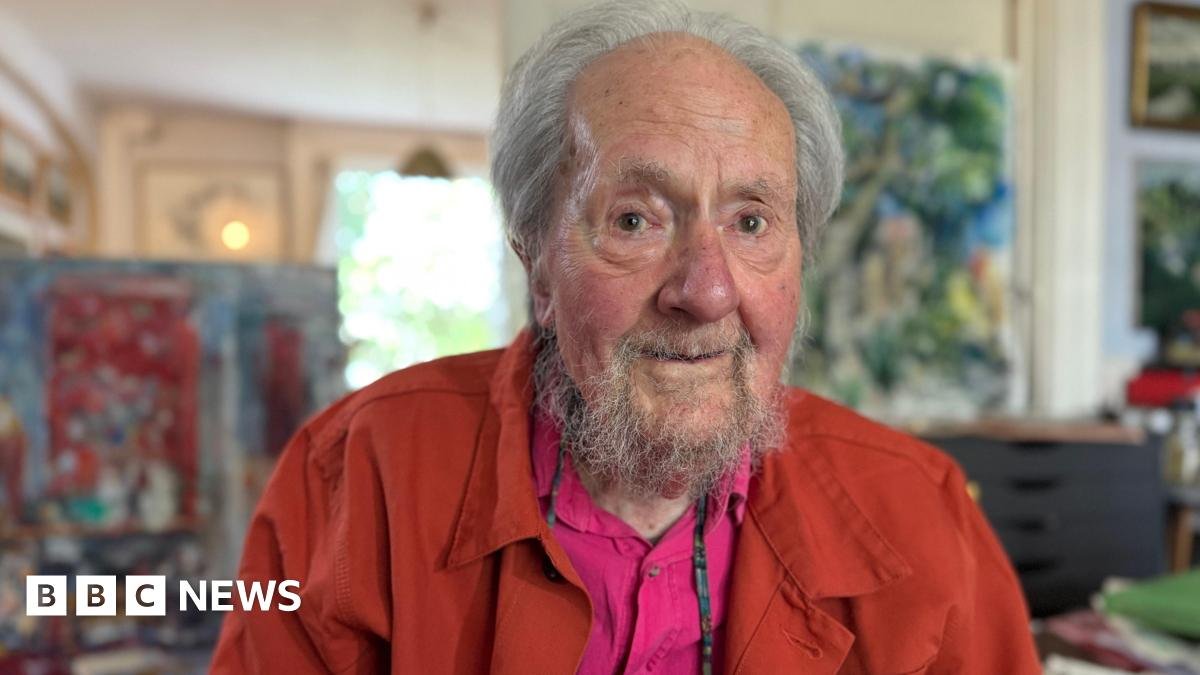
The subject of this latest work, currently on display at the Art Gallery of New South Wales, is fellow artist and filmmaker Angus McDonald. His 2023 documentary, Freedom is Beautiful, traced the experiences of Moz and fellow refugee Farhad Bandesh, both detained by the Australian government. The film is also about the tentative rebirth of Moz and Farhad after their release. Both are still on bridging visas that must be renewed every six months – they have no stability to make longer-term plans. Both are at risk of deportation should Labor’s new immigration bill pass.
“No one would like to be treated the way a refugee is currently treated in Australia,” Moz says. “We live on temporary visas and, unbelievably, adults are forbidden from studying.”
“I am one of you,” he tells The Saturday Paper. “I am part of this society while the government wants me to leave Australia.
“I hope that no people suffer in Australia and that we get our permanent visas soon.”
Mostafa Azimitabar, now 38 years old, with an angular frame and deeply expressive face, is Kurdish. He was born in Iran and grew up in a marginalised community constantly under threat, which only deepened during the Iran–Iraq war of his childhood in the 1980s. His human rights activism made him a target and, in 2013, he escaped by boat to seek asylum in Australia. He was intercepted and taken to Christmas Island, and from there to a detention centre on Manus Island in Papua New Guinea.
He and his fellow refugees lived first in tents that mouldered in the monsoonal rains and then in filthy metal shipping containers, with barely any personal space. Moz remembers long stretches of insomnia, interspersed by nightmares, and a blow from an iron bar that left him with a stammer.
This is where I first encountered him, through his close friend and supporter Christina. As an advocate for those held in Australia’s offshore processing centres on Manus and Nauru – part of the former prime minister John Howard’s “Pacific Solution” and perpetuated by the Gillard government and its successors – I handled countless cases of self-harm, rape by locals, children with traumatic withdrawal syndrome. Thirteen people died as a result of their physical and mental struggles in offshore detention.
Moz lived on Manus for six years, until PNG’s supreme court ruled the island’s punitive detention system was illegal and the centre was finally forced to close – the protests of the nearly 600 stranded refugees were heard around the world in 2017. Moz was among those abandoned in Port Moresby. Suffering PTSD and asthma, he was brought to Australia under the medevac bill, only to be shut away for 14 months in tiny rooms in Melbourne’s Mantra and Park hotels, amid privations that worsened throughout the Covid-19 pandemic. Even under these oppressive conditions, he took control of advocacy, orchestrating text for surprise banner drops from nearby buildings to coincide with protests outside the hotel.
In January 2021, after 2737 days as a detainee, and with no explanation, he was freed.
The case he subsequently brought against the federal government over its use of hotel detention was unsuccessful, in the sense that the policy was deemed lawful. However, in the ruling handed down a year ago, Judge Bernard Murphy spoke of the cruelty of this practice: “I can only wonder at the lack of thought, indeed lack of care and humanity, in detaining a person with serious psychiatric and psychological problems in the hotels for 14 months,” he said. The court’s findings were embarrassing to Australian governments. For Moz and his fellow detainees, that was a win.
Anyone who has been trounced at Scrabble by Moz in any of his many languages knows he is a polymath whose abilities extend in many directions, including music, activism and charity work as well as art. These, along with long-distance running, self-discipline and carefully curated autonomy have helped him escape the despair I have witnessed among thousands of detainees offshore and so many people struggling in this country with the immigration system.
There are still close to 100 refugees on Nauru. Detainees onshore are still being held in alternative facilities, including hotels. And migrants in this country are still being used as scapegoats for housing shortages and the cost of living. Australia has re-engaged in deportation negotiations with a turbulent Iran, the draconian Migration Amendment (Removal and Other Measures) Bill 2024 is before the Senate and the guidance from the immigration minister that required community ties to be considered in any deportation case, direction 99, has been replaced by an emphasis on the safety of the Australian community as the highest priority.
The lives of refugees in Australia are always suspended on a thread of hope – the misery of waiting with no certainty about the future is the point. The minister for immigration has told Moz he will never be granted a permanent resident visa, nor allowed to settle here. Yet Moz says he can harbour no resentment towards the politicians and bureaucrats who keep him in limbo.
“Forgiveness is healthy,” he says. “With hate they kept me in detention indefinitely. Truth can melt the hate. Together we will melt the hate indefinitely.”
Nevertheless, complex trauma can make connection hard. The average person is not able to comprehend the intense experience of being known only as a number for eight years, sharing space with thousands, having possessions raided, fearing solitary confinement, queuing for ghastly food or squalid amenities, being in pain and denied painkillers, moving under constant guard or in handcuffs, yielding to dehumanising pat searches every day. Every refugee responded to the ordeal differently.
For Moz, endurance has brought clarity. He arrived in this country as a politically bold, opinionated young Kurd at odds with his more conservative relatives over human rights, free speech and the Iranian regime. He is now someone who can negotiate the upper echelons of the art world in this country.
Moz says art occupies his mind from waking to sleep. He now works as a guide at AGNSW, and paints at home in Sydney. Without any formal training, he delves into himself to create truly original work.
“I like to connect myself with what I paint. If I can’t connect to what I paint then what is the point of art?”
His entry for the Sulman Prize last year – also shortlisted – is a grim landscape. The contrast with the radiant colour in his latest pieces shows he can see both light and dark: natural beauty and unnatural cruelty. It also suggests the artist may be emerging from the troughs of despair under state-sanctioned abuse.
Mostafa Azimitabar says quietly of his work: “This technique comes from suffering. It’s a sad story but it’s beautiful because I share it with society.
“I think this is the best of me.”
This article was first published in the print edition of The Saturday Paper on
July 6, 2024 as “Truth melts hate”.
For almost a decade, The Saturday Paper has published Australia’s leading writers and thinkers.
We have pursued stories that are ignored elsewhere, covering them with sensitivity and depth.
We have done this on refugee policy, on government integrity, on robo-debt, on aged care,
on climate change, on the pandemic.
All our journalism is fiercely independent. It relies on the support of readers.
By subscribing to The Saturday Paper, you are ensuring that we can continue to produce essential,
issue-defining coverage, to dig out stories that take time, to doggedly hold to account
politicians and the political class.
There are very few titles that have the freedom and the space to produce journalism like this.
In a country with a concentration of media ownership unlike anything else in the world,
it is vitally important. Your subscription helps make it possible.

[ad_2]
Source link