[ad_1]
Published May 6, 2026 06:00AM
Before it became a creative outlet (or a social media following) GPS art was just a happy accident for Australian ultra-runner Peter Mitchell.
Some five years ago, the 51-year-old was out on a casual run with friends through a local reserve when the group got split up. Peter and a few other runners went back to find those who’d gone off course, making their route a bit messy.
But afterward, sitting at a café and scrolling through the run map on Strava, something caught his eye.
“Someone said it looked like a bird – maybe a pelican,” Mitchell recalls. “But I saw something different. It looked like Big Bird from Sesame Street.”
Curious, he zoomed in, studied the surrounding streets, and began mentally tweaking the shape – adding a loop here for a foot, extending a section there for a tail. Soon, he was sketching over a screenshot, mapping out how the route could be run more deliberately.
He went back out and did exactly that.
“It ended up looking very much like Big Bird,” he says. “And from there, it took a life of its own.”
The evolution of GPS art
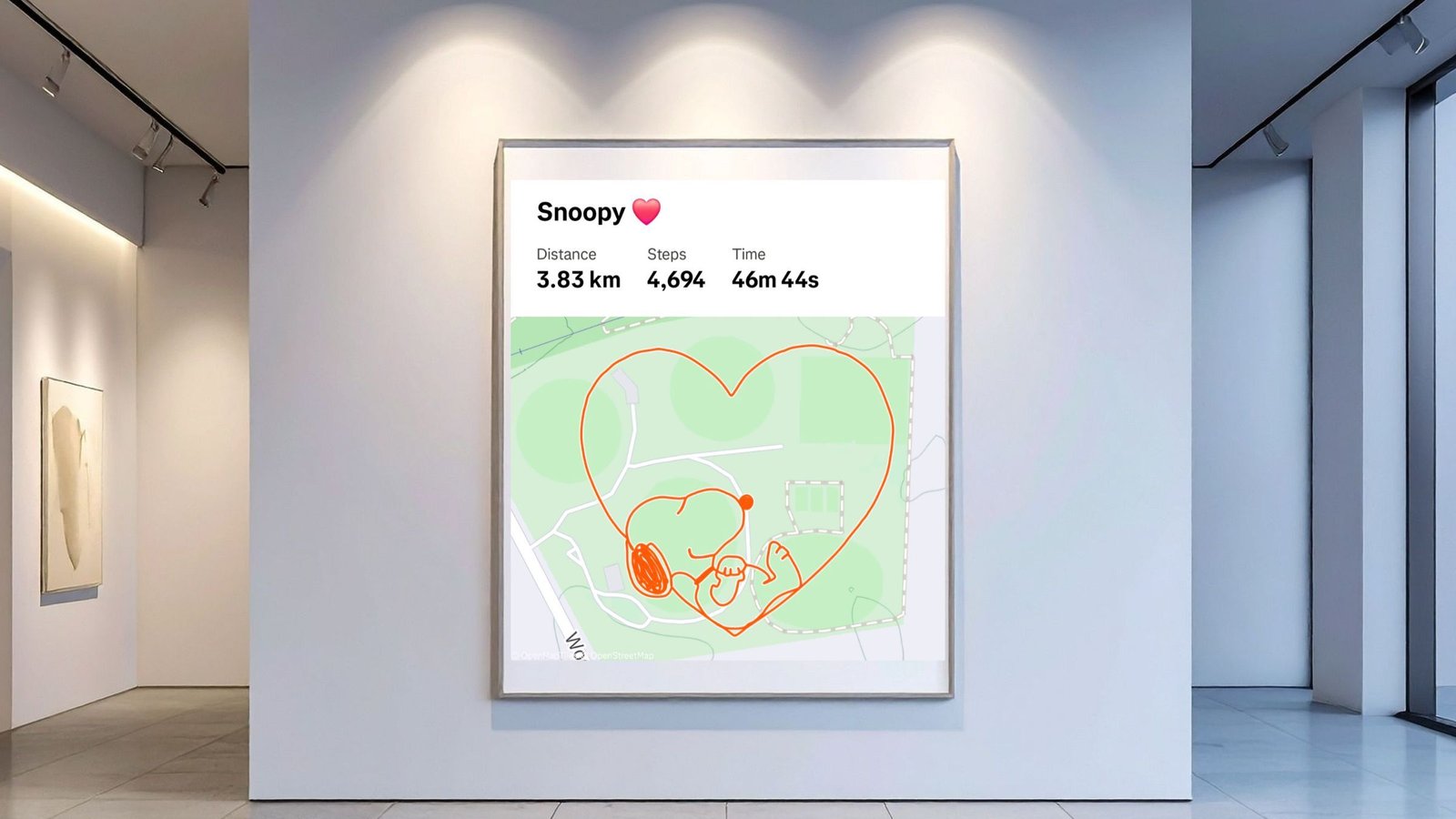
That spontaneous moment quickly grew into something bigger. What began as a playful experiment became themed routes, group runs, and a full creative pursuit. Today, Mitchell shares intricate GPS designs – drawn mile by mile across roads and trails – with 13,000 Instagram followers as GPS Art Guru, turning everyday workouts into sketches of icons from Kermit the Frog to Taylor Swift, LeBron James, and Lisa Simpson.
While GPS art has been around since the 1990s, it began gaining traction among endurance athletes in the 2010s, popping up on Strava and MapMyRun feeds. One of the early adopters was Canadian cyclist Stephen Lund, who created routes resembling everything from a T. rex to Darth Vader, eventually launching gpsdoodles.com to showcase his work. Others soon followed, including prolific runner and artist Lenny Maughan (who calls himself a “Human Etch A Sketch”) and has traced everything from Frieda Kahlo to the Coldplay “Kiss Cam” Couple through the streets of San Francisco.
In recent years, advances in GPS technology have made it possible to produce far more precise results, and Mitchell has leaned into that shift by collaborating with software engineers to refine tools built specifically for GPS art. He has also experimented with moving beyond static map images by animating his work, by combining multiple GPS artworks into a GIF/cycle video, similar to a digital cartoon flipbook.
The pursuit of precision in GPS art
That precision, however, has not come easily. It has been built over years of experimentation – testing devices, reworking routes, overlaying designs onto satellite maps, and plenty of reconnaissance missions before ever starting the run. Each image can take hours, if not several days, to complete.
“I’m always thinking about what’s possible next,” he says. “It’s something that just keeps evolving. I’m always thinking about what’s possible next and trying to turn those ideas into reality.”
Running into roadblocks
That’s not to say he hasn’t run into some challenges, uh, en route to making his masterpieces. On one three-hour run designed to trace a Lionel Messi portrait along the Australian coastline, Mitchell returned to find his parked car partially submerged by an unexpected King Tide. (The car was totaled, but the artwork – and the story behind it – went viral.) He also frequently has to get creative with adapting his planned route, especially when construction sites, fences, or other obstacles cause him to detour.
“What looks like a simple connection on a map might turn into an arcade, an underground passage, or a building interior,” he shares. “I’ve ended up running through places like shopping arcades, a hospital foyer, and even the State Library. A lot of it comes down to adapting in real time while still trying to keep the design as accurate as possible.”
Where inspiration strikes
So how does Mitchell decide what to draw next?
Part of the answer lies in timing. Many of his routes are shaped by cultural moments or seasonal hooks. Last spring, he revealed a rotating globe for Earth Day.
In March, he organized a group run in Melbourne that traced the shape of a horse for the Lunar New Year. For Halloween, he mapped out a skeleton. And for his 50th birthday, he spent a total of 19 hours and 10 minutes running a 105-mile route that formed a map of the world.
His running buddies have some say, too: “I often do activities with friends. Sometimes they’ll have an idea, and I’ll design it, and then we’ll go out and execute it together,” he shares. “It’s evolved into something much bigger than just a final image. It’s about the idea, the vision, the process, and the story, and finding ways to show how it all comes together.”
GPS art tips from the guru himself
Peter Mitchell’s pro tips for creating your own masterpiece of miles.
Get the tools: Using a planning tool can make a big difference. Mitchell recommends Route Sketcher and GPS Artify as good starting points for learning how to design and follow GPX routes.
Freestyle first: Freestyle modes open up the creative process. You can upload images to trace, draw your own designs freehand, then place, resize, and rotate them anywhere – from parks to beaches to open fields. Once complete, the design can be exported as a GPX file and followed on a GPS device.
Start simple: Save the Frieda KTK. A simple outline and focus on getting a clean result rather than trying to do something too complex straight away.
Go big: Larger designs tend to work better, since they incorporate more turns, have more flexibility, and give more detail. Open areas in particular reduce GPS noise and make it easier to create accurate, recognizable shapes.
[ad_2]
Source link