[ad_1]
Drawing the Italian Renaissance, The King’s Gallery, Edinburgh ★★★★★
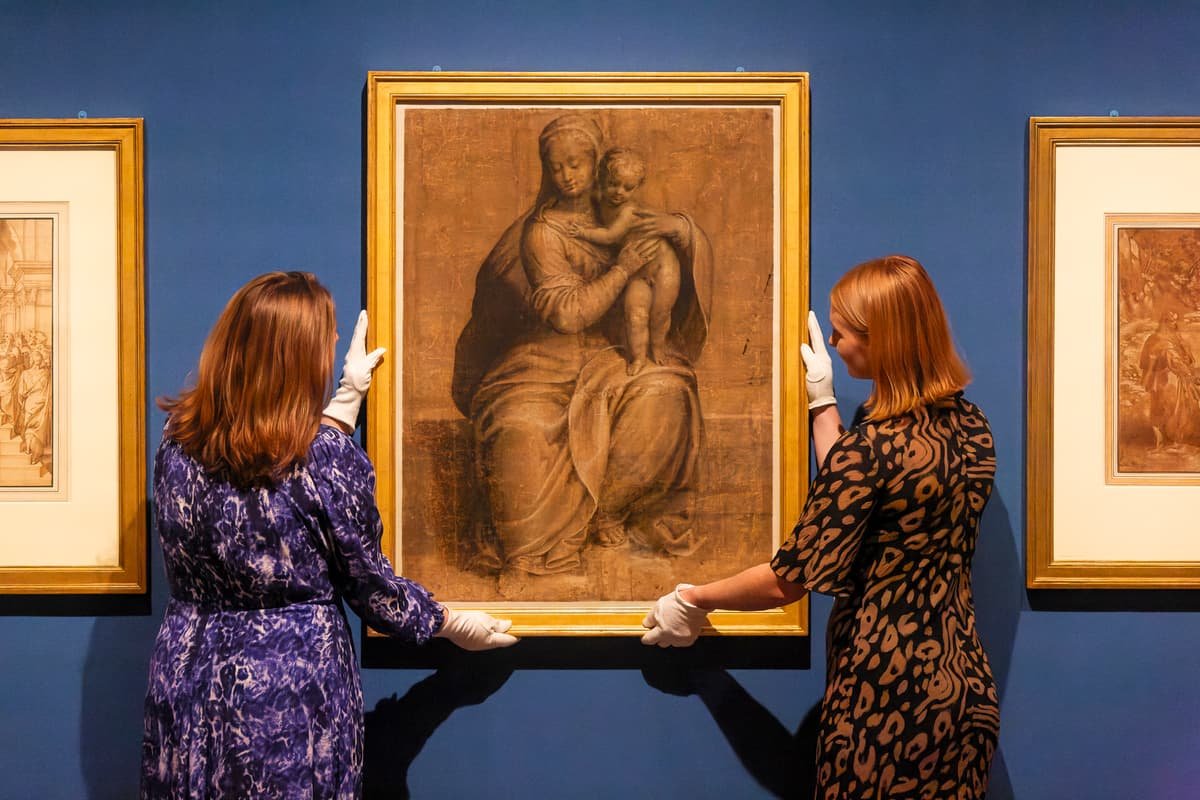
Drawing was central to the art the of the Italian Renaissance. The Royal Collection of Italian drawings is one of the world’s greatest collections of Renaissance drawings and a stunning selection is now on display at the King’s Gallery. All from the 15th and 16th centuries, there are drawings by Leonardo, Raphael, Michelangelo and other giants of the Renaissance. Many are less well known, but are still amazingly good.


The exhibition begins with an anonymous drawing from the mid-15th century of a boy sitting drawing with a dog sleeping nearby. Done in ink with white heightening on blue paper, although there is nothing else in the picture, we see the boy and dog as catching the light in an enclosed, shadowy space. The means are minimal, but their use highly sophisticated. After this introduction, the show is thematic. The first section is titled Drawing the Head. The very first drawing is by Leonardo and is of a boy’s head. Leonardo loved a vortex and here he has indulged himself by adding black chalk to red to pick out the spirals in the boy’s curly hair. Nearby a drawing by Ghirlandaio of the head of an old woman with an abstracted, inward gaze is much more direct and also deeply sympathetic. In contrast to its quietness, a head of St Thomas by Polidoro da Caravaggio, clearly drawn from the life, is dramatically animated. This contrasts again with an exquisite head of the Madonna by Federico Barocci. Executed in coloured chalk on blue paper, the artist’s delicacy of touch feels reverent.
The second section, Animating the Divine, consists of drawings of religious figures and compositions. A star here is a Madonna with the Infant Christ by Michelangelo in black chalk. Christ’s arms are around his mother’s neck while the infant St John is leaning rather casually at her back. Together they make a beautifully realised, massively sculptural group. From much later in the century, a large drawing of the Virgin and Child by Bernardino Campi has a similar sculptural feel to it, but its large size reflects its purpose as a cartoon, a full-sized drawing made to transfer the composition to the support prepared for the painting. Because of their practical function, cartoons like this one rarely survived. The sharply defined outlines of a study by Correggio for the frescoes in the Duomo of Parma likewise reflect the composition’s intended purpose. When executed in place, these figures would be seen from a long way below and needed to be clearly legible.

Mostly the drawings here are remarkable for the confidence with which they are executed. There are very few signs of changes of mind or rubbing-out, but others show the excitement of creation. A vivid study in ink for a Coronation of the Virgin by Parmigianino, for instance, vividly suggests the excitement of his thinking. Paper itself was precious and not to be wasted. A lovely pen and ink drawing of the Return of the Prodigal Son by Agostino Carracci has various other bits of drawing on the front of the sheet and a lot more on the back including a rather beautiful nude study.
Drawn geometry was vital to perspective, a major preoccupation of Renaissance painters. In Alvise Vivarini’s Virgin and Child with saints, the mother and child are enthroned in a carefully geometrical classical niche. Vivarini was a Venetian and this work recalls that of his more famous contemporary Giovanni Bellini. Much later in the century, the deep shadows, animated poses and eye-level viewpoint of Paris Nogari’s Presentation in the Temple, a study for a wall painting, seem to anticipate Caravaggio.
In a section called Drawing the Figure, there is a page from one of Leonardo’s sketch books showing the muscles of the leg. Alongside is a similar study by Michelangelo. What a conjunction! Stars here, nevertheless, are two red chalk studies by Raphael, one for the tapestry cartoon of Christ’s Charge to Peter and the other for the Three Graces in the fresco of the Marriage of Cupid and Psyche in the Farnesina. Both these are studies of real people in the studio, clothed boys in the first and a single naked girl for all three figures in the second. This latter drawing which somehow keeps all the freshness of that moment in the studio is one of the loveliest works in the show. Perversely it is also one of a few that are double-hung above eye level. It’s a shame.

As I said, however, it is not just the great names that shine here. A red chalk drawing of a man with a flail, a study for a Flagellation of Christ by Battista Franco, is a truly dynamic image. So too is a drawing of two struggling figures by Luca Signorelli. A prophet by Veronese is not such a success, however. He is clutching himself as though he is having a gastric crisis. Still, you can move on to the sublime beauty of Michelangelo’s Risen Christ. How can simple black chalk create anything so grand?
A further section is devoted to design, which of course depended on drawing then as it does now. There are designs for all sorts things here, a pair of Heron’s fountains, a kind of spouting syphon, by Leonardo, for instance, and a design for a carved crystal by Polidoro da Caravaggio in which black chalk and white on a dark blue ground exactly match the effect of carved crystal. There are designs for stucco decorations by several artists, for a carved altarpiece attributed to Sansovino and a full-size drawing for an elaborate candelabrum attributed to Marco Marchetti. There is also a magnificent design for a tapestry of the Feast of Scipio by Giulio Romano, a commission from Francis I of France.
A very small section of the show is devoted to Observing Nature, but it does include a lily attributed to Verrocchio, Leonardo’s teacher, and a wonderful study of a laden branch of blackberries by Leonardo himself.

The last section is called Decorating the Private Realm and is a selection of drawings that we know were done in connection with some private, or at least secular commission. If you were wealthy, it was fashionable to have the outside of your house decorated as well as the inside, though few such decorations survive. A crossbowman drawn by Lelio Orsi would once have taken aim at people in the street from the facade the artist’s brother’s house in Rome. A powerful drawing of a god of the winds and two goddesses of rain by Giulio Romano was for a ceiling in the Palazzo Ducale in Mantua. Here too we see drawings done as gifts, testimony to how much they were valued at the time. Paolo Farinati’s Hercules slaying the Dragon in the Garden of the Hesperides is actually inspired with a dedication to the artist’s patron. The last drawing and one of the most complex and accomplished in the whole show was likewise made as gift. It was drawn by Michelangelo for Tommaso de’Cavaliere with whom, we are told, the artist had fallen in love and to whom he made drawings and addressed sonnets. With more than 20 figures of children drawn in highly finished red chalk, this beautiful and mystifying drawing is called A Children’s Bacchanal. The children running wild appear to represent raw, unmodified humanity and the central group have evidently overwhelmed a deer. The deer was a symbol of the soul and so here the soul is overwhelmed by something more basic. It’s a drawing with a message for it’s recipient, Michelangelo’s young lover, although perhaps one that is deliberately obscure and so private.
The Scotsman’s arts newsletter is now sent twice a week – subscribe today
Want the latest Scottish headlines sent directly to your phone? Sign up to our new WhatsApp Channel here.
[ad_2]
Source link