Divergent Lines
Luan Gallery, Athlone
★★★★★
Luan Gallery is a bright and airy exhibition space overhanging the Shannon as it meanders through the centre of Athlone. With two substantial rooms and a long, light-filled, glass-sided corridor, the gallery is an ideal architectural setting for Divergent Lines, a stimulating group show that considers an expanded field of drawing practice, from works on paper through to large-scale installations and site-specific interventions.
Comprising works by just six contemporary Irish artists, it concentrates its focus to afford the viewer a substantial engagement with each practitioner.
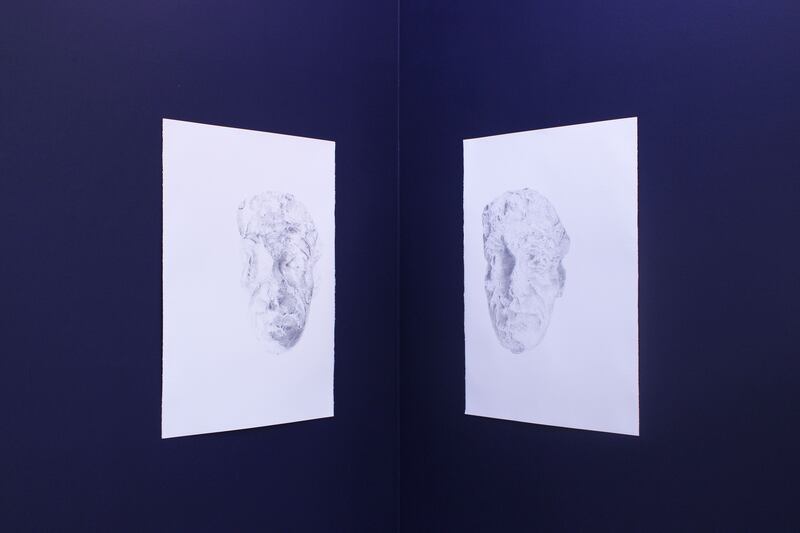
Eleven framed pencil-on-paper works by Brian Fay offer a series of meticulously achieved considerations of art history in its guise as a repository of images studied, pored over and dissected by the scientific gaze.
Infrared and Reverse Drawing Views from Erased de Kooning (2018) is a powerful study of Robert Rauschenberg’s infamous 1953 conceptual piece. Vermeer Woman with a Pearl Necklace c 1664, Cracks Drawing (2011) maps the crazed varnish surface cracks of that Dutch masterpiece with an obsessiveness that poses the question of what exactly it means to look at physical artworks.

Lelia Henry presents an imposing installation comprising two works. The first, Paddy Hanly’s (2026), is an impressive, almost life-size charcoal rendering of the facade of an abandoned cottage. Suspended from the ceiling of the gallery, the drawing transcends its own two-dimensionality by acting as a threshold beyond which we encounter found objects and furniture arranged as a domestic tableau. The effect is completed by Maggie’s Window (2026), a charcoal drawing over two superimposed sheets presented in a deep frame to create a trompe l’oeil effect.
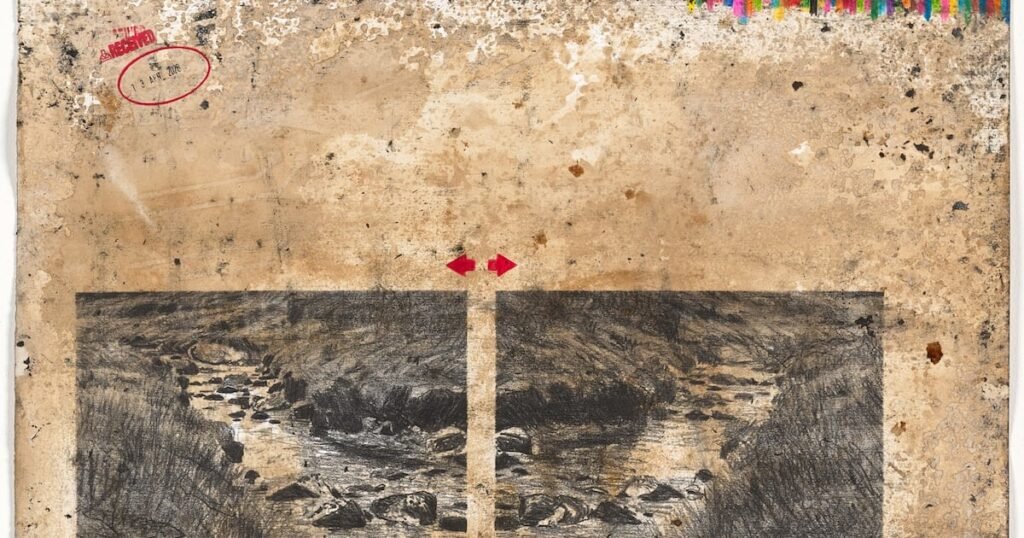
Tabulinum Purgamentorum (Binned Archive) (2026), a set of graphite and mixed-media works on paper by Michael Wann, are offered as fragments of a fictional archive. Stamps, labels and annotations give each sheet a neglected, bureaucratised feel, while fleeting river imagery suggests a tension between such systems and the human impulse to record and represent.


In Felicity Clear’s Laminar and Turbulent (2026) the restless forms of wind and water are translated into a three-dimensional installation of black swirls and spooling loops suspended between ceiling and wall. The work interplays with both the architecture of the space and the geophysical riverside location with great sensitivity, as do two Mary-Ruth Walsh pieces that straddle the divide between drawing and sculpture.
In her Architecture of the Natural World I and II (2026), paper scrolls inscribed with organic and bacterial forms among linear structural outlines creep from wall to floor. One in particular is partially suspended in order to catch the light falling from the gallery windows, both revealing its own transparency and gesturing to the living world beyond.


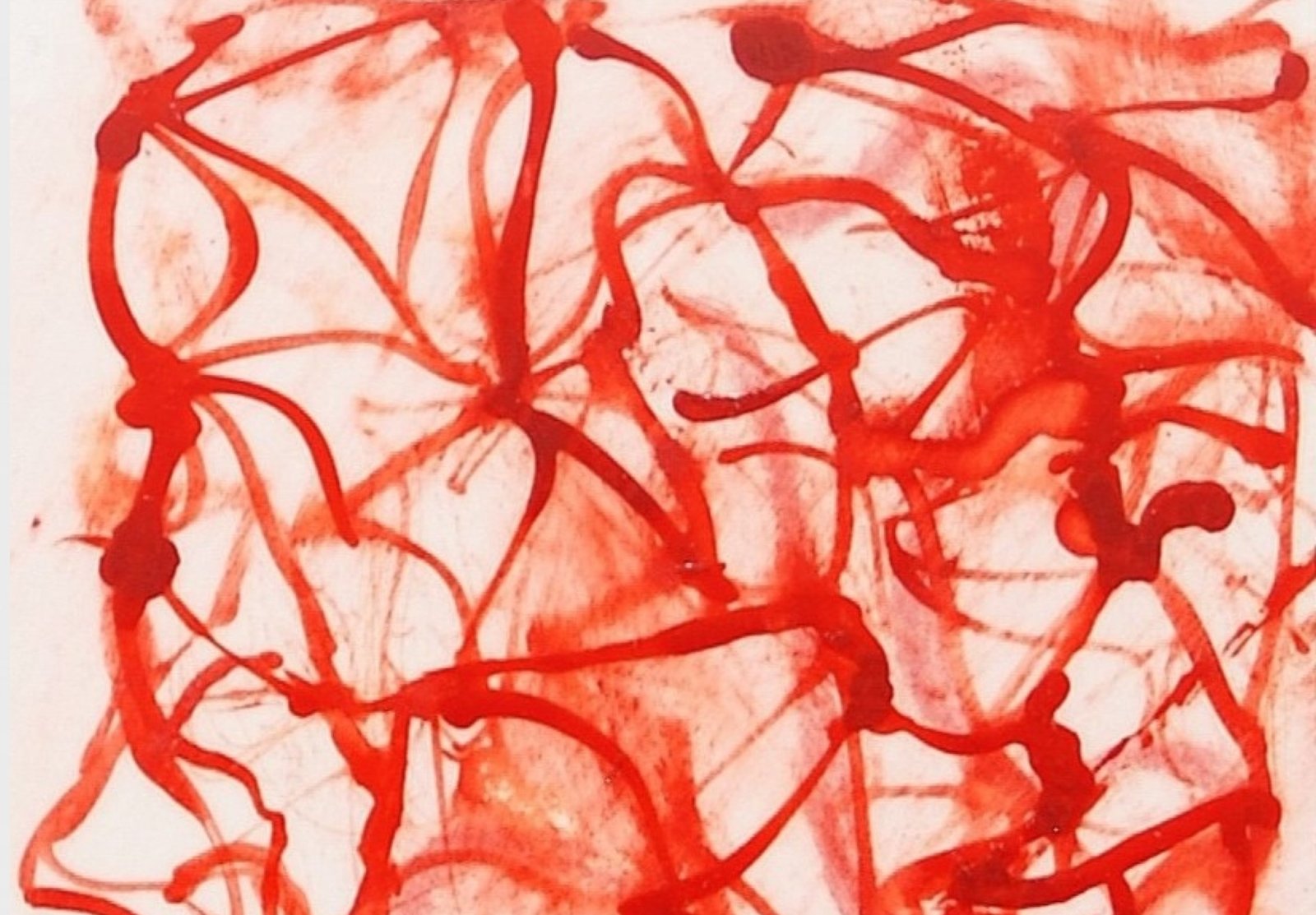
The show is completed by Kiera O’Toole’s Affective Cartography: Athlone, Counties Westmeath and Roscommon (2026), a more gestural work that combines loose, bruise-like colourations applied directly to the gallery wall and then overlaid with vertical strips of pigmented paper. As with other pieces in the show, it seems to maintain an impressive, deliberate tension between imposed systems and unpredictable forces.
A rich show thoughtfully curated by Aoife Banks, Divergent Lines nicely demonstrates the way such tensions are key to drawing, a practice that can extend in space and time far beyond the confines of the page.
Divergent Lines is at Luan Gallery, Athlone, Co Westmeath, until Sunday, June 21st