[ad_1]
Born in 1971 in Charleston, South Carolina, and currently working in New York, Maxwell Stevens has established drawing as a cornerstone of his practice, elevating it far beyond a merely preparatory role to stand as an autonomous visual language. In this interview, the artist reveals his fascination with the immediacy and materiality of works on paper, where line and surface serve as dynamic vehicles for thought and emotional revision. By exploring the tension between figuration and abstraction, Stevens invites us to view drawing as an intimate, “palimpsestic” space that, in its elemental simplicity, captures the fragmented complexity of our contemporary experience.

Maxwell Stevens, “Untitled Drawing (Crouching Nude)”, 2011, ink on parchment over charcoal on paper (Fabriano), image 27 cm x 27 cm, paper 58.5 cm x 43 cm, courtesy Galleria Tilde, Palermo
Andrea Garcia Casal: To begin, could you situate drawing within your overall practice?
Maxwell Stevens: Drawing has long been the foundation for all of my work, from compositional sketches to the linear movements and edges in my paintings, but also as works of art in their own right.
Looking back to your early formation, were there particular teachers, draftspersons, or historical works on paper that shaped the way you understand what a drawing can be?
Drawing became a regular activity for me long before I knew anything about art, but as I began to engage with works I would see in books and museums, I started to see the versatility of the practice within the simplest of means as both an intellectual construct and an emotional reservoir. The most impactful exhibition I’ve seen was a major Leonardo da Vinci drawings retrospective at The Met in 2003, and while there were many finished works on view, there were numerous examples from his notebooks, and these works really highlighted drawing and sketching as an extension of the thought process itself.
Your biography often highlights your work in painting. At what point did you feel the need to develop a distinct body of drawings rather than letting them remain embedded within the painting process?
I’ve made drawings alongside my paintings for most of my career, which is natural since I was drawing regularly prior to painting, and every once in a while I return to drawing as a way of engaging with the intimacy of scale and simplicity of materials it offers, as well as engaging in a method in which the thought processes and material execution are revealed explicitly within the image.
Do you think of yourself as “a painter who draws” or as an artist for whom painting and drawing are simply two different manifestations of the same set of questions?
I tend to approach drawing now as a distinct series of images I’m interested in engaging with in terms of line, form, and surface, sometimes relating to a specific group of paintings, but mostly they take on a life and direction of their own, so I consider them as parallel practices that inform one another. The materiality of the parchment paper, for instance, and how a charcoal drawing is physically embedded within that translucent surface when these materials are adhered together, and subsequently how the ink lines bleed into that topographically, scraping lines down, erasing, and reworking, the delicacy and materiality of these are unique and are not available to painting.

Maxwell Stevens, “Untitled Drawing (Male Nude)”, 2011, ink on parchment over charcoal on paper (Fabriano), image 27 cm x 27 cm, paper 58.5 cm x 43 cm, courtesy Galleria Tilde, Palermo
Your Instagram account is described as an archive dedicated exclusively to your drawings. What motivated you to create a separate, public space for them?
Simply an interest in sharing these works, which I hope to make more accessible to the public in the coming years.
When you use the word “archive” in relation to these drawings, what exactly do you mean? Is it a chronological record, a research notebook, a virtual exhibition space, or something else?
This drawing archive is designed to shed light on a key aspect of my practice, while displaying works that I consider integral to my development as a painter, many of which have only been exhibited in a limited way or have not been seen. The selections currently displayed represent only a small portion of this overall body of work, which is part of a physical and digital archive I am currently organizing chronologically, and plan to continue to share in the coming years.
How do you decide which drawings belong in this archive and which remain private or in the studio? What criteria guide that selection?
At some point I think all of my drawings, napkin sketches included, will find their way into the archive. It is more a matter of organization than anything else. At this point, I’m mainly adding selected sets of drawings that I consider finished and have a clear relationship to my paintings.
Has the act of publishing drawings in this serial, digital format changed the way you make or edit them in the studio?
Not at all, the seriality of these sets of drawings has been a way of organizing and presenting these works I’ve been doing for decades now.

Maxwell Stevens, “Untitled Drawing (Female Couple)”, 2011, ink on parchment over charcoal on paper (Fabriano), image 27 cm x 27 cm, Paper 58.5 cm x 43 cm, courtesy Galleria Tilde, Palermo
Much of the writing on your work emphasizes the interplay of abstraction and figuration. How does that tension manifest differently in drawing than in painting for you?
For one thing, in the paintings there is an inherent risk in overpainting an image you’ve spent months developing, because you can literally lose the entire image. The drawings can be reworked more effortlessly, and there is more time to decide whether or not it looks right. There is a finality to the paintings that is about resolution, whereas the drawings remain a bit open-ended, which may be why I prefer to present them as a series with some repetition. Also, the abstractions in the drawings are linear, and even when they mimic the shapes of some of my brushstrokes in my paintings, you are clearly seeing through to the background image throughout the work. This differs from the paintings, wherein entire areas of an image are overpainted and covered with abstraction, interlacing the scenery with vivid smears of color and impasto brushstrokes. In the paintings, the viewer becomes aware that there is imagery embedded underneath the abstractions and the mind fills in these areas, whereas the drawings are almost like ghosts of the paintings.
In some of your drawings, the figurative elements feel on the verge of dissolving into a field of marks, while in others the abstract gestures seem to veil or interrupt recognizable scenes. When you draw, which tends to come first: the figure or the abstraction?
As in the paintings, the figure is always drawn prior to the abstraction. The parchment and vellum sheets that overlay the figure serve a dual purpose in that it keeps the figure intact regardless of how much overdrawing, scraping, erasing and re-drawing occurs in the action, while also enveloping the figure with a luminous patina surface to work on.
Do you see drawing as a space where you can test the limits of recognizability—how far an image can be pushed toward abstraction before it ceases to be legible?
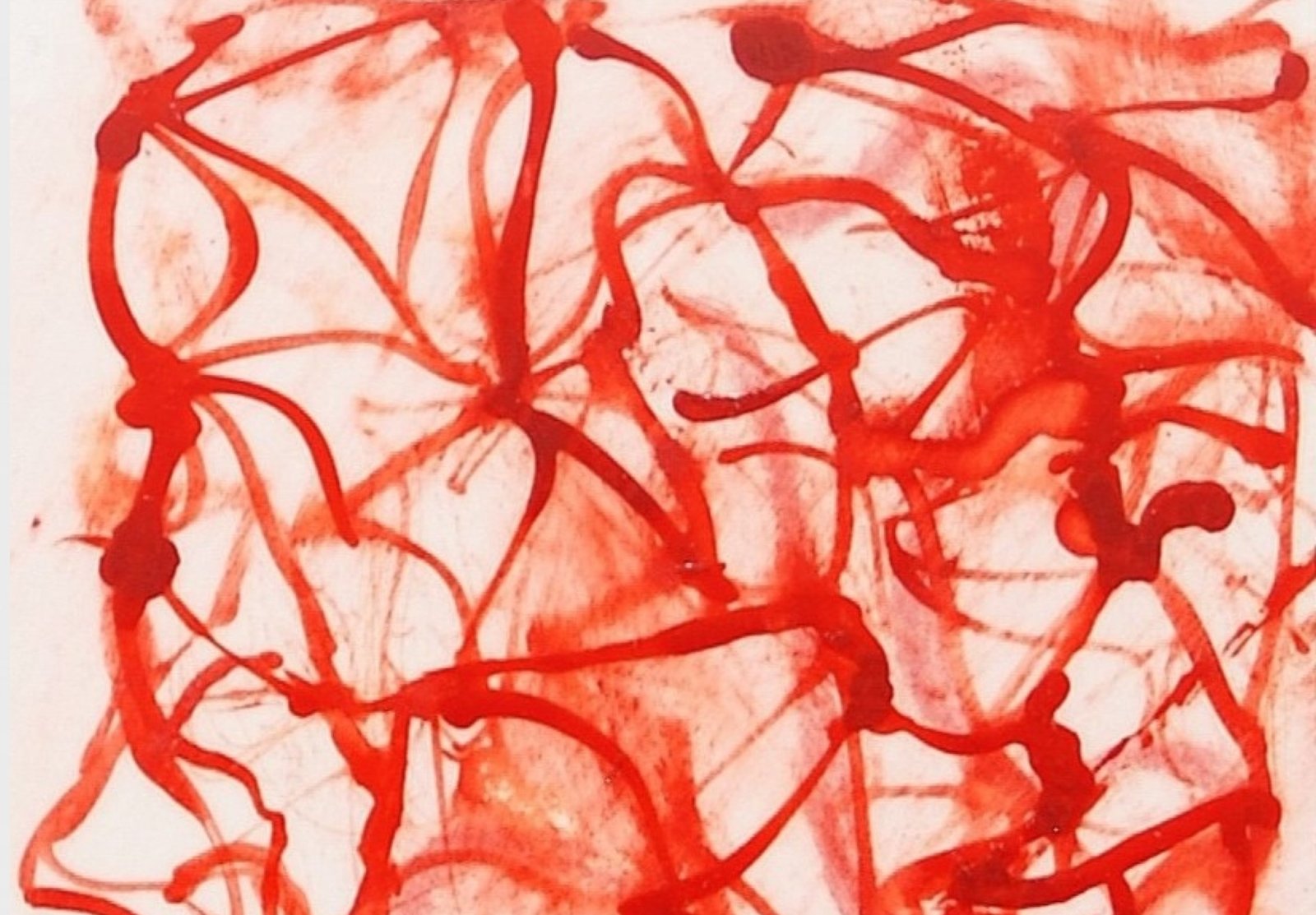
I’m always interested in seeing how far I can push an image, however, I’m more interested in striking a balance between these forms that can morph and change in intriguing ways. Whether a figure is legible or not is less of a concern than finding a surprising composition that introduces a strong psychological component to the works. In the more abstract series, such as the Vermillion Sets, there is a metamorphosis, and a life cycle to the compositions that is, as you suggest, pushed to a point that the underlying image (in these it’s a pictogram) is no longer legible.
Are there particular constraints of drawing-line, paper, scale, monochrome or limited color—that you find especially productive for thinking through this abstract/figurative dialectic?
Yes, all of these that you mention are constraints that create a productive set of limitations to work with. Each series has its own set of constraints, and it is through working within these set limitations that the variability and permutations of line, form, and expression can be best realized, at least for me. As I’m working on my drawings, I’ll tack them up in succession on the studio wall as if for a presentation, so when I’m working on one, I’ll refer to the others and think about how I might want these to develop individually and as a group. I’ll often finish one then go back and scrape out and erase another and rework it differently as well, it’s all really intuitive.

Maxwell Stevens, “Untitled Drawing (Female Nude)”, 2011, ink on parchment over charcoal on paper (Fabriano), image 27 cm x 27 cm, paper 58.5 cm x 43 cm, courtesy Galleria Tilde, Palermo
Could you describe your preferred drawing materials and supports at the moment, and what led you to them?
I’ve been mainly working with traditional drawing media, and I look to combine these materials in ways that do not currently exist in the history of drawing. If you look through any major museum archives, you will not find drawings similar to these. That is very important to me, that many of the seemingly limited basic materials of pencil, charcoal, ink, and paper can be used innovatively, and combined in unexpected ways, thereby directly relating to the rich, antiquated practices of the past and yet at the same time present something that is entirely new and contemporary. For my paper, I prefer a mouldmade 100% cotton that is extremely archival and lightfast as the surface for my charcoal or pastel figurative drawing, which I then overlay with an Italian parchment paper which is typically a writing surface for calligraphy, or clear drafting vellum, and on this I draw with ink and brush, as well as technical pens.
Many of your painted works are described as “multi-layered,” combining photorealist imagery with gestural abstractions. Do your drawings also unfold in layers, or is their temporality different?
Yes, the drawings are executed in distinct layers similar to the paintings.
How important is erasure, revision, or over-drawing in your works on paper? Do you treat corrections as a trace to be preserved, or something to be concealed?
Many of these drawings are palimpsests. This is a crucial aspect of the drawings, and the revisions and erasures happen very quickly in succession with the various layers of linework. Some drawings will go through numerous revisions where many different compositions and designs are erased out almost completely and then suddenly, I redraw a design and everything falls into place. I’m not too concerned about all of the various small traces and markings that subsequently remain, because they tend to introduce notes that enrich the entire composition. I’m often curious about these various markings because there’s an unintentional aspect to the pentimenti that compliments intention. Rather than concealing, I feel like this allows greater transparency and a window into my process.
Do you ever work directly from photographs or digital images when drawing, or is observation and memory more central?
My early training in life drawing is still the foundation for all of my figurative work, even when referring to images, so it really is a combination of observation, memory, and technique.
How do you navigate scale in drawing? Are these works conceived as intimate, close-viewed objects, or do you also think of them architecturally, in relation to the wall and to the body of the viewer?
I consider them in both of these ways. Taken individually, each drawing presents its own intimate reality, and for me this smaller scale in relation to my paintings is intended for very close viewing. They can be presented on a wall individually or hung in a group of 3 or 5 for instance, but also as an album that lays flat. As I mentioned earlier however, I work in sets of anywhere from 5 to 50 drawings which are identical in scale and format. So, when they are displayed as an entire group, sometimes as a grid, then there becomes a natural relationship to the architecture of the space.

Maxwell Stevens, “Untitled Drawing (Nude Couple)”, 2011, ink on parchment over charcoal on paper (Fabriano), image 27 cm x 27 cm, paper 58.5 cm x 43 cm, courtesy Galleria Tilde, Palermo
To what extent do you experience drawing as a form of thinking—almost a notational system for processing perception, memory, or emotion?
Drawing visually processes our thinking in real time, much like writing, except that instead of words you are working with lines, contours, signs, and symbols. One of the recurring motifs in my linework are repeating curvilinear lines and edges, which are based upon the abstract brushstrokes and smears in my paintings, so there is a compositional notation going on, but in drawing these shapes repeatedly and building improvisational configurations out of them they become something else entirely.
Are there drawings in your archive that you would describe as “scores” or “scripts” for later paintings, even if they remain complete works in their own right?
Yes, there several drawings in which there are corresponding paintings, however, I prefer to allow them to be differentiated in terms of the visual language of a more reductionist network of lines as opposed to the complexities of color and surface in an abstract overpainting.
Do you keep distinct categories in the studio—such as studies, sketches, diagrams, finished drawings—or are these boundaries deliberately blurred?
There is certainly a distinction in my studio between these drawings and sketchbook studies, notational diagrams, etc., which are sometimes simply functional. As an activity, I’m constantly drawing, the works we are discussing are more developed and have a certain amount of time invested in them much like a painting.
When you return to an older drawing years later, what kind of information do you find in it? Does it still function as a live proposition, or does it become more of an historical document of a previous self?
I recently opened a box of nudes from several years ago, and I was surprised by how resolved they were. When I was working on them, the process seemed so open-ended, and I always felt like there was a possibility that I might go back and rework a couple of them. But seeing them years later, they strike me as completely finished works. The information in them is surprising to me, because there are so many inflections of line and surface, and intermingling of the figure with these abstract lines that only exist in each specific work. Some of these seem like everything fell into the right place, but it’s not the sort of process where that can be planned.

Maxwell Stevens, “Vermillion Set 3, No. 7”, 2011, ink on vellum over pastel on paper (Fabriano), image 12.5 cm x 10.25 cm, paper 38.5 cm x 29.5 cm, courtesy Björn Ressle and the artist
Your paintings have been discussed in terms of seasons, autobiography, and everyday scenes. How do your drawings register time and narrative—are they fragments of larger stories, or self-contained moments?
Time in relation to art is a subject that is absolutely fascinating to me, and I’m convinced there is a plasticity to time itself, not simply our sense of time, that we experience more deeply when creating and viewing art. Alan Lightman’s novel “Einstein’s Dreams” plays with various notions of time much in the way visual art does, and this book was always a favorite of mine. I don’t think drawings and paintings merely contain singular moments in the way photographs do, rather the time invested in their making becomes preserved within each image, like a vessel. This is why I think visual art is so alive. Even as self-contained moments, the drawings are always strewn together by a variety of common threads—the time and place they were made, their shared subject matter, visual language, stylistic appearance, etc. Each piece is a sort of time capsule, so to speak. So, each series of mine might be seen as a fragmented narrative, in the same way our lives become fragmented narratives. Even in the drawings that are more purely abstract like the Vermillion Sets, there is a life cycle and a metamorphosis from image to image that seems to slow down time a bit. The drawings also present a theme that is autobiographical, and though not directly tied to the seasons, there is a direct relationship to nature, in the inks are ocean blues, leafy greens, vermillion, some of the movements take on the fluid linearity found on the contours of leaves and shells, and others the turbulent motions in water or the flickering quality of fire. An earlier series of drawings was all based on ocean waves, and to some extent I consider the Nudes as a current take on the theme of the figure in landscape, except that the landscape is now shaped by language and culture.
Do you use drawing to access memories or internal images that might never appear so directly in your paintings?
I actually painted an entire series of nudes that is quite explicit, many of which have been exhibited in New York and yes, I do think they are a way of accessing some internal memories and images, and dealing with them is some constructive and communicative way.
Are there particular recurring motifs in your drawings—gestures, spaces, bodies, fragments of landscape—that you see as anchors for longer narrative arcs across series?
Companionship is a theme that interests me, and interpersonal relationships are found throughout all of my work. This fragmentary aspect, of how an image appears when broken and fractured in some way, for whatever reason feels much more whole to me than a straightforward depiction. And I still don’t fully understand why this is. The process itself seems to anchor the narrative arc, even two unrelated nudes, when presented in this context, are bound together by the linear netting of the abstractions which move across the drawings, and it is almost as if a narrative exists where it wouldn’t otherwise, which is interesting to me.

Maxwell Stevens, “Vermillion Set 3, No. 8”, 2011, ink on vellum over pastel on paper (Fabriano), image 12.5 cm x 10.25 cm, paper 38.5 cm x 29.5 cm, courtesy Amy L. Brandt Art Collection
How consciously do you construct sequences of drawings? Do you plan them as cycles, or do connections only become visible later when you look back over the archive?
The sequencing is intentional, but how that sequencing works out is entirely unpredictable. So, part of my drawing process is to look at works in relation to one another, and I ask myself, how do these relate? Are they too similar, or are there subtle shifts and nuances that resonate? Since the works are executed individually though, I’m always surprised when I tack them up on the wall at how the sequencing differs from what I might have had in mind. Discovery is a key part of my drawing process, so by often working in cycles with 10 or more interrelated images, it allows me to discover more visual possibilities within each set.
Critics have described the surface of your paintings as a frontier between inner and outer spaces. Does this notion of the surface as a threshold also guide your drawings?
This duality of the picture plane, as well as this notion of the surface as a threshold is crucial to my approach and to understanding my drawings as well as my paintings.
When you lay down an abstract gesture over a more descriptive passage in drawing, how do you imagine the viewer’s position in relation to those overlapping spaces? Are we outside looking in, or already implicated within the field of the drawing?
I’m not generally thinking about the viewer in that moment, instead, when I’m drawing, I’m entirely focused on the execution as it develops. The abstraction happens extremely fast, so the alteration to the imagery, obscuration, and interaction with the figures occurs too quickly to consider the viewer at that stage. For me, the role of the artist, and the goal of my art, is to communicate emotionally to the viewer, and to elicit the imagination of that person through the work in a clear and direct way, since the viewer is already implicated within the field of the drawing.
Do you think of the paper support as a stable ground, or does drawing allow you to destabilize and fracture pictorial space more radically than in painting?
I use a heavyweight paper that is overlaid with a translucent sheet that is itself quite stable which allows for a great deal of scraping, erasing, and rewetting before becoming compromised. It almost has the quality of a very thin sheet of frosted glass that has been mounted, and there are drawings in which the topographical linework comes to a quick resolution with ease, and others where I have reworked and erased all of the linework numerous times prior to completion. Either way, the vellum and parchment serve functionally to separate the layers in a way that protects the figurative imagery beneath, whereas in my paintings there is oil paint layered directly on oil paint, and the image is not as protected against vigorous reworkings.

Maxwell Stevens, “Vermillion Set 3, No. 2”, 2011, ink on vellum over pastel on paper (Fabriano), image 12.5 cm x 10.25 cm, paper 38.5 cm x 29.5 cm, courtesy Björn Ressle and the artist
How does drawing allow you to approach psychological or emotional states that might be more difficult to articulate in painting?
Drawing is more immediate in certain ways and there is a stream of consciousness that occurs with it that is different than in painting. It is more limited than painting, and as an artist that’s very clear as you’re working, so I try to exploit those limitations. I’m not sure either is any more or less capable of approaching any given emotional or psychological state, rather they arrive at these areas differently.
Are there specific emotional registers—melancholy, tension, intimacy, disorientation—that drawing seems particularly suited to evoke in your hands?
The process of drawing is emotionally variable, lines, forms, and subject matter all take nuanced qualities of all sorts of emotions that seem to come out effortlessly and unconsciously, and I think how we see a drawing changes with our emotional state as well. There is a sort of heightened intensity to how melancholic, disorienting, or intimate an image can be that arrives naturally through the very act of drawing.
When you are working on a drawing, do you feel closer to the immediacy of gesture and touch, or to a more distanced, analytical mode of making?
Drawing is the most intimate of all the arts. As a process, drawing is very immediate for me, and that more analytical thought process comes afterwards, sometimes the next morning or days later after I’ve finished. Then I will begin to critique, and either leave a work as is, rework it in part or in its entirety, or destroy the artwork if it’s not worth saving.
From your perspective, what is the role of drawing within contemporary painting and within the broader visual arts discourse today?
I cannot speak to the role of drawing in anyone else’s work except my own. I see it as a discipline that is so pure in its expression and simplicity that it is like poetry. Some novelists write poetry, others don’t and vice versa. Drawing to me is the discipline that separates the greatest visual art and architecture from everything else. One of my favorite sculptors, Tony Cragg, begins everything with drawing. The late Frank Gehry sketched site plans for Maison Louis Vuitton on a napkin in an LA Chinese restaurant. Käthe Kollwitz left us with such a profound body of work, her drawings could easily be about the Gaza strip or Ukraine today. Drawing is important in so many ways, like one’s personal handwriting, it is an inimitable and an unmistakable trace of the human mind and hand. It is also elemental, and even if you’re working with the most traditional media, it can be unlimited. Your mind is the only limitation.
Do you sense that drawing is still often treated as secondary or preparatory in the market and in institutions, or have you noticed a shift in how works on paper are valued and discussed?
Major institutions such as The Metropolitan Museum of Art, the Getty Museum, and The Art Institute of Chicago have all consistently presented exquisite drawing exhibitions over the years and continue to do so. Generally speaking, I’m not thinking about the market in relation to drawing, but it is worth noting that a Michelangelo Sistine Chapel sketch brought $27 Million recently and a small Rembrandt drawing of a lion just drew $18 Million, so perhaps it is no longer viewed as secondary to collectors. Connoisseurs of painting understand the importance of drawing.
How do you see your own drawings dialoguing with the history of drawing—from Old Masters’ studies to twentieth-century abstraction and contemporary practices?
My drawing practice developed out of an interest in innovation while using the simplest materials available. Our contemporary condition is fragmented, this is something I experience, just as others do, so I cannot approach traditional figure drawing in the same idealistic way an Old Master could, because I see things differently. Nor can I take a purely abstract approach like Franz Kline or Mark Tobey, because I’m not capable of being idealistic about abstraction either. My work recontextualizes abstraction and figuration simultaneously in an effort to create something new that I can believe in, a hybridized approach that speaks to a contemporary audience and the contemporary condition.

Maxwell Stevens, “Vermillion Set 3, No. 10”, 2011, ink on vellum over pastel on paper (Fabriano), image 12.5 cm x 10.25 cm, paper 38.5 cm x 29.5 cm, courtesy Björn Ressle and the artist
If you were to articulate a “theory of drawing” emerging from your own work, what would its key principles or questions be?
I’ve honestly never thought about articulating a “theory of drawing” but there is something to the overdrawing of images with abstraction that creates a different spatial dimension and heightened emotional expression than what has existed in previous eras. Insofar as realism and the European tradition reached a level of objective perfection and understanding of presenting three-dimensional forms and spaces that still defines realism today, and Abstract Expressionism opened up an entirely new relationship to space that was at once insistent on the flatness of the plane and the art object as a vessel for raw emotion, I think of my work as navigating the emotional and psychological terrain expressively while holding firm to a sort of elemental reality in what is depicted with respect to the materials themselves, while exploring a hybrid space open to actuality and imagination that speaks to the contemporary fragmented self. Fragmented by history, language, body politics, interpersonal relationships, technology, social discord, etc., and that by layering these aspects of abstract form over observational reality we can come closer to accurately reflecting the experience of what it is to be human at this time.
Are there directions in drawing that you have not yet explored—perhaps in terms of scale, installation, or collaboration—that you would like to pursue?
I’m curious to see how some of my recent imagery might translate into drawing, and in exhibiting alongside other contemporary painters who maintain a commitment to the practice within their own work. And at this point I would be very interested in mounting a presentation devoted exclusively to the drawings as a solo project as well, in a way that would traverse the developments in my approach over the years.
How do you imagine the future of this drawing archive? Do you foresee it evolving into books, exhibitions, or other formats beyond Instagram?
Yes, all of the above. I’m currently discussing forthcoming drawing projects with Galleria Tilde in Palermo, who I have been working with for several years now, and this will encompass small edition book publications as well as exhibitions devoted exclusively to my drawings.
Finally, if a viewer were to encounter your drawings before ever seeing your paintings, what would you hope they understand or feel about your practice from these works on paper alone?
That there are deeply connective aspects to our lives and our relationship to the world that go far beyond any particular culture.
Info:
For additional information regarding the drawings of Maxwell Stevens, please contact Galleria Tilde, Palermo at info@galleriatilde.it.
instagram.com/maxwellstevensdrawings

Andrea García Casal is an art historian specializing in international contemporary art. She holds two master’s degrees, including one in Gender and Diversity, which has been fundamental to her development and enables her to apply a critical and gender-based perspective across different fields of knowledge. She combines her work in the cultural sector with writing on contemporary art and art history, as well as curating exhibitions, serving as a member of art juries, and delivering lectures. She is also the director of La écfrasis de Miss Goethe, where she publishes theoretical texts on contemporary artists from around the world.
[ad_2]
Source link