[ad_1]
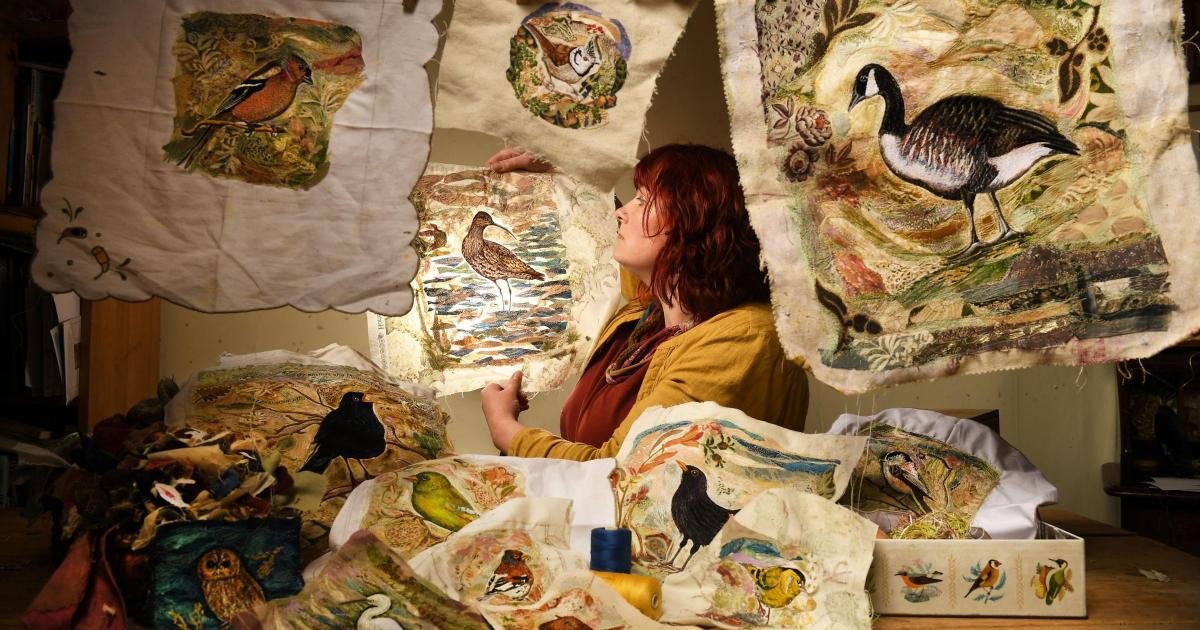
Textile artist Chloe Morter combines embroidery, collage and found fabrics to create richly textured celebrations of birds and nature. Her work is shaped by a bucolic childhood spent in an old cottage in the Mid Devon village of Culmstock, raised by parents with deep connections to nature. Chloe’s father introduced her to the joy of birdwatching whilst her artist mother taught her about flowers. Chloe says: ‘We did lots of walking, along the River Culm, at nearby Beacon and Hackpen. Dad has always had so much knowledge about the world around us. He worked as a mechanical engineer and always found relaxation in nature.’
From a young age she enjoyed art; the quiet process of drawing and hobby crafting, but for many years Chloe was far more interested in academic studies. ‘I loved research and history. I took a history of art and architecture degree in Manchester, appreciating the chance to scrutinise the colours, textures and patterns of different eras and artists, like the Italian Renaissance and William Morris.’

She says at one point she thought of becoming a teacher; especially after working as an art technician at Richard Huish College. ‘But like many people in their early twenties, I didn’t know which direction I wanted to go in.’ So instead, she started selling her craft items – although her intention then was not to make a living. ‘I was playing at art really, making funny little mirrors and bowls to sell at mediocre craft fairs.’
Chloe first came into contact with the potential of embroidery art when she joined a Honiton business supplying school book bags and corporate branding.
‘They’d bought an embroidery machine and needed someone to run it. I taught myself how to use the machine and learnt to work with design software. It gave me confidence in production and design skills, as well as interacting with clients. By the time I left in 2015, I knew I wanted to produce my own designs, using the capabilities of an embroidery machine to express my love of wildlife, especially birds.’

Chloe’s methodology is highly intricate. ‘With the machine I use three dimensional techniques like quilted patterns to create a feather-like look. But this is quite blocky, so I then add free motion embroidery – it’s a bit like sketching with a pencil over paint. Then I hand-stitch. So that’s three types of sewing that work together to bring texture and life to a piece.’
Chloe takes inspiration for her designs from the world around. ‘When I’m walking with my dog Flo, I often see a movement and spot a bird, like a nuthatch. It’s a lovely moment and I start thinking what I can do with it. I research, look at photos online, and come up with a pose. Then I analyse how the feathers sit and break the bird down into sections, thinking about stitch direction and colour, how to suggest, for example, the iridescence of a magpie. Wider stitches give a sense of structure, satin stitches shape the tail feathers, while the body is always worked in a fill stitch.’
Chloe creates her design with software before transferring it to the fabric base, which might be heavy duty linen or recycled cotton pillowcases. She runs the design on the embroidery machine; this can now be used time and again. But each one of Chloe’s pieces is different due to her very special collage process.
‘Embroidery gives me the structure, and my collage work I think of as a response to it. The beauty of collage is that if something doesn’t quite work, I can take if off – or add another layer.’

She shows me a heap of different fabrics she’s found in charity shops or antique shops, or which have been given to her by friends. ‘I’m obsessive about different fabrics. I have really old lace, discoloured Victorian silk, and I just love patterned fabrics.’
Chloe also uses handmade paper, bits of old print and dyes to create the unique look of a piece. ‘I’ve even repurposed my wedding dress, it’s a green shot silk with two tones, perfect for a watery background. And some of my mum’s patchwork skirt from the 1970s features in my nuthatch design.’
It strikes me that Chloe’s way of working draws on both the engineering and artistic influences from her parents: how she carefully scrutinises a subject to get the initial design right, before letting rip with bohemian creativity as she rifles through her piles of materials to find something to give the perfect effect. Her work is always evolving. ‘I used to try to create realistic backgrounds of trees and landscapes, but now, while the main subject has realism, the background is more of a vague impression. Sometimes a little bonkers!’

She’s also moving away from framed artwork, creating hangings instead, such as one featuring a thrush, which has a flavour of the Medieval era. Chloe has recently found inspiration from 1700s artist Mary Delaney, known for her collages of wildflowers on black backgrounds.
With her designs celebrating nature, it comes as no surprise that Chloe is focused on the ecological impact of her work.
‘The thought behind creating hangings stems from a desire to use less new material. And the old fabrics I use, they already exist. I know I’m not being wasteful, instead reusing what’s already there and keeping materials out of landfill.’

She shows me a huge work that she created out of an existing Jacobean-style embroidery that had been partially stitched, possibly for use as a fire screen. ‘It was unfinished and there was lots of damage. I thought, I’ll make this into something that both celebrates what it was and also renews it.’
She stitched into the damaged sections lines of poetry and butterflies she’s seen out on her countryside walks. ‘I’m interested in doing more of this type of work, it’s a type of art restoration. It gives new life to pieces that would either be hidden in a drawer or just thrown out.’

I ask which are her favourite subjects, a tricky question as she loves all birds. ‘Maybe blackbirds and wrens. One of my designs is a plump wren. I think it combines an old-fashioned look with a modern twist. It’s popular with my customers.’
Making a living from this type of intensive creative work is always going to be a challenge. As well as selling online, Chloe exhibits at many craft fairs and shows and is thrilled this year to have been selected for Craft Festival at Bovey Tracey. ‘For me this is a huge thing.’
She acknowledges that her work is evolving, growing, changing and indeed, improving. ‘For years I struggled with imposter syndrome, but I now have faith in myself.’ As well she should, having been chosen in 2025 as one of Country Living’s top 40 artisans nationally.
In my home I have a treasured piece of Chloe’s work, a delightful, chirpy blackbird, one of my favourite British birds. It makes me smile every time I look at it, as I’m sure the artist intended. .
chloemorterdesign.co.uk
[ad_2]
Source link