[ad_1]
Updated ,first published
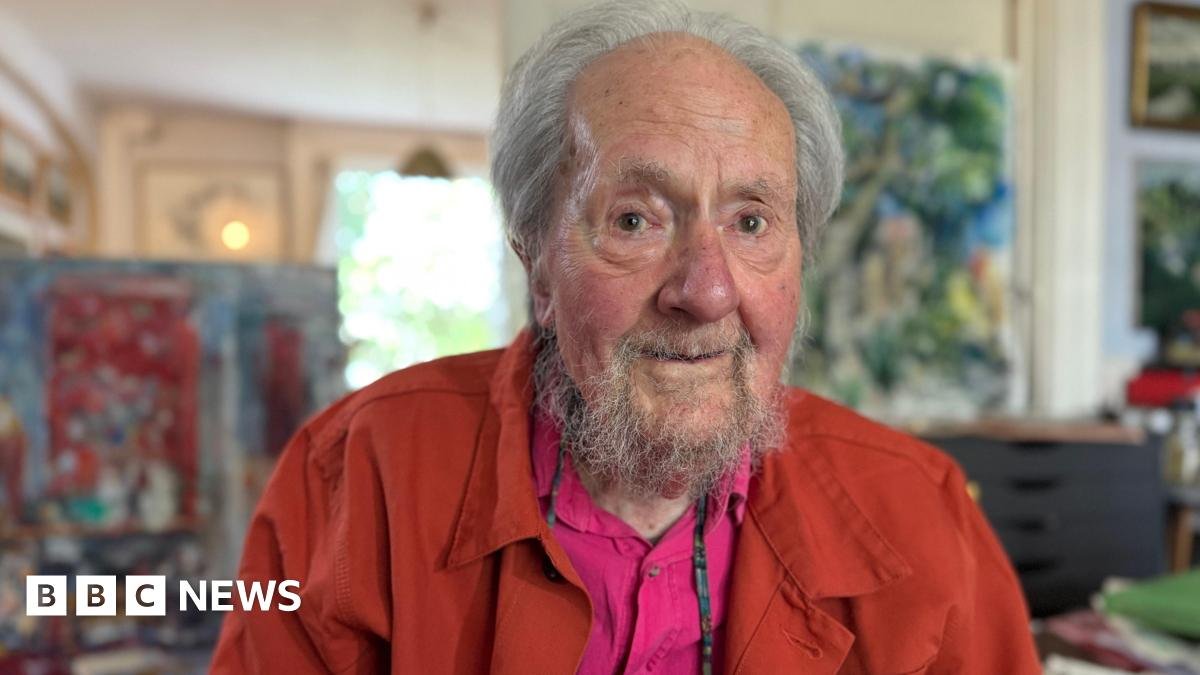
Melbourne artist Richard Lewer paints an occasional series called Richard’s Disasters, A True Story. They are vignettes from his personal life: girlfriend breakups, a spider bite and a near drowning in rough surf near his home town of Auckland. There was even his chagrin at a major arts award night when he wore a green parka among a sea of black-tie guests.
Lewer, who admits to being accident-prone, might be rethinking a new series of highlights after he was awarded this year’s Archibald Prize for a portrait of Indigenous artist Iluwanti Ken.
“I just have many disasters, probably like lots of people, but I tend to document mine. They are humorous, they’re funny, but kind of tragic,” he said. “Documenting is important to me, but the Archibald is definitely not a disaster. But who knows? I might end up tripping on something tonight.”
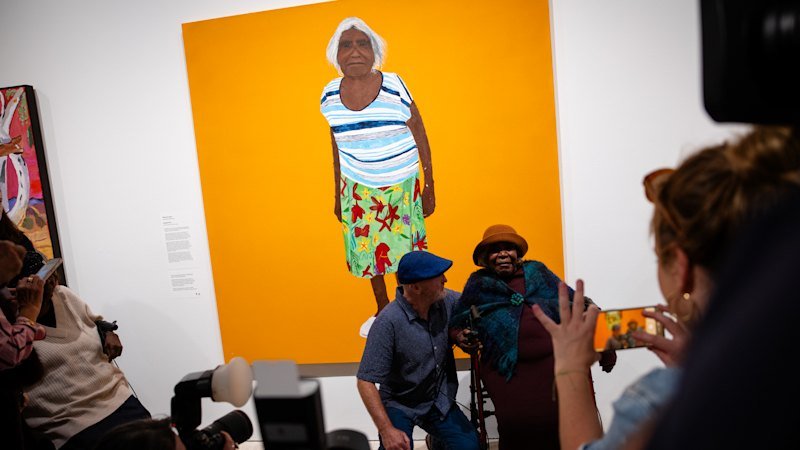
Lewer’s portrait of Ken was announced the winner of the $100,000 prize at the Art Gallery of NSW on Friday, selected unanimously by gallery trustees from a near-record 1034 entries and 59 finalists.
Accepting the award, Lewer said he was “deeply humbled” to win, and his intention had always been to bring recognition to the work of his subject, a Pitjantjatjara elder and artist known for her ink drawings of mother eagles hunting.
“It’s a really proud moment. When I heard, I was shocked to be honest because you never know how things are going to go,” Lewer said. “Like, I painted other paintings that I thought were really great, and they haven’t necessarily won. I don’t know, maybe it’s the right painting at the right time.
“The best thing about winning this award is I’ll never be referred to as Richard Lewer, sixth or seventh-time finalist of the Archibald Prize, which is good because I was kind of sick of it.”
New Zealand-born Lewer’s art spans painting, drawing, animation and video. He studied at the Elam School of Fine Arts in Auckland and the Victorian College of the Arts in Melbourne before becoming a fixture in the Australian art scene.
Lewer is no stranger to the Art Gallery of NSW; in 2022, he documented the construction workers behind its Sydney Modern project. And in 2024, he reimagined the Adam and Eve story in 12 paintings for the National Gallery of Victoria’s Triennial. He’s just finished an animation and a series of paintings about dementia for the National Gallery of Australia that will tour Australia for four years.
He paints, he says, to heal himself, and “that’s never going to go away”. With his win he plans to build a studio for himself with dual-cycle airconditioning. “I know where I am going. I know I have to work hard, and I’ll be back painting tomorrow.”
The Archibald, regarded as Australia’s most prestigious portrait prize, is awarded to the best portrait of a person “distinguished in art, letters, science or politics” painted by an Australian resident. Entries must be painted in the past year and from life, with artists meeting their subjects face-to-face for at least one sitting.
Lewer travelled to the Anangu Pitjantjatjara Yankunytjatjara (APY) Lands of South Australia last November for the sitting, the painting the result of several conversations with Ken. “That’s how I paint,” he says, “it’s building up a story.”
Ken is featured larger than life, against a background of solid ochre yellow depicting the heat of the desert. Flecks of paint on Ken’s arm suggest her life as a working artist, as if she has just stepped away from the studio.
Alongside the Archibald, the $50,000 Wynne prize for landscape painting and figurative sculpture was awarded on Friday to Gaypalani Wanambi for a large, double-sided work detailing the songlines of the Marakulu clan and the ancestral honey hunter, Wuyal.
The $40,000 Sulman Prize for best subject painting, genre painting or mural project went to sentimental favourite Lucy Culliton for a painting of her greyhound, Toolah, one of nine rescue dogs she keeps.
Toolah is the “Mona Lisa of the art world”, according to Culliton. “Her eyes follow you around the room,” who was overwhelmed to finally land one of the big three prizes after being a finalist on multiple occasions.
“It’s a love-hate relationship with the Art Gallery of NSW and the trustees, I guess,” she said. “Because my painting might be hung, and then the following year, it’s not. So I feel that disappointment, then I don’t go in for a year, and then I forget, and then I go again.”
Culliton is a passionate advocate for animal rights and outspoken against conditions of greyhound racing.
“They’re beautiful dogs, and they don’t deserve to be in cages. They need couches,” she said. “Toolah is the prettiest of my dogs. She is a lovely blonde brindle. And she always sits in this chair. Every time I see her in that chair, I’ve got to paint her.”
Culliton’s only regret was that Toolah wasn’t on hand (or paw) to lap up the adulation at the art gallery.
“She’s very social, she loves people, and she would have loved to say woof to everyone,” she said. “She’ll get all the hugs and kisses when I get home.”
A near-record 2524 entries were received across the Archibald, Wynne and Sulman prizes this year, with an almost equal share between male and female artists.
A total of 42 per cent of Archibald finalists were painted by first-time nominees.
Artists again dominated as subjects, with five entering self-portraits and 14 submitting portraits of a fellow artist. Another 13 sitters came from stage and screen, eight were activists or advocates, six were from the world of music, five from fashion and design, and three from media and journalism.
From our partners
[ad_2]
Source link