


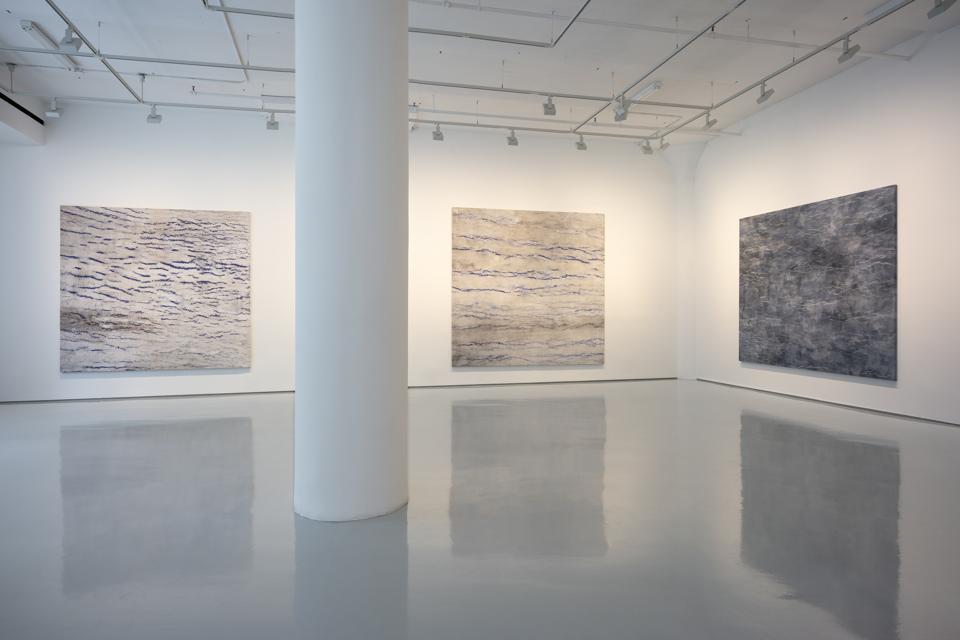
Installation view of ‘Kathleen Jacobs: Woods of Symbols’ on view at Fergus McCaffrey in New York through October 25
Fergus McCaffrey
Viewers may imagine a watery landscape or a stormy sky, drawn into the natural drama of a monumental canvas. The effect is far more visceral and connected to nature than a depiction of a typical landscape derived from observation, memory, or dreams. Born from a technique called frottage (taking a rubbing from an uneven surface to form the basis of a work of art), the paintings by Kathleen Jacobs embody the natural patterns and rhythms of tree bark, natural light, and weather, taking as long as three years to evolve through her intimate and inimitable creative process. These fervent paintings evoke myriad emotions, and provoke an exploration into the nuanced relationship between art and nature.
Literary, philosophical, aviatic, and geometric references commingle to enhance Jacobs’ visual narratives achieved through an artistic process that connects art and nature at intense physical and metaphysical levels. Twelve of her paintings produced in the woods surrounding The Mount, the Lenox, Massachusetts, home and gardens designed and built by writer Edith Wharton in 1902, are on view at Fergus McCaffrey in New York through October 25. Woods of Symbols is the artist’s second exhibition at Fergus McCaffrey’s 26th Street location.
A member of the “reverse Hudson River School” – a counterpoint to the 19th-century art movement that captured the splendor of uncultivated nature through the Romantic lens of the sublime – Jacobs was born (1958) and raised in Aspen, Colorado. She now lives and works in Massachusetts, laboring tirelessly for each large-scale museum-quality work. Jacobs wrapped canvases around tree trunks in the woods on The Mount property, leaving them exposed to the elements for months or even years.
Installation view of ‘Kathleen Jacobs: Woods of Symbols’ on view at Fergus McCaffrey in New York through October 25
Fergus McCaffrey
Renowned for her novels that exposed both scandals of upper-class New York society of the early 20th century – The Age of Innocence (1920) and The House of Mirth (1905) – as well as the plight of poor, rural New Englanders – Ethan Frome (1911) – it’s as if Wharton uncannily foreshadowed the depth and essence of Jacobs’ oeuvre in her book Italian Villas and Their Gardens (1904). Wharton envisioned gardens as architectural compositions just like houses and structures, in a series of outdoor rooms that elegantly co-exist with the natural landscape.
“In the blending of different elements, the subtle transition from the fixed and formal lines of art to the shifting and irregular lines of nature, and lastly, in the essential convenience and livableness of the garden, lies the fundamental secret of the old garden-magic,” Wharton wrote.
Further elevating her practice, Jacobs belongs to a small club of artist/aviators including Doug Wheeler and James Turrell, whose experiences of flying small aircraft have opened an inimitable perspective on atmosphere and the aesthetics of the sublime. Clouds, mountains, oceans, the wind, and other natural and weather phenomena appear differently to an artist/pilot like Jacobs than to landscape painters to typically stand or sit within the spaces they depict. Her acrobatic flight patterns further subvert her perspective of landscape to directly inform her abstract art.
Installation view of ‘Kathleen Jacobs: Woods of Symbols’ on view at Fergus McCaffrey in New York through October 25
Fergus McCaffrey
Jacobs’ works are simultaneously serene and visceral, commanding close inspection of the textures and marks that emerge from her painstaking technique.
McCaffrey, owner and director of the gallery he founded in 2006 to promote post-war and contemporary art, introduces a connection to Edmund Burke’s argument that the sublime is a powerful aesthetic experience, distinct from the delicate pleasure of beauty, and is primarily rooted in feelings of awe, terror, and danger. The Anglo-Irish politician, journalist and philosopher explored this idea in A Philosophical Enquiry into the Origin of Our Ideas of the Sublime and Beautiful (1757), borrowing from On the Sublime, attributed to the anonymous Greek rhetorician Longinus (also called “Pseudo-Longinus”). Burke re-contextualized the 1st-century A.D. work of literary criticism and aesthetics through the lens of Enlightenment-era aesthetics and psychological theory.
Installation view of ‘Kathleen Jacobs: Woods of Symbols’ on view at Fergus McCaffrey in New York through October 25
Fergus McCaffrey
Jacobs’ collaboration with the capriciousness of nature is also rooted in the geometry of aeronautical navigation. Unlike navigating on a flat map using Euclidean geometry, aeronautical navigation requires solving complex problems by calculating position and plotting courses on a model of the Earth as an ellipsoid, or a sphere. Jacobs likens the parameters of her canvases to the aeronautical box in which she flies aerobatic patterns. Moreover, her five-letter titles refer to satellite navigation waypoints and fixes for aircraft flying in clouds or at night, that offer passage to imaginary locations defined by the interception of magnetic vectors drawn from the earth’s poles.
Jacobs keeps handy a copy of Night Flight (Vol de nuit), a 1931 novel by French writer, poet, journalist and aviator Antoine de Saint-Exupéry (who died in a plane crash), which explores the challenges, dangers, and philosophical implications of early commercial aviation through the story of pilots and managers on one precarious night.
Installation view of ‘Kathleen Jacobs: Woods of Symbols’ on view at Fergus McCaffrey in New York through October 25
Fergus McCaffrey
While context informs and amplifies the viewing experience, Jacobs’ abstract paintings may be appreciated without these backdrops. Take time to explore the relationship between the linear marks and the monochromatic fields of color, how the lines evoke the horizon line or layers of sedimentary rock. Scrutinize the nuanced variations and the physical abnormalities embedded in the canvas. Contemplate how her tones of whites, blues, and yellows impact your mood and perception of space. As you follow her inherently physical creative journey, embark on your own voyage into composition, texture, and color, and embrace the sense of serenity that’s born from her Herculean efforts.


