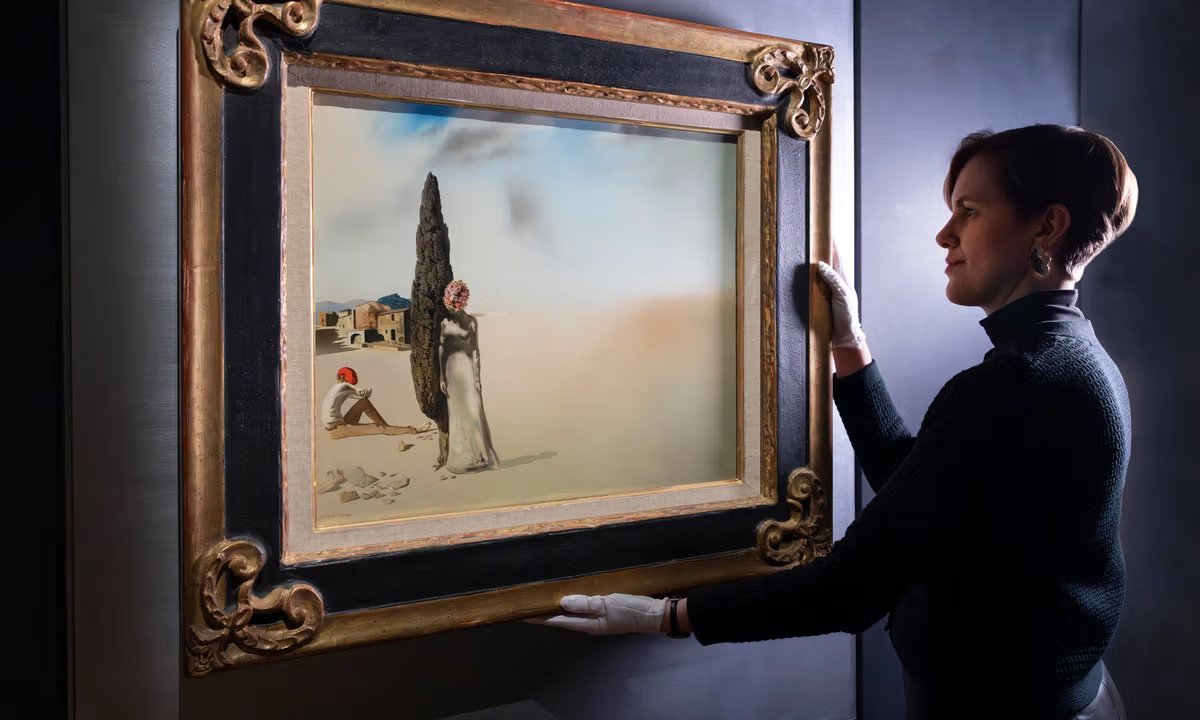
A painting by the Surrealist master Salvador Dalí not shown in the UK before will go on show in an exhibition dedicated to the famed Italian couturière Elsa Schiaparelli launching at the Victoria and Albert Museum (V&A) in London later this month (Schiaparelli: Fashion Becomes Art, 28 March-1 November).
The work, Necrophiliac Spring (1936) was owned by Schiaparelli and inspired one of her most famous creations, the Tears Dress (1938), which is adorned with trompe l’oeil rips and gashes. The exhibition curators also uncovered important research linked to the Dalí painting—a photograph by Mark Shaw published in Life magazine in November 1953, which shows the work on display in Schiaparelli’s home in Paris.
Necrophiliac Spring shows a flower-headed figure and a fisherman on a beach thought to be at Rosas near Dalí’s home village in Port Lligat on Spain’s Costa Brava. The absurdist painting was first shown in 1936 at an exhibition in New York and was last shown at the Fondation Beyeler in Basel in the 2011 exhibition Surrealism in Paris. The work, which was sold at Sotheby’s New York in 2012 for $16.3m, is on loan to the V&A show from a private collection.

Tears dress with veil, designed by Elsa Schiaparelli and Salvador Dalí (Summer 1938) Photo: © Emil Larsson
The Tears Dress meanwhile is in the V&A collection. “The dress is printed, and the rips in the veil have been carefully cut out and lined in pink and magenta. The trompe l’oeil tears print was specially designed by Schiaparelli’s friend, Dalí,” the V&A website says. Dalí’s flowery head resonated with Schiaparelli who, according to her memoir, planted seeds in her nose and mouth as a child so as to beautify herself.
“The Tears Dress is in a section in the centre of the exhibition, which really looks at this relationship that Schiaparelli had with artists such as Dalí, Jean Cocteau, Alberto Giacometti and Leonor Fini. She collaborated with a huge range of artists, not only to design garments but also designing buttons in the case of Giacometti and perfume bottles with Fini. The artists are contributing to the visual culture of Schiaparelli,” says Rosalind McKever, the V&A curator of paintings and drawings.
“Wonderful work has been done by fashion historians, but it’s been really interesting to come at Schiaparelli from [an art history] angle,” she adds. McKever outlines how Schiaparelli’s work was steeped in art and artists in an essay published during her time in residency at the Metropolitan Museum of Art in New York.
Schiaparelli looked to Modernist art movements throughout her career, a passion sparked by hearing the Futurism founder Filippo Tommaso Marinetti speak in Rome. “I can see a lot of Futurist influences in her ideology and interests, particularly in her early work in the late 1920s and early 1930s… she was dressing [aviator] Amy Johnson. She was interested in clothes that were aerodynamic,” McKever adds.
“Working with artists like Bebe Berard, Jean Cocteau, Salvador Dalí, [Marcel] Vertes, Van Dongen, and with photographers like Hoyningen Huene, [Horst P.] Horst, Cecil Beaton, and Man Ray gave one a sense of exhilaration,” wrote Schiaparelli in her 1954 biography, Shocking Life.

A portrait of Elsa Schiaparelli by Man Ray (1933) © 2025 Man Ray 2015 Trust; DACS, London; photo: Collection SFMOMA
The Italian trailblazer had a special affinity with Surrealism, fostering close links with Dalí who even made a pink version of his Mae West lips sofa for her salon and boutique at Place Vendome in Paris in the late 1930s (the idea for the sensuous settee came from the British patron Edward James).
Schiaparelli also organised the exhibition First Papers of Surrealism at the Coordinating Council of French Relief Societies in Manhattan in 1942. André Breton and Marcel Duchamp are credited with curating the exhibition in New York but it was Schiaparelli’s idea, says McKever.
“This is someone who was really, really involved in quite a hands-on way [with artists]. To be able to feature Necrophiliac Spring really gives a sense of how close she was to these artists in the show.” The exhibition features more than 400 items encompassing garments, accessories, jewellery, paintings, photographs and sculpture.