[ad_1]
In 1997, the Library of Congress discovered a collection of 10 unpublished plays by the Harlem Renaissance writer, anthropologist, folklorist and documentary filmmaker Zora Neale Hurston.
All of the plays had been submitted for copyright between 1925 and 1944 as unpublished plays, according to The Washington Post. The works, found by staff members in the Library’s Manuscript Division, revealed a “rich treasure chest of neglected creative items,” the Library reported at the time.
Of those 10 titles, one, “Spunk,” adapted in 1935 by the legendary author and playwright from her own short story of the same name, will be performed by the Yale Repertory Theater through Oct. 25.
Trivia Question
In 1973, an intrepid young writer managed to reinvigorate the career of Hurston. Who was it and how did she do it?
Gone to the Dogs
If you’re a dog lover, or a fan of The New Yorker and plan to be in the city, you might want to drop by the Museum of the Dog at 101 Park Ave.
The New Yorker has been celebrating its last 100 years with a series of events, special issues dedicated to its centenary. It’s been republishing the works of New Yorker cultural luminaries like Dorothy Parker Janet Flanner, A.J. Liebling and E.B. White for the last year, publishing issues in which its contemporary stable of writers reflect on the work of early contributors to the magazine, including Lillian Ross and Kenneth Tynan.
But, really, where would The New Yorker be, without all those wonderful dog covers? (And, yes, Fido, there is a book, “The New Yorker Book of Dog Cartoons” published by Penguin Random House in 1995.)
This fall, the AKC Museum of the Dog, whose website says it “preserves, interprets, and celebrates the role of dogs in society and educates the public about the human-canine bond” is exhibiting a private collection of 44 covers of The New Yorker related to dogs. The collection spans nearly the entire run of the magazine, with covers featuring the work of New Yorker notables such as Peter Arno, James Thurber, Charles Addams, and Mark Ulriksen.
The exhibition will include commentary on the specific covers with additional background material supplied by the staff and archives of The New Yorker, according to the museum. In addition to the role of dogs in the city, other themes will include dog shows, grooming, country life and sports. A section of covers addressing the Westminster Kennel Club’s annual dog show (whose 150th anniversary is coming up; make sure you book your grooming appointment).
The Museum of the Dog reopened in New York in 2019 after spending decades on the outskirts of St. Louis.
And for more dogs …
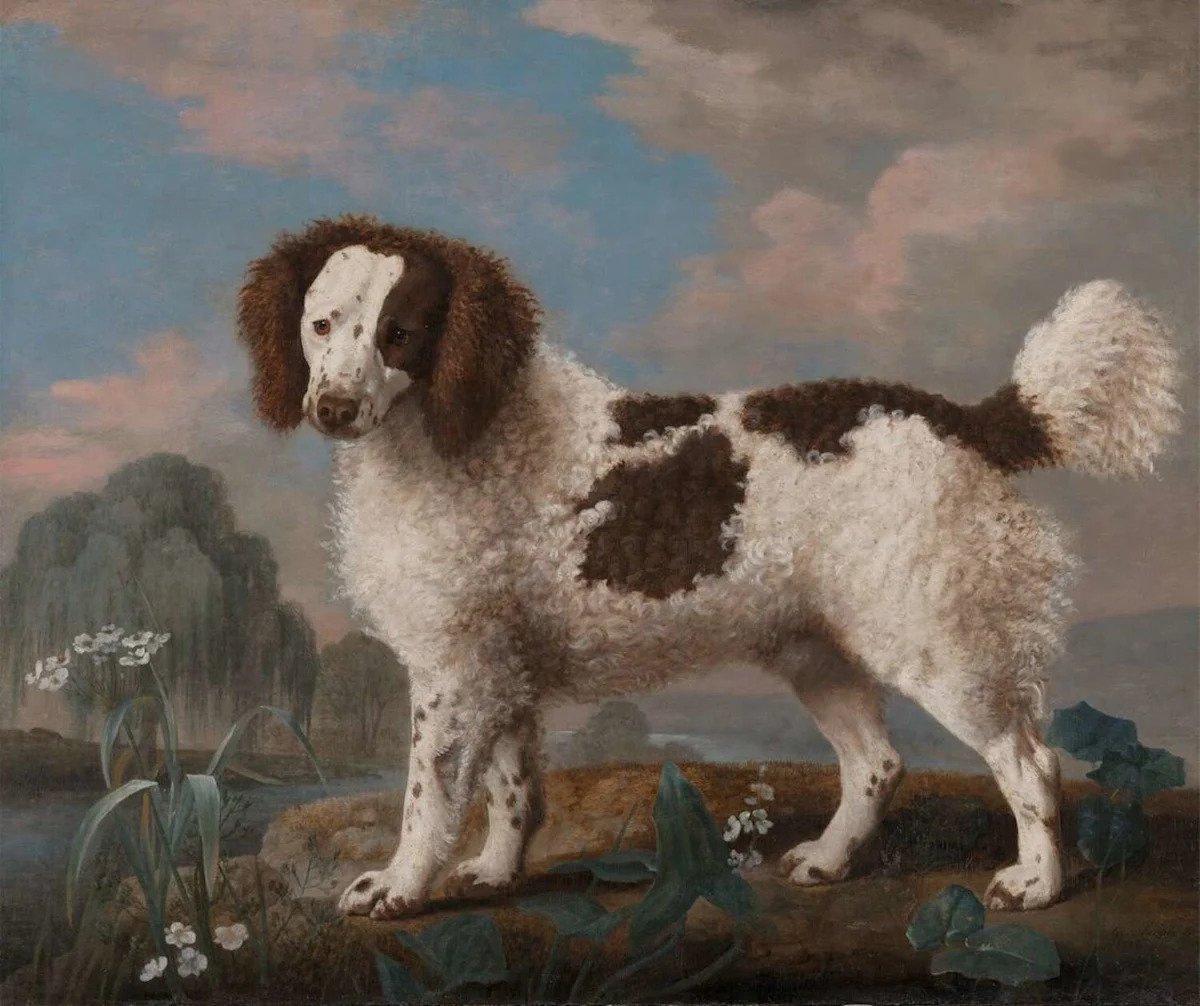
If you had to pick the best dog artist (in paint, anyway), you’d be hard-pressed to get anyone better than Sir Edwin Landseer, followed by George Stubbs and Rosa Bonheur. Stubbs and Landseer, both of whose works can be seen at the Yale Center for British Art, took dramatically different approaches to painting dogs. Stubbs (1724 –1806), an empiricist, takes a cooly analytic approach to dogs in works like “Water Spaniel,” at a time when painting dogs was seen as the lowest type of genre painting accepted by the Royal Academy.
Dogs, of course, were helpful to the hunt – a popular British diversion – and painting them could earn an artist a fair sum. By the time the slightly younger Landseer (1802–1873) began painting, his Victorian audiences warmed to his more sentimental portrayal of dogs, horses and even stags. As he once said, “I wish to bring out …. human feeling and human thought ― endurance, impudence, pain, joy and the rest ― through the medium of animal life.” It’s no wonder Queen Victoria, a devoted animal lover, admired Landseer and patronized him, calling him “the cleverest artist there is.” Visitors to London may recognize Landseer’s four iconic bronze lions that stand at the base of Nelson’s column in Trafalgar Square.
For evidence of Landseer’s capacity to make the stoniest among us weep, look for his “Old Shepherd’s Chief Mourner,” at the Metropolitan Museum of Art, which depicts a sheepdog with its snout resting on the shepherd’s coffin.
Trivia Answer
Alice Walker reinvigorated Hurston’s career when she wrote an essay about searching for her grave for Esquire in 1975.
This article originally published at CT and New York museums feature art about dogs and Hurston play performed at Yale Repertory Theatre.
[ad_2]
Source link