
[ad_1]
The legendary and archetypal artist Charles Winans served in the U.S. Air Force 433 Troop Carrier Wing as an airborne radar technician until his discharge in 1961, when he became a biker and hot-rodder, designed the logo for Los Bandidos 1% M.C., and gradually became deeply embedded in the sixties’ counterculture. He found his creative feet building winter wonderlands at Joske’s department store in San Antonio, and by 1966, began working with the experimental composer Philip Krumm performing innovative light shows in San Antonio, Texas at Mind’s Eye, the first psychedelic club in the South, which was owned by the boundary-breaking band 13th Floor Elevators. Performing as Light Sound Development (acronym LSD), they enhanced concerts by the Elevators and Rachel’s Children with layered dimensions of liquid light and sensual experience, using multiple overhead projectors, film, and a cleverly built mirror ball covered in dichromatic glass of their own invention. Krumm said Winans was “one of SA’s native geniuses.” Each of them used a hearse as their car, and Winans opened the first hippie gallery and headshop in San Antonio, which he named Grandma’s Tea House. Perfectly positioned as a cosmic cowboy, he began working as an artist, designing album covers for the Sir Douglas Quintet. His comic strips were published in underground magazines like Open City, the Southern California Oracle, and Yellow Dog – the latter featuring an especially bizarre and incomprehensible series of acid imagery.
Life at the Heart of Hippie Culture
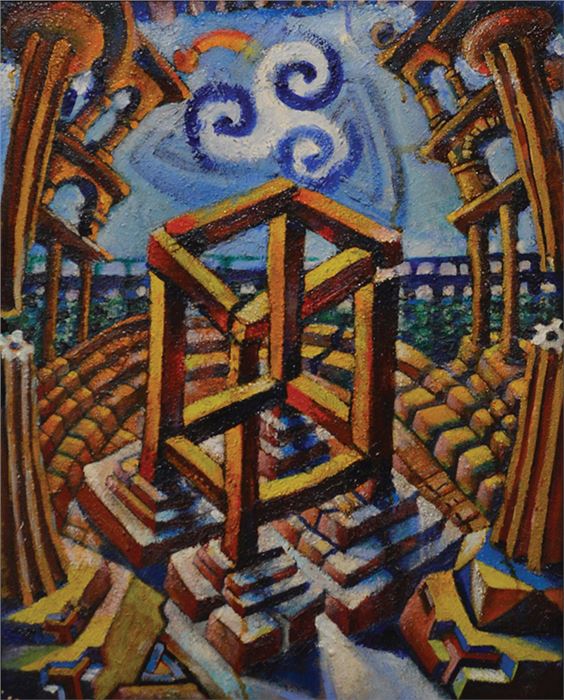
Charles Francis Winans, The Ben Ben Stone on the Altar of Illusion, Oil on canvas 21″ x 17″, 1998, Bravo Collection
In September 1967, Winans and his family traveled to find a new life in California, stopping for a while in Los Angeles at the log cabin once owned by Tom Mix on idyllic Laurel Canyon to stay with the Sir Douglas Quintet road manager Richard Williams. The vast log cabin was inhabited by a disorganized and communal chaos of dozens of bohemians, including the troupe of dancers and groupies later known as The GTOs (Girls Together Outrageously), the Fraternity of Man psychedelic rock band, and some of the staff of The Southern California Oracle alternative newspaper. During that halcyon stay at the heart of the hippie scene in Laurel Canyon, Winans’ chaotic sketchbooks turned from a stream of cartoons mocking the ignorance of redneck hippie-haters in Texas to a joyful flood of beautiful, surreal drawings scented with the naïve idealism of the movement. Beneath a sketch of a naked dancer, he wrote in the flow of streaming consciousness, “Ladies of the Canyon out my window. The log cabin – the grottos – the Rose Garden. The fount – waterfall I hooked up and fixed – the underground passageway neath the Eucalyptus. the dancers sprites lithe – nubile the pinkest the blondest the blackest the brownest the yellowness we were a blend all of us, we were called the Hollywood Hillbillies We Texicans Resolved to Resolve – Stop the War! Peace Now! LOVE – PEACE – JOY – PROTECT OUR EARTH. NON.EXPLOITATION Children of the oak-‘tree’” Infected with the optimism of the year he sketched an ink drawing of his first wife Carolyn Scriven naked and listening to the Velvet Underground and Nico, with a fan blowing air “like honey hot and heavy.” A surrealist drawing of a rectangular phonograph horn blared “lucky lucky lucky,” and Winans was happy, writing in Tejano vernacular, “Life can be so lucky, mijos.”
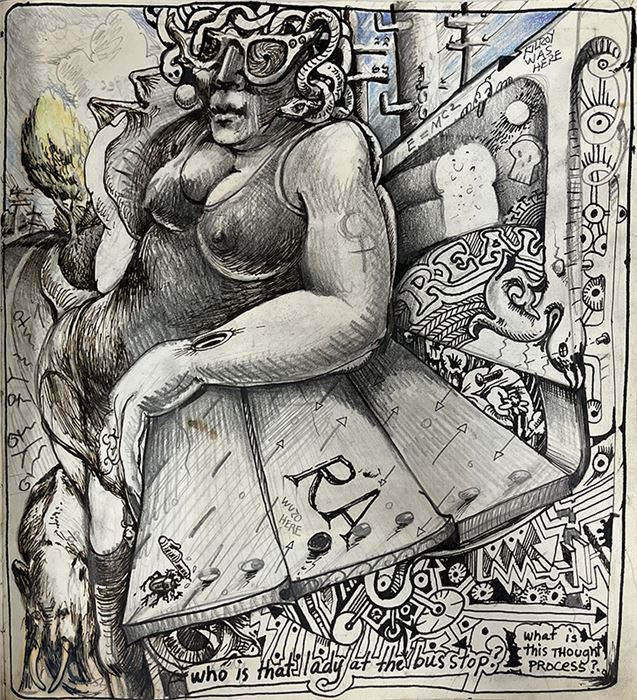 Charles Francis Winans, Gold Sketchbook, Collection of Cindy Reed
In the Web of the Manson Murders
Frank Zappa and the Mothers rented the log cabin, and Winans moved his family to Carmel, a beautiful art-oriented community on the golden coast of the sunny Monterey Peninsula, South-West of San Francisco, where he found himself on the brink of success as a designer and light-show artist for Chet Helms and the Family Dog. But darkness waited for him there. The Winans’ friendly new next-door-neighbor Louise James was a Peace and Freedom Party activist promoting American socialism, and a busy participant in the anti-war community then prominent on the peninsula. She was convinced she was being watched by the US government. Her pleasant welcome to the Winans family was a lie. James’ equally paranoid friend Mae Brussel lived a short walk away through the trees that scattered the hills there, and the two women began spying on Winans’ activities, believing they could discern a series of strange, nighttime meetings, dead-drops, and mysterious figures coming and going. Deceitful James befriended the Winans, playing games with the children and the part of good Carmel Valley Road neighbor. She told Brussel, Winans had been helped to move in by U.S. Army men using a military truck – a dubious claim. Mistrustful and frightened, the women decided Winans was a spy and he became a focus of their conspiratorial obsessions, and Brussel encouraged James to keep a close eye on him. In 1970, when the Manson murderers were arrested and newspapers filled with lurid stories of the hippie death cult, James convinced herself she had seen members of the Family at the house, and the Winans’ home was a safe house for the Helter-Skelter murderers. Hearing James’ fantasies fed Brussel’s paranoia. After a radio appearance on KLRB in 1971 gave her the opportunity to tell her theories about the Warren Commission she became a weekly guest, and was soon given her own show named, Dialogue: Conspiracy.
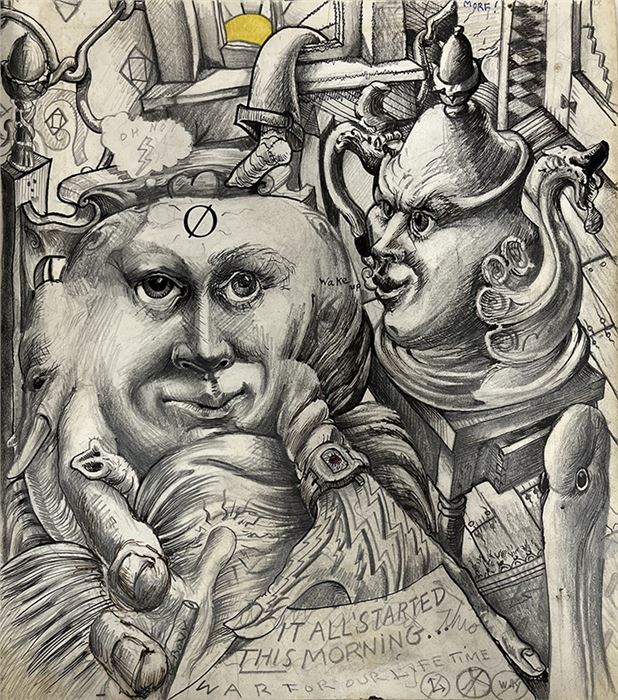 Charles Francis Winans, Page from the Gold Sketchbook, Collection of Cindy Reed
Her lies harmed Winans irreparably. His dreams of a golden future at the heart of hippie culture were shattered. After the end of the fantastic but unsustainable idealism of Laurel Canyon, he was struggling. A poignant sketchbook note reads, “January 1968 – we are now poor. Not just low on money but out of it and low on hope. No Jobs. No commissions. Why? I hitch-hike to S.F. to find work – Louise James and Mae Brussel my next-door neighbors are telling everyone in the area I am a CIA or FBI agent sent to spy on them. I am not very ‘popular’ with my peers.” On another page, he wrote an epitaph to himself, “Charles Francis Winans. Very Poor. Neutralized by Mae Brussel and Louise James, my neighbors the Pair a’ noids.” (sic)
He turned to art as a means of making a productive living, assisting in the Graphic Arts Department at the Monterey Peninsula College between 1969 and 1974, offering intaglio printing workshops at Carmel Graphics, and donating an etching to the museum. He created a mural for the Robert H. Down School in Pacific Grove and showed his paintings in monthly exhibits. He looked for practical opportunities to create positive change. He told curator Joseph Bravo he saw protestors outside the offices of Kaiser Aluminum and sent a foot-locker full of hippie artefacts to the board of directors, suggesting they send a representative to meet him if they wanted to understand the motivations driving the movement. Kaiser Aluminum Director of Publications Don Fabun responded and spent a week with Winans to learn about the counterculture, inspiring him to write a guide to it titled Children of Change which was illustrated by Winans. Ultimately, Fabun followed Winans’ advice to begin recycling aluminum soda cans and paying for the program with the small remuneration. It was a profitable relationship for Winans, who was paid well by Kaiser for his illustration work, and received a royalty check when his pictures were reprinted in the company’s book of news later in the year. More good fortune came when June Braucht, director of the Monterey Peninsula Museum of Art, bought four of his paintings, and he sold illustrations to the new Planet underground newspaper, published in San Francisco to tell the stories of the counterculture. He must have thought he was breaking free of James and Brussel’s lies.
[ad_2]
Source link