[ad_1]
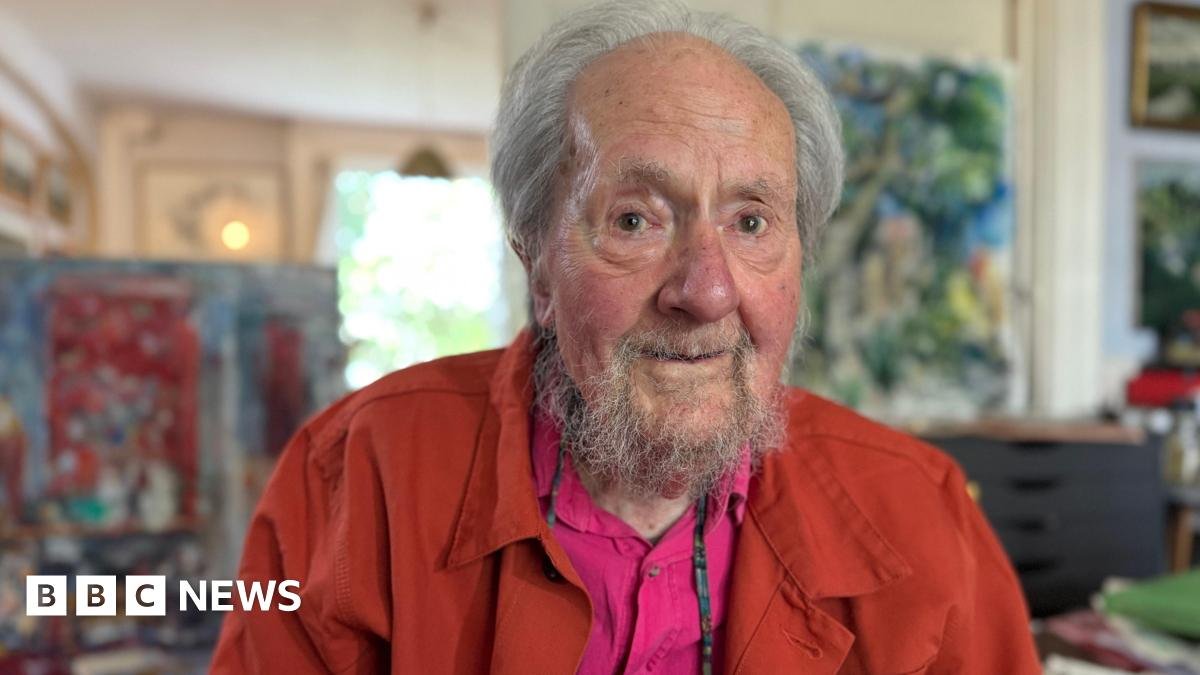
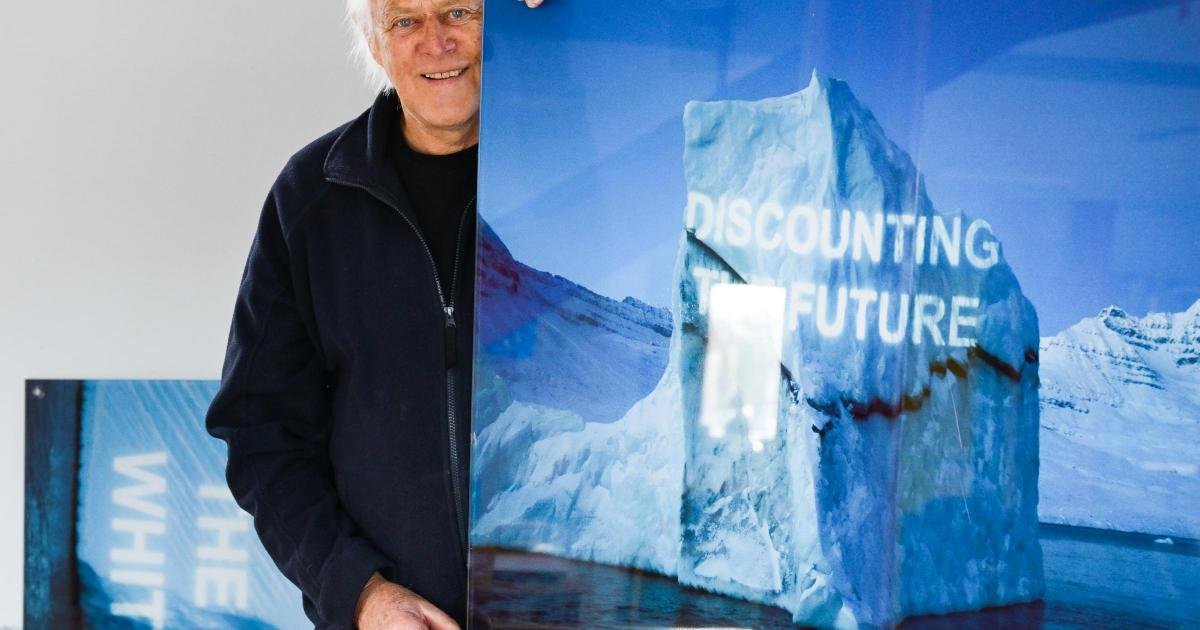
Propped against the wall of David Buckland’s studio in the Sydling Valley is a photograph of an Arctic iceberg, its side emblazoned with the words ‘Discounting the Future’ in capital letters. Big, bold and impossible to ignore, it pulls no punches. It also makes you wonder: ‘How on earth did he do that?’
‘It took the captain of the schooner Noorderlicht hours, looping round and round the iceberg, for us to video project the text and for me to get the right shot,’ answers Buckland, hauling the enormous glass print on to his workbench and tipping it to the light as if reacquainting himself with an old friend. ‘If that iceberg had rolled, it would have swamped the schooner and taken us all down with it.’
It’s lucky it didn’t, because otherwise he might not be standing here today – and Cape Farewell, the arts-climate organisation that he set up in 2001, would never have achieved what it has.
Over the past two decades, it has drawn some of the world’s most imaginative minds to the planet’s most remote regions, from early Arctic voyages to later expeditions in Greenland and, more recently, the Marshall Islands in the Pacific, now the focus of a major exhibition at the National Maritime Museum. The mission has always been simple: to bring together art and climate science in ways that spark fresh thinking.

Antony Gormley, Rachel Whiteread, the late composer Ryuichi Sakamoto and Ian McEwan – whose novel Solar was inspired by an Arctic voyage – all joined Cape Farewell’s 2005 expedition, as did composer Jonathan Dove, who has since gone on to write two climate operas. Not content with taking only writers and visual artists, in 2008 Buckland gathered a constellation of musicians for his ‘Disko Bay’ expedition, taking Jarvis Cocker, KT Tunstall, Martha Wainwright, Laurie Anderson and Feist up the west coast of Greenland in what sounds remarkably like a floating jam session.
It’s hard to fathom how one person could galvanise such a remarkable rollcall of talent, but Buckland is nothing if not dynamic, and it seems the musicians needed little persuading.
Today, though, both feet are firmly on Dorset soil rather than Arctic ice, and it’s swans, watercress and the quietly recovering ecosystems around his Sydling studio that occupy our conversation. We stand by the large picture window, taking in the wintry scene: a broad, low sweep of valley tufted with grasses; the cedar-clad ecological artists’ residence he built during Covid for writers, artists and creatives ‘wanting a little headspace’; an Anthony Caro sculpture; a lake; and Sydling Water, a chalk stream which, having grown up in a village nearby, is running as healthy as I’ve ever seen it.
It’s hard to believe that the cool, architect-designed space we’re standing in – now entirely encircled by water like a moored houseboat – was a trout farm five years ago, and before that served as a watercress farm. Buckland dashes off to find an old photograph and the transformation is miraculous. ‘When I got it, it was totally abandoned,’ he explains. ‘At its peak there were 28 concrete trout pens marching down the valley, serviced by a lattice of sluices and pumps. It was incredibly intensive and they were using huge amounts of antibiotics.’

Before that it was watercress. ‘This valley used to have five watercress farms,’ he continues, pointing to a bunch happily growing just outside his window. ‘Every morning the train would take all the watercress up to Bristol. Four of the commercial beds closed in the 1960s, as imported salads flooded British supermarkets.’
Cape Farewell’s Dorset HQ sits within a chain of organic farms all along the valley – holdings whose regenerative practices have coaxed wildlife back in abundance, drawing birders, river scientists and moth experts in their wake. For Buckland, who has spent decades witnessing the effects of ecosystems unravelling, this resurgence couldn’t be more welcome.
Birdlife has returned to the valley too – 54 species were counted this year – and then there’s his resident swans, which, as we step outside onto the deck, waddle one by one across from the lake, before splashing down in front of us for a late breakfast. ‘Last year they got bullied by Canadian geese and ended up moving away,’ Buckland explains, scattering some chicken feed pellets into the water to a frenzy of snapping beaks. ‘So this year, I made them a nest on the island with some straw and they’ve stayed. Whenever the Canadian geese came along, I used to go down and chase them off. Eventually, the swans realised I meant no harm, so they stayed and have had six cygnets, five of which have survived.’

Wildlife notwithstanding, it’s clear Buckland has a deep affection for this little corner of Dorset – his childhood home until the age of 15, when his family moved to Canada in the late 1960s after his father, a nuclear engineer, took a post abroad (his parents later returned to Dorset, buying a house in Sydling, his mother training in art at Bournemouth College and opening one of the county’s first art galleries in Dorchester). After completing his final year of school in Canada, Buckland earned a place at the London College of Printing, then Britain’s leading school for film and photography. Through the Seventies, Eighties and Nineties he forged a successful career as a photographer in London, Paris and New York and in 1999 presented a one-man show of digitally mastered portraits of performers at London’s National Portrait Gallery. Five books of photographs followed and more than 20 stage sets and costumes, which he designed for his partner, Dame Siobhan Davies, and for her dance company, as well as the Royal Ballet and Rambert Dance Company, among others.
As I ponder the scope of these achievements and a lifetime spent working on one incredible project after another, we step back inside and I ask Buckland what the turning point had been in his career – the moment he realised the climate was the story he needed to tell. ‘It actually came over breakfast beside the Grand Canal in Venice,’ he explains. ‘I’d just finished documenting overnight Anthony Caro’s The Last Judgement sculptures for the Biennale – 25 monumental works exploring sin, redemption and St Peter’s Gate – and was sitting there, feeling a little exhausted. I opened The Guardian and found this tiny piece about oceanographers who had just mathematically mapped the whole of the North Atlantic. As a sailor, I thought: that’s ridiculous. How on earth do you even do that?’

One enquiry led to another, and soon he was at the Hadley Centre in Exeter talking to climate modellers whose algorithms took months to run on Japanese supercomputers, and at Southampton’s National Oceanography Centre, working with oceanographers tracking shifting currents and warming seas.
‘They all said the same thing: “Why is nobody listening?” Back then, if you mentioned climate change people thought you were mad. The science was there, but it wasn’t landing.’
Well, thanks to Cape Farewell – and the artists, musicians and scientists that have joined Buckland on his expeditions – the message is now very much landing. Universities and institutions from London to California (and Sherborne Girls closer to home), have all held cross-curriculum exhibitions of his work. His approach, he says, shows that the arts can open minds in a way that raw facts alone rarely do.
‘Activists rattle the cage and make people think, and Greta Thunberg does that brilliantly, but they poke you, and people don’t like being poked,’ says Buckland. ‘What the arts do is seduce you. And people love to be seduced.

‘We’ve invented some terrifying things as humans that have led to the climate crises, but the good news is that we’ve also invented the technology to deal with them. The question is how fast we move, and I don’t think we’re doing it fast enough. People are already suffering, and it’s going to get bumpy. The only question is: how bumpy?’
Holding that thought – and feeling slightly unsettled by what we are leaving to our grandchildren – we wander across to the artists’ residence, pausing to take in the living arrangements and the vista down the valley from the deck: brittle in its wintry state, yet beautiful and unmistakably Dorset.
‘The Ice Age halted on the Dorset coast,’ says David, looking out towards the swans on the lake. ‘Dorset has been shaped mostly by grazing and natural processes, and it’s extraordinary. If you ever want to be somewhere where the climate really unwraps itself, this is probably the best place to be. It’s the most magical place on Earth.’.
Kõmij Mour Ijin/Our Life is Here runs at the National Maritime Museum in Greenwich until June 14 2026.
[ad_2]
Source link