[ad_1]
Early life
Alfred Lys Baldry was born in 1858, one of the six children of Alfred Baldry & Charlotte nee Whitehead. He was baptised at St Mary’s, Upton, a village near Torquay, on December 16, 1858. His parents had married there on June 4, 1851. In about 1865 the family moved to live in Bournemouth, where they had a house built in what is now Gervais Road.
Alfred Lys went up to Oxford University, where he studied art, then in 1877 was awarded a scholarship at the South Kensington School of Art. In 1880, Albert Moore, the renowned artist, invited Alfred to work with him. He did so for four years, developing a close working relationship and friendship with Moore.
At the time of the 1881 census, Alfred Lys was living with his father at 3, Holly Terrace, Chelsea, London. He began to exhibit his own figure paintings and landscapes in London and the provinces in the early 1880s. At that time he also became involved in the theatre, which is probably how he met his future wife.
Alfred Lys marries
On August 10, 1887, Alfred Lys married Annie Lilian Brocklehurst at All Saints Church in Fulham. Annie was a well-known actress with the stage name of Miss Lily Linfield. She had graduated originally in ballet, but then developed a career in comic opera. It was said that she “possessed musical as well as saltatorial ability, appearing in engagements at the halls as a singer and dancer, and in pantomime.”
After their marriage Alfred Lys and Annie worked together in the theatrical world. For example, in April 1889, Annie, still using her stage name, was producing, and acting in, a new comic opera ‘Faddimir’ at the Vaudaville Theatre, and her husband designed the seventeenth century Russian costumes.
Alfred & Annie had one son, Alfred Francis Hope Baldry, born in 1899.
Career change
In 1892 Alfred Lys received a commission which was to change the focus of his career. Montague Marks, the editor of Art Amateur, asked him to write an illustrated account of Albert Moore’s career. He then followed this with articles about Moore in other journals such as the Pall Mall Budget, Studio, Art Journal and the Old Water Colour Society Club.
Moore died in September 1893, when Alfred Lys collaborated with another of Moore’s pupils, Walford Graham Robertson, to put on an exhibition of 100 paintings and drawings by Moore. Held at the Goupil Gallery, this opened on January 22, 1894. Later that year Alfred Lys published a biography of Moore, which provides valuable information on Moore’s life and work, but avoids details of his private life.
Alfred Lys Baldry now became a prolific writer on contemporary art and artists, with regular reports in the national press featuring his work. He also continued to combine his love of art with his keen interest in the theatre, stage managing several notable productions. His name was often mentioned in ‘The Stage’ magazine, for example in March 1890 when it reported that at his home in West Kensington, he “was working on a portrait of the actress Alma Murray surrounded by at least 40 other oil and watercolours of land and seascapes”.
He must have been extremely shocked in November 1890 to read in the press of his ‘death by his own hand’. This report was swiftly rescinded by the press, which explained that the mistake was confusion with ’another artist Mr Harry Lister Baldry’!
In 1906 Alfred Lys exhibited at the Ryder Gallery in London 70 “notes and sketches in oil and watercolour, consisting of English landscape sketches and a few figure studies”.
The family move to Marlow
The Baldry’s decided to leave West Kensingon, London and move into the country. In 1911 they bought a large area of woodland in Marlow from the author Jerome K Jerome. This was not beside the river, but 200 hundred feet above the Thames at Marlow Common. At that time Marlow Common was something of an artists’ colony, with Dressler living at ‘Bovingdon’ and Jerome K Jerome at ‘Monks Corner’; they were then joined by Alfred Lys Baldry.
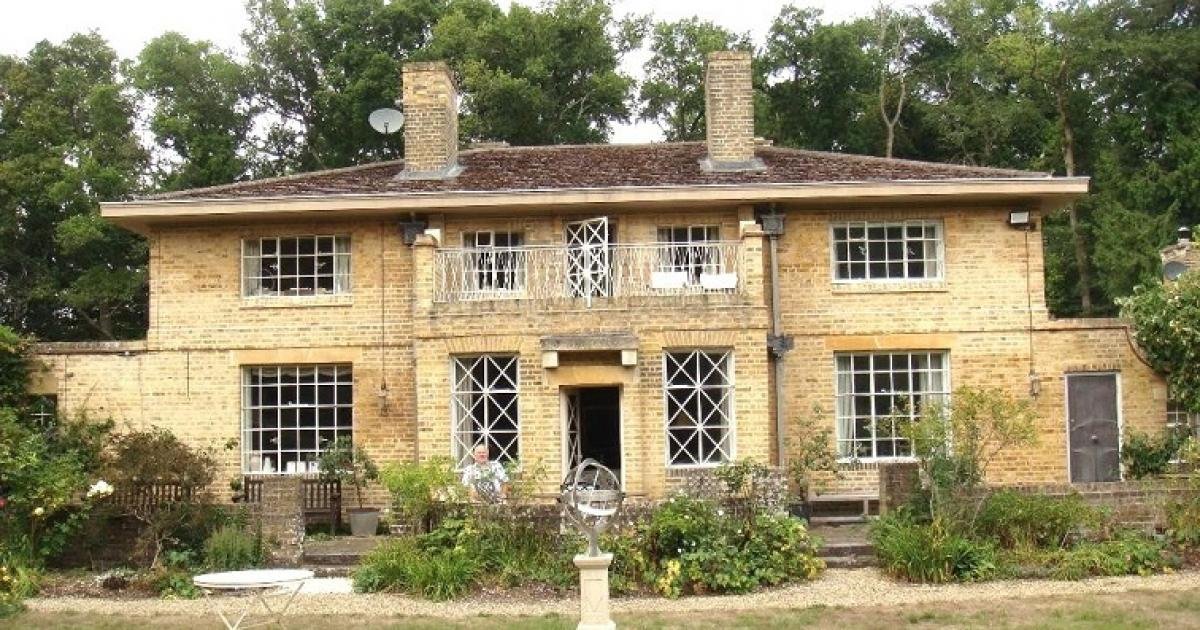
A clearing was made in the woodland and a large house built. This was designed by a young architect by the name of Algernon Winter Rose. Alfred Lys wanted a house that was “as modern and lasting in its building as it might be, which meant, among other things, fireproof floors and roof”. So the roof was concrete, therefore needed to be of low pitch, and covered with tiles. The building was “a simple mass of orange stock brick pleasantly relieved by some bricks of a light blue tint”. The front door was unusual, being of wood covered with lead-sheet, so never needed painting. There was a large garden, and a tennis court.
The family moved to their new home in 1912, which they named Wolmer Wood, and Alfred Lys and Annie remained living there for the rest of their days. Their son Alfred Francis was educated at Sir William Borlase school, about a mile from the house. from 1910-16. He joined the army during WW1 and became a 2nd Lieutenant with the Royal Engineers. His name appears on the Silver Badge Roll for June 18, 1918, meaning he was then unfit for war service at that time, probably because of wounds.
Alfred Lys continued to pursue his career as an artist and art-critic. In 1911, he wrote his first article on Philip de László, the Anglo-Hungarian painter known particularly for his portraits of royal and aristocratic personages, who had had a successful exhibition at Agnew’s earlier that year. He soon became de László’s firm friend and the only visitor outside the family allowed at the Ladbroke Gardens nursing home during the dark days of Laszlo’s internment.
He became art critic to “The Globe” for fifteen years and was London art critic for the “Birmingham Post” for nearly thirty years. He wrote several biographies of great painters such as Marcus Stone, Millais and G.H. Boughton, in addition to books on water-colour painting and modern mural decoration. Alfred Lys also contributed to the Encyclopaedia Britannica. He also continued his keen interest in the theatre, stage managing several notable productions.
Alfred Lys and Annie both became very involved in Marlow-life. He stage-managed several theatre productions at the Public Hall, such as “Robina in search of a husband”, in which his wife played a major part, in 1914. She was also a leading figure behind many plays produced by the Bovingdon Green WI. He was a subscriber to the First Marlow Troop Boy Scouts, and a great lover of the river like his father, who when completing his education at Cambridge had pulled the boat oar in the great Oxford & Cambridge boat race of 1849.
Alfred Lys became a well-recognised figure in Marlow, with his white beard and flowing cloak. One bookseller in London described him as a typical Christ figure for the Oberammergau Passion Play due to his sad intellectual face, large full eyes and lips, flowing jet black hair and beard.
He passed away at his home on May 18,1939, aged 80yrs. Many tributes were paid to him, but his funeral was private and he was buried in St Peter’s Churchyard in Bournemouth, where Mary Shelley is buried along with a cenotaph (marker for her husband Percy Bysshe Shelley). Annie died less than a year later on January 9, 1940 at a nursing home, “Greenlands” in Reading. She was also buried in Bournemouth.
Alfred Lys’s legacy
Alfred became better known for his work as an art critic and author rather than his paintings. He made many friends in the Art world during his life and he was said to be a great conservationist, which endeared him to so many people, ordinary or famous.
It seems that Alfred gifted many of his paintings and sketches during the last years of his life, many most likely to relatives. Some may never have been recorded. No paintings of local Marlow scenes have been located but several show scenes around his beloved Bournemouth.. Wycombe Museum has one, “The Spirit of Mischief” which was gifted in 1936.
Alfred was a renowned author of many books relating to Art and artists of his time, including “Contemporary Figure Painters”, “Millais,Masterpieces in Colour”and“The Wallace Collection at Hertford House”. One of his most famous books was “Albert Moore, His life and Works” which is still used for reference by art students today including “Mural Decoration” which is a classic in art literature.
[ad_2]
Source link