[ad_1]
‘Viollet-le-Duc Drawing Worlds’ at Bard Graduate Center

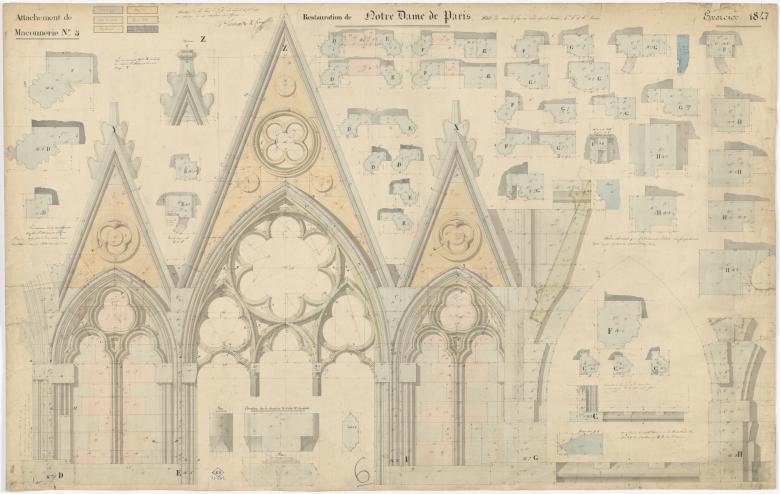
Jean-Baptiste-Antoine Lassus, Eugène- Emmanuel Viollet-le-Duc, and Émile Boeswillwald, Janvier; Lemaire et frères (contractors), southern choir aisle of Notre- Dame de Paris, shop drawing of the gables of the fourth, fifth, and sixth bays after the transept, 1847. India ink and wash on paper. (Médiathèque du patrimoine et de la photographie, Charenton-le-Pont, F/1996/83/389-37642.)
Viollet-le-Duc Drawing Worlds, on display at the Bard Graduate Center in New York City, is billed as “the first major US exhibition devoted to Eugène-Emmanuel Viollet-le-Duc (1814–1879), the visionary architect, designer, and theorist who redefined the Gothic past for the modern age.” World-Architects recently stopped by the gallery and filed this report.
Eugène-Emmanuel Viollet-le-Duc’s name made headlines in 2019, 140 years after his death, when people around the world learned that the spire of Notre-Dame de Paris that burned to the ground on April 15 was actually a 19th-century creation, not an original piece of the medieval church. Viollet-le-Duc, with Jean-Baptiste Lassus, won a design competition in 1843 to restore the medieval splendor that had been lost steadily over the centuries, in which they restored stonework, added sculptures, and designed a spire replacing the one that was taken down in 1792. Many visitors will head to the Bard Graduate Center on Manhattan’s Upper East Side to see documentation of Notre-Dame as part of Viollet-le-Duc Drawing Worlds. They will not be disappointed, but before seeing those drawings on the second floor of the former townhouse at 18 West 86th Street, they first learn about Viollet-le-Duc’s early travels to Italy.

Installation view: Viollet-le-Duc Drawing Worlds, Bard Graduate Center, New York. (Photo © Da Ping
Luo)

Eugène-Emmanuel Viollet-le-Duc, Piazza della Signoria and Palazzo Vecchio, Florence, view from the Loggia dei Lanzi, June 1837. Watercolor on paper. (Médiathèque du patrimoine et de la photographie, Charenton-le-Pont, I/2012/24- 80086. Cat. 20.)
Viollet-le-Duc was like other French architects of the 1800s in taking a grand tour of Italy, but the similarities basically ended there. As explained by curators Barry Bergdoll and Martin Bressani, Viollet-le-Duc’s portfolio from his travels in 1836 and 1837 was unconventional. Whereas such contemporaries as Henry Labrouste and Léon Vaudoyer, who each traveled to Italy via a Grand Prix from the École des Beaux-Arts, produced measured drawings of ancient buildings, Viollet-le-Duc’s self-funded travels resulted in stunning perspectives of urban spaces populated by people (above). To accentuate his unique approach, visitors see Viollet-le-Duc’s drawings alongside the more conventional architectural drawings by Labrouste and Vaudoyer in the first-floor gallery. While his contemporaries were also skilled, Viollet-le-Duc’s drawings stand out for their colors, liveliness, and merging of the real and the imagined.

Eugène-Emmanuel Viollet-le-Duc (French, 1814–79), view of the antique theatre at Taormina, restoration project, 1840. Pencil, watercolor and gouache on paper. (Médiathèque du patrimoine et de la photographie, Charenton-le-Pont, F/1996/83/HF-4715.)
To better grasp Viollet-le-Duc’s understanding of past and present, the curators position a pair of drawings at the entrance to the exhibition, both depicting the ancient theater of Taormina in Sicily and both exhibited at the Paris Salon in 1840. One drawing documents the theater as he would have seen it, as a ruin, while the second drawing (above) shows it in an imagined historical state, full of Taormina citizens watching a performance. To the curators, “This fantasy restoration shows Viollet-le-Duc’s early ambition to bring the past vividly back to life through the magic of drawing,” foreshadowing his later works at Notre-Dame and other places back in France.

Eugène-Emmanuel Viollet-le-Duc, Jean- Baptiste-Antoine Lassus, south elevation of Notre-Dame de Paris, competition drawing, January 28, 1843. Watercolor on paper. (Médiathèque du patrimoine et de la photographie, Charenton-le-Pont, F/1996/83/-1840.)
Most of the second floor is devoted to the work of Viollet-le-Duc and Lassus on Notre-Dame de Paris. Before seeing some of the competition drawings, visitors learn how the spire-free church had been neglected in their day, used as a grain warehouse and then ransacked by anticlerical rioters after the 1830 Revolution. Victor Hugo’s Notre-Dame de Paris (The Hunchback of Notre-Dame), published in 1831, admonished the church’s dismal state and its upkeep by neoclassical architects, but it also stirred some patriotic fervor by making the cathedral a symbol of France. The design competition that followed in 1843 therefore found the winning team using rigorous historical research to develop, in the curators’ words, “stylistically consistent gables, pinnacles, and balustrades rendered in a unified style.” They further describe Viollet-le-Duc and Lassus’s work as “a turning point in restoration practice in France” and point out how Hugo, returning to Paris in 1870, described the church as “superiorly restored.”

Installation view: Viollet-le-Duc Drawing Worlds, Bard Graduate Center, New York. (Photo © Bruce M. White)
Ironically, some of the most beautiful drawings on display are not the ones produced for the competition; they are the shop drawings, or attachements in French, that were used to share information between the architects, the builders, and the quarry for the replacement pieces of stone to be used on the church (top). Never meant to be displayed to the public, these dense color-coded drawings are stunning, holding their own with the elevations and other presentation drawings of the church. The shop drawings are displayed close to models and other documentation of the spire, as well as a video of the spire burning and collapsing in April 2019—the video is tucked away, as if the scene is too horrific to be displayed out front alongside the drawings depicting the church’s then imagined future. The presentation drawings, shop drawings, and model all became valuable documents in the church’s repair and rebuilding following the 2019 blaze.

Eugène-Emmanuel Viollet-le-Duc, Georges Erhard Schieble (chromolithographer), map of the Mont Blanc massif drawn at 1:40,000 scale, 1876. Chromolithograph. (Médiathèque du patrimoine et de la photographie, Charenton-le-Pont, I/2021/24-34001.)
The third floor features a hodgepodge of Viollet-le-Duc’s output and personality, from sketches of the cat that kept him company in his study and the desk itself on display at the stair landing, to his plans for the restoration of Gothic buildings in France and the architect’s troubling embrace of 19th-century racial science. Most rewarding to this visitor are his documentation of the Alps that came out of summers spent in Switzerland between 1870 and his death (at his desk in Lausanne) in 1879. Viollet-le-Duc and his assistants used the teleiconograph, which combined a telescope and a camera obscura, to help generate remarkably precise drawings of the mountains in his search for the “hidden (crystalline) order of Mont Blanc.” A large map of Mont Blanc (above) is one of the highlights of the exhibition.

Installation view: Viollet-le-Duc Drawing Worlds, Bard Graduate Center, New York. (Photo © Da Ping Luo)
A small gallery on the fourth floor brings Viollet-le-Duc into the present by revealing how his approach to restoration and his imagining of worlds past and present have worked their way into both academia and popular culture. The former is found in a digital reconstruction of Viollet-le-Duc’s home in Lausanne by students at ETH Zurich, visible via a VR headset, while the latter is expressed in board games and artifacts from films incorporating his restorations, most notably of Notre-Dame. These pieces, combined with the room’s white walls and windows bringing in plenty of light (a contrast to the color-saturated galleries free of windows downstairs), make for a somewhat jarring end to the exhibition. But its location on the top floor of the former townhouse means it can be skipped without impacting one’s appreciation of Viollet-le-Duc’s skillful, beautifully imagined and rendered drawings.
[ad_2]
Source link