[ad_1]
Even before it’s been drawn on, painted over or shaped, material can tell many different stories. In the humble jute and cotton Swapnaa Tamhane incorporates in her artwork, the Montreal-based artist finds the sagas of craft, labour, slavery, colonization, war and revolution.
She also sees the story of resistance.
A curator, writer and visual artist, Tamhane works predominantly in textiles, drawing, installation and block-printing. She often uses handmade materials, like paper and cloth, to create immersive environments, inviting her viewers to think about the histories of the media and techniques on display.
“I want to create beauty,” she says, “but I want there to be a larger story.”
Representing Quebec, Tamhane is one of six finalists for the $100,000 Sobey Art Award — the country’s richest prize for contemporary artists. To better get to know the contenders, CBC Arts sent a questionnaire to each of the 2025 Sobey shortlisters. Read on to learn why Tamhane uses cotton as a metaphor for resistance, what the artist listens to while working in her studio and how an ancient ceramic pot gave her a powerful art experience.
The winner of the 2025 Sobey Art Award will be announced on Nov. 8. You can follow all of our Sobey Art Award coverage here.
This interview has been edited for length and clarity.
WATCH | 2025 Sobey Art Award — Swapnaa Tamhane:
CBC Arts: When did you first know that you wanted to be an artist?
Swapnaa Tamhane: I think I always knew I was an artist, even as a small child, but I didn’t know what being an “artist” entailed, as I had no examples around me. I was always drawing, always looking, always knowing that I had an ability to reflect the world through drawing it. At the age of 41, I went back to school for a graduate degree in fibres and material practices, and really decided that I had to figure out what I wanted to say as an artist.
What does art give you the opportunity to do?
Art gives me the freedom to talk about all the complicated things I want to address, and it allows me the opportunity to create a new language. Through my practice, I can connect with craft communities in India — where I work — and learn with and from them. I can also cull from all the things that have informed me and pull them into parts of my work to create something new.
I love that art allows me the opportunity to speak about deeply political moments, like the removal of colonial power in India through a material like cotton, from which I make paper for block printing. It gives me the opportunity to create large installations that I want people from every single background, gender, age, etc., to feel welcome in and to feel they have access to. Art also gives me the chance to explore, research, play and build new worlds.
Is there a question, inquiry or investigation central to your art practice? What is it?
My main inquiry is: How can I create an aesthetic or visual language that is driven by craft knowledge — and be conceptual? How can I create a language of drawing that is outside of how the West considers drawing? How can I fuse art, craft and design into one frame of making when they have been kept separate through colonial ideas of high and low art? And how can I develop new methodologies and practices of working with craftspeople, where there is a sense of creating something together through collaboration and conversation?
Why do you practice the disciplines you do? Why do you use the materials you do? What is their significance?
I use cotton and jute because of their significance in the role of Indian nationalism and independence. While working in Canada as a settler, I was thinking about the “decolonial” and the process of “decolonization.” I began to use cotton or khadi from India (handwoven yardage and organic cotton from an indigenous seed) because it is a metaphor for resisting British-made goods and a metaphor for decolonization from the British Empire.
For me, cotton, when used to make paper, suddenly had an intense presence, and it connected me to a historical line of resistance. Therefore, when a viewer is looking at one of my drawings, the paper the drawing is on is quietly present, but it reflects that incredible history of decolonization.

What do you hope viewers experience through your art?
I want viewers to have a visual experience, to enjoy beauty, to enjoy the details and looking, but I also want viewers to learn about the materials and processes I use. I want them to learn about the very complicated histories of colonialism in India, economic emancipation and how the history of cotton and jute is actually a global history connected to slavery, both world wars and the industrial revolution. I would love for viewers to understand that regions in India were so sophisticated in their textile arts, but they were slowly decimated by the British, who mimicked designs and patterns and produced them on a mass scale.
To work best, what do you absolutely need?
Good light, no conversation, a good playlist or several news podcasts or BBC’s Desert Island Discs, and lots of snacks in the studio.
What was the most impactful work of art — in any medium — you experienced this past year?
I saw this incredibly detailed painted line work of a burial theme on a late Moche ceramic pot from northern Peru dated to AD 650-850 at the Fowler Museum at UCLA. The drawing played between narration and text or a script (as the curator described), and I am also interested in the use of text as drawing. I also saw Wolfgang Tillmans’s exhibition at Centre Pompidou. What made it powerful was his deep commitment to love and the blink of time in which we get to inhabit this earth.
If you weren’t an artist, what would you like to do for work?
It’s impossible for me to do anything else!

Can you tell us about the artwork you’re showing at the National Gallery of Canada for the Sobey Art Award exhibition?
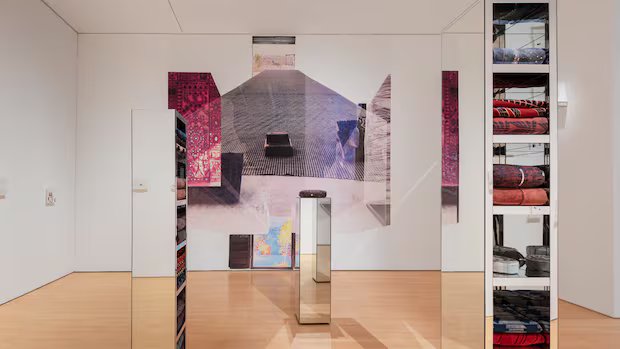
I am showing a new body of work that was made for this exhibition, which includes drawings on handmade paper (from khadi or handspun cotton); mirrored cabinets containing a number of folded fabrics that include motifs from Le Corbusier’s Mill Owners’ Association Building [in Ahmedabad, India, a major textile hub] as well as the chemical compound of indigo; and a large digital collage.
In these works, I am building a larger story on how to think about the histories of cotton and ornamentation while including elements from an artisan’s workshop or the maker’s space. The works together create a narrative that slowly unfolds to tell the viewer that there are multiple perspectives from which to consider the impact of colonialism, the extraction of cotton and the utopian project of building a nation in the decolonial period.
The work also creates a kind of domestic space. The cabinets are like bookshelves and the folded cloths are like the spines of books. I was thinking about my aunt’s closet or my mother’s closet, and their inherent knowledge about the complexity of the weave or the narrative in the ornamentation — their love and pride for their textiles. I always wondered how they knew so much, and I reflected on inherent knowledge versus learned knowledge.
The history of textiles in the Indian context is a history of the land. The British Empire decimated the Indian textile trade while copying and reproducing motifs and styles by machine. The installation begins with the collage of a block printer’s clothes and it ends with a loom.
The winner of the 2025 Sobey Art Award will be announced on Nov. 8 in Ottawa. The Sobey Art Award exhibition continues at the National Gallery of Canada through Feb. 8, 2026.
[ad_2]
Source link