[ad_1]
I first visited Mike Rader’s studio eight years ago. It was a hurricane of ideas, full of constructed paintings, videos, animations, and puppets. A collection of props for a Three Stooges–inspired video caught my eye, each representing the ego, superego, and id. I couldn’t wait to see the final film.
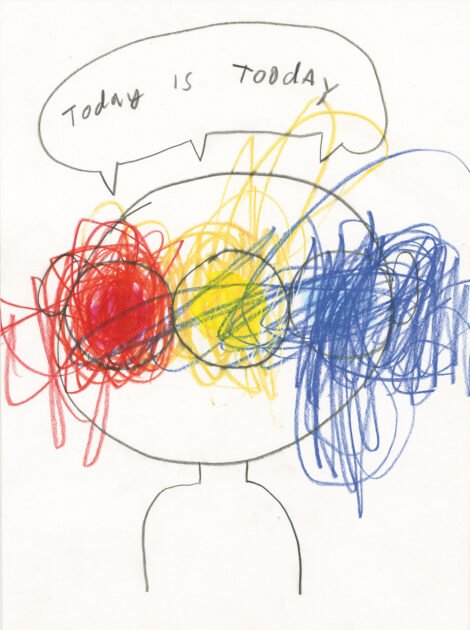
A few months ago, everything changed for Mike. After teaching a class at the Yale School of Art, a car struck him as he was walking to a student exhibition. The accident caused a traumatic brain injury, and he was suddenly bedridden, unable to process language or tolerate screens. A week after returning home from the hospital, he started drawing again, instinctively, after his wife placed a sketchbook in his lap and colored pencils next to him. Some drawings were finished in minutes, others in longer stretches between naps. Drawing was a way to release fear, pain, and confusion. When words failed, the line and drawing remained. Instead of retelling the trauma, Mike handed the drawings to visitors. They said more than he could. There was no plan, just an urgent need to speak through them.
The drawings have grown in complexity as his brain continues to heal. The earliest were raw emotional bursts, and over time, the drawings have become more structured. Parts are stapled and pieced together as though his mind were reassembling itself. By selecting red for ego, yellow for superego, and blue for id, the Three Stooges metaphor has cycled back into the work, and these parts of the mind take turns in the visual conversation.
Even at his most fractured, Mike reached for the pencil. Now, as his thoughts reconnect, the work is about healing but also about clarity and change. A visual diary and a map of recovery. The drawings aren’t just art objects—they are proof of resilience and of creativity as a lifeline.
—Bruce Pearson
[ad_2]
Source link