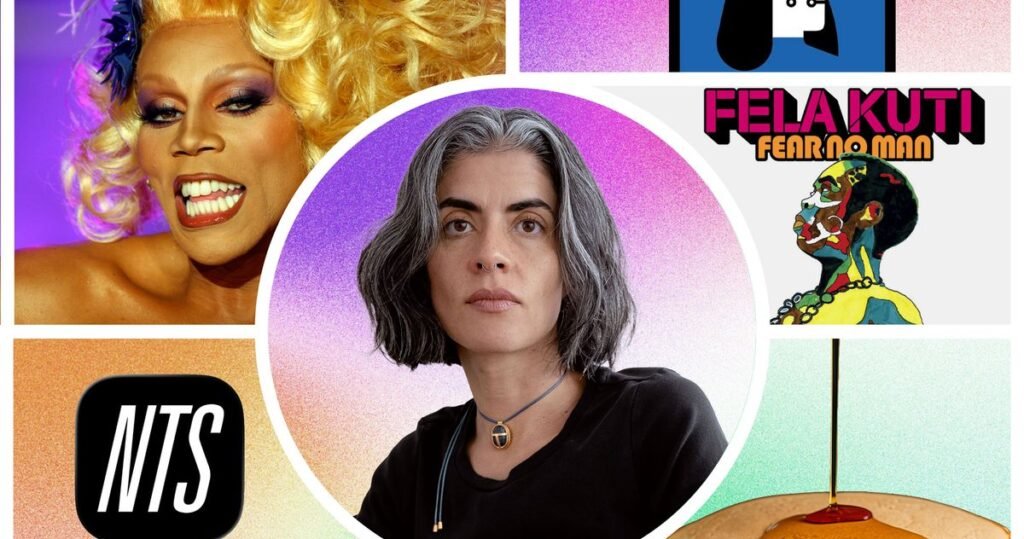

Photo-Illustration: by The Cut; Photos: Karin Verbru, Getty Images, Retailers
For Mexican artist Pia Camil, the world around her has always been a part of her practice, whether it’s a secondhand market on the outskirts of Mexico City, a series of abandoned billboards, or the plantain trees in her backyard. “Once I zoom in on something, there’s a natural unfolding,” she tells The Cut. Camil studied painting at the Rhode Island School of Design, graduating in 2003, and soon began delving into other mediums. “My preferred methodology was being outside on the street with a camera, documenting things that interested me and trying to build on that,” Camil says. After completing her M.F.A. at London’s Slade School of Fine Art in mixed media, she returned to Mexico City to begin working on a combination of textiles, performance art, and site-specific installations.
In 2020, she left the city in favor of the countryside. After spending years making capitalist critiques through art, she says, “it seemed like a good time to walk the walk.” She made a conscious decision to live in harmony with her interests, which now include agriculture, the relationship between human and nonhuman species, and the subject of desire. And she returned to painting. Her latest work, including what she’s exhibiting at Frieze New York this year, tries to expand the notion of desire tied into the natural world, our ideas about wildness, and how much of that is constructed versus innate.
Can you tell me more about the paintings you’re showing at Frieze? What inspired this work?
They are a set of eight paintings representing these trees that are right behind my house, seen at different times of day, from dawn to dusk to night. They’re really massive trees, part of the plantain family. I was fascinated by how many uses this plant has in terms of its regenerative abilities or how it’s commonly used as a mother plant, where it can sort of mother other plants that are growing. It’s also corresponded with an important moment in my life. I’ve been living in this house for two years. I separated from my partner, and it was important for me to start thinking about this idea of regeneration from a practical but also personal standpoint.
In the paintings, there’s also the presence of these erotic nude women, but there’s a slight shift in how we see them. They’re not the usual passive, beautiful nudes. These women are blending into the landscape in a way that suggests this interconnectedness between human and nonhuman species. And all the women have fangs, so they have this feral quality to them.
Do you have a pre-painting ritual?
Since I’m a mom, I don’t have the leisurely time that I would like to have around my studio. I usually have four hours and I zero in on the work and do it before I have to go get the kids from school. There’s not much romanticism. But one thing that I have to have before I work is music. It’s a very important part of my practice. I almost can’t paint without music in the background. I like listening to independent radio stations. I listen a lot to KCRW from California or NTS radio. I love stations that are well curated and I love the existence of music played by humans because, more and more, I’m bothered knowing that the algorithm in my Spotify is going to curate my experience.
What music are you listening to these days?
I have very eclectic taste and I usually put on this long, messy playlist in my Spotify that evolves. I’m trying to get off Spotify, but I haven’t done it. There’s Nina Simone, Elmore James, the Strokes, classical music … My father was an outstanding piano player, so I listen to a lot of classical music.
Recently, though, I listened to this podcast that I adored that I really want to recommend. I’ve been a fan of Fela Kuti’s music for a long time, but the Fear No Man podcast blew my mind. It’s really well researched. Kuti set up this ideal living situation in this autonomous country that he declared in the middle of Nigeria; it was very utopic. And in the podcast, there’s this insistence on the role all these strong women were playing in Fela’s life. His mom turned out to be this amazing character, an activist that overthrew the king. Now, I’m going back and listening a lot to Fela’s music.
What do you love about Fela Kuti’s music?
It’s up front and rebellious. It’s trying to go against the system and empower the people through a very simple way, which is music. It isn’t overly preachy. It’s celebratory and fun. In my work — not to say that I’m doing the same thing because it’s a very different scale — when I try to make political commentaries, there’s always a level of play or accessibility. I dislike these notions that art has to be very highbrow. Artists that really speaks to me — for example, the Neo-Concrete artists in Brazil in the ’60s and ’70s like Hélio Oiticica and Lygia Pape — were coming out of the art world and going into the favelas or the barrios to make art with the people. I suppose these are things that, when I see Fela, really speak to me.
What is the last meal you cooked?
We have this Sunday habit of doing pancakes with my kids that’s always a really enjoyable time. We experiment with different things. This Sunday, there was this really odd recipe we tried, but we didn’t really accomplish it: a bacon slice in the batter of the pancake, fried, like a reverse pancake.
We eat pancakes with different kinds of honey. I bought this land nearby with some friends and we put in 40 beehives, so we have a consistent honey flow in this house. It’s not a luxury; we always have it around in big jars. We have a new honey now that my daughter loves that’s very floral.
What five celebrities, dead or alive, would you invite to a dinner party?
I would invite the feminist writer Donna Haraway because she seems like a goofy, interesting person. Little Simz because I’m really interested in her vibe. I find her very diligent and talented. I would invite Argentinian author Mariana Enriquez, who wrote this book, Nuestra Parte de Noche. She’s very punk but also brilliant. For a few years, I was doing cabaret nights in my studio. They were a riot. It was very queer and we had drag shows. This is the energy that I enjoy. I would have to invite a drag queen: RuPaul. And for the last one, a good cook so that we’d have a delicious meal. Máximo’s Eduardo “Lalo” García has an interesting story because, for a time, he was in the U.S. working as an immigrant and then came back to Mexico with basically nothing. He just built this empire.
What’s your favorite game to play?
I’m actually working on a book of games with two friends of mine. I don’t know what the official title is going to be, but they’re games for the end of the world. All you need is to be with a group of friends. One that I love playing is called, “Who is my fiancé?” One person from the group has to exit the room and everyone else decides what the fiancé is going to be. It can’t be a person, it has to be a thing. Say we decide on my cell phone. Then, the person enters and starts asking questions. You give hints, trying to personify the object. You say, “She’s highly communicative, but eventually her battery is going to run out.” They have to eventually guess the thing. I like the idea of games that are simple and turn out to be super-fun.
What’s a book you couldn’t put down?
I never expected this, but there’s a Nigerian writer called Akwaeke Emezi. Most of what they are known for are erotic romantic novels and when I’m reading them, I’m like, “Oh my God, I turned into this woman who gets a thrill from reading erotica.” But you really cannot put them down. The last two I read were Little Rot — it’s a little crazier, a lot going on in that novel — and You Made a Fool of Death With Your Beauty. I would almost blush when I was reading in front of my kids.
Do you have a favorite piece of art that you own?
I don’t have major works — yet — but I’ve exchanged works with people, usually artist friends. I have a drawing from a fairly important Mexican artist, Juan José Gurrola, that I love. He had a great sense of humor. It’s a couple taking a bath; one of them is smoking and the other one has this boxing glove. The absurdity of the scene and how it’s done and the humor … it really speaks to me. I like him as an artist because he was multifaceted, very theater-influenced and performative, but had a highly conceptual side to him. He was a very complex, interesting character from the Mexico City scene in the ’80s.
What is a piece of advice you’d give your kids?
To live with their hearts and to not be afraid of vulnerability. I really admire people who live by their vulnerability and, unfortunately, it’s not really the rule. I would love it if my kids were living with that in mind.
You had your son in 2012 and your daughter in 2015. You said the experience of motherhood changed your work and began to speak to a more feminine perspective. Outside your practice, how has motherhood influenced your approach to life?
I think the experience is transformative, regardless of how much you want to pay attention to it or not. For me, specifically, it was challenging because I developed an autoimmune condition after my second pregnancy. My relation to my body was totally radicalized and I had to try to not be put down by it but find a way to live with it. It took a whole mental state to try to turn all of that around and make it a superpower. It truly forced me to pay attention to the little things that give quality to your life.
Philosophically, I’m very influenced by Ayurvedic culture. I went to a clinic in Kerala, India, when I was at my worst. It’s so different to our way of understanding health. When an Ayurvedic doctor explains health to you, it’s a whole cosmic trip, from how the universe was made to how the elements interacted with each other to how that created certain patterns in life to how that lives within you. Tapping into that was very important in how I now live my life.
What would you say your Ayurvedic journey has taught you?
It’s what sustains my day to day. It’s where I find the energy and the impulse to keep going. They said something very interesting — back to your question about good advice — along the lines of, “You’re not sick now. You were sick before and now you’re getting healthy.” When you are disconnected from the body or taking your health for granted, that’s when you’re sick. This idea of doing the opposite, of reconnecting with your body, eating healthily, sleeping well, these are all habits that foster longevity and a good life.
This interview has been edited and condensed for clarity.