
Listen to this article
Estimated 5 minutes
The audio version of this article is generated by AI-based technology. Mispronunciations can occur. We are working with our partners to continually review and improve the results.
Just as the tree buds break in the park outside Glenhyrst Art Gallery, inside, the museum teems with life as well. The first-floor exhibition rooms of the Brantford, Ont., public art gallery are full of blooms and birds and plenty of bats.
Night Vision, a solo show by Toronto-based artist Laura Findlay, invites visitors to ponder the magic of the garden at night. Her ethereal, sometimes eerie paintings convey the wonder and mystery of encountering another living thing in the wild — be it a robin’s egg or an earthworm. In this twilight space, Findlay’s art welcomes the kind of introspection private moments in nature tend to inspire.
“Her work prompts us to turn inward,” says Glenhyrst curator Matthew Ryan Smith, “to think deeply about our loved ones and ourselves, and about how fleeting all this can be. The world is a precarious place, and these paintings help us make sense of our vulnerability.”

Born in Montreal and raised on Vancouver Island, Findlay discovered art’s expressive power at a very young age. “My mom died when I was six, and my dad found that the only way I could really talk about the feelings was through drawing and making images,” she says. “I was very fortunate to have just always been encouraged.”
As she grew older — attending a specialized arts high school, then moving abroad to work in photography, before returning to study art in university — Findlay’s knack became a persistent urge. “I’m like one of those spiders,” she says. “I have this compulsion to make things.”

A busy commercial photographer who documents artworks for artists, galleries and collections around southern Ontario, Findlay’s paintings are also indebted to the visual language of the camera. Her subject is always centred in-frame. And even rendered in oils, her scenes appear to be lit by flashbulb.
“I’m obsessed with what it means to take a picture,” she says. “Why do people try to preserve something? That’s a big question in painting, but it’s also a big part of everyday photography.”

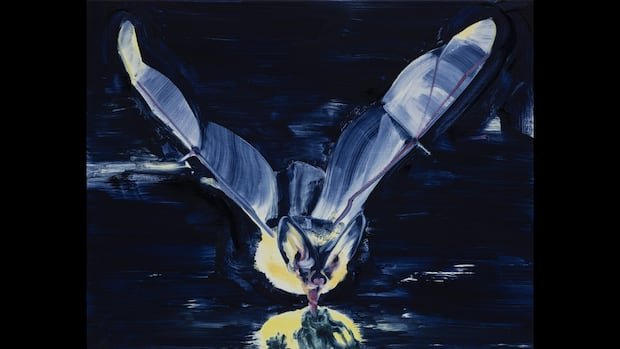
The luminous quality of Findlay’s painting — which can make a bat’s wing glow like stained glass — comes from a subtractive, Old Masters technique. The artist applies transparent glazes in a thick coat to create a dark ground, then wipes away pigment with a rag to reveal colours and define highlights. Much like a photograph, her images emerge from the darkness.
“Laura is your favourite painter’s favourite painter,” says Smith. “She pulls the paint away from the surface to leave a stain, creating these remarkable effects with light and colour. Her paintings are at once beautiful and haunting.”
Findlay uses the garden as a site to reflect on the cycles and seasons. “You cannot have life without death and rot,” she says. “I don’t think you can even appreciate the beauty of the flower if you’re not occasionally remembering slugs exist.”

For the artist, the image of the garden implies the presence of a gardener — though Findlay never pictures them. “I am particularly interested in pointing to absence as an ingredient in the thoughts I’m trying to depict.”
The bats, which Findlay began painting more than 10 years ago, evolved as a related motif. The artist regards the flying mammal’s echolocation as a kind of one-sided conversation. For her, it represents the dialogue interrupted when someone leaves your life.
“What if I continue to have this conversation without the person ever receiving that message?” she asks. “Sending it out into the darkness.”
The symbol also makes her think about her lot as an artist, putting work into the world — another one-sided conversation she’ll continue throughout her life. Sometime after starting the project, Findlay came across an essay by Thomas Nagel called “What Is It Like to Be a Bat?” in which the American philosopher considers the unknowability of other people. “Unknowable things keep me coming back over and over again to these subjects,” says the painter.

At Glenhyrst, alongside images of bramble, dandelions and a hornet’s nest, a large triptych forms the centrepiece of Night Vision. It shows a pond covered with jade- and rust-coloured lily pads, where bats dive to lap up water and catch bugs. It is the work that finally gave the bats a home.
“The garden at night is a quiet, cool space of contemplation, for big questions and small ones,” Findlay says. “[It] is a beautiful, private crossroads.”
Laura Findlay: Night Vision runs through June 21 at Glenhyrst Art Gallery in Brantford, Ont.