[ad_1]
Inspired by the mills, terraces and skylines of his Lancashire upbringing, Richard Wood has turned an accidental hobby into award-winning art, all from the back room of his childhood home
With a surname like Wood, it might seem inevitable that Richard Wood would end up working with timber. It’s the sort of coincidence people can’t help but comment on. ‘I promise I’ve not changed my name to Wood just to suit what I do,’ he laughs when we meet.
In his studio in Egerton, Bolton – surrounded pieces of dark walnut or warm-toned cherry waiting to be sketched, burned and transformed – it does feel fitting. But it wasn’t always the plan.
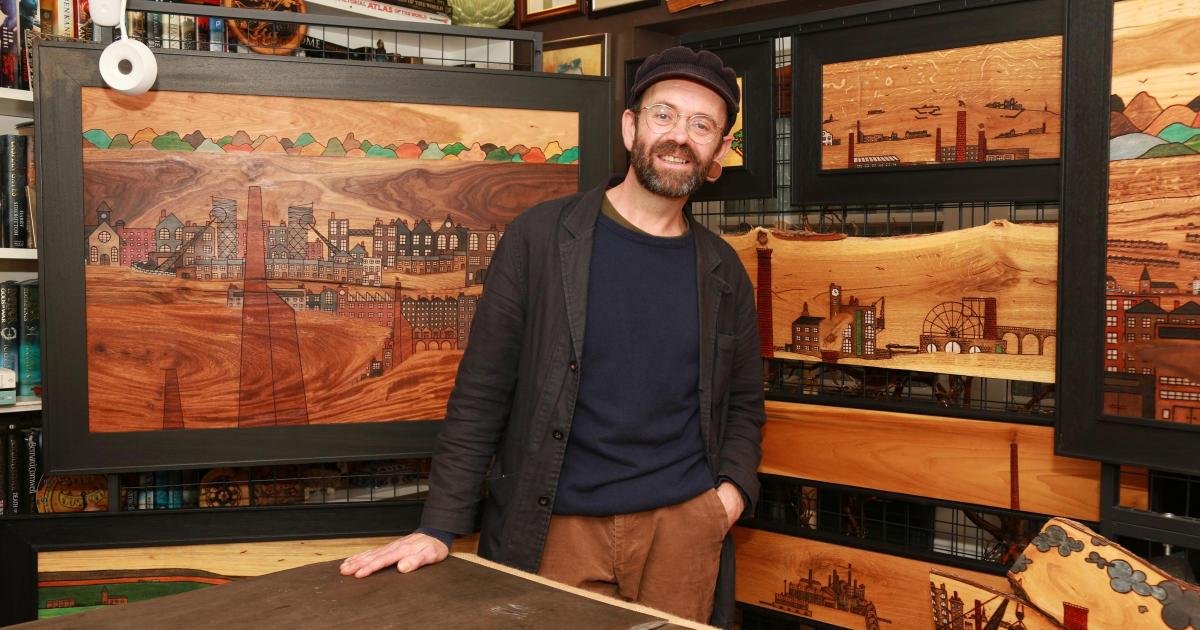
Richard is a pyrography artist, creating artworks by burning intricate northern industrial landscapes directly into hardwood. Using heat rather than paint, he builds atmosphere through scorched lines, layered dyes and carefully controlled shading. The result is work that feels textured, nostalgic and unmistakably northern: mill chimneys rising into smoky skies, terraces nestled into hills, rolling landscapes etched into the fabric of an industrial past.

Pyrography – literally meaning ‘writing with fire’ – is an artform with centuries of history. From Victorian pokerwork to earlier decorative traditions across Europe and Asia, artists have long used heated metal tools to scorch designs into wood and leather. Modern burners resemble precision pens, allowing control over temperature and tone so that depth is created through nothing more than heat and patience.
Unlike paint, there is no covering a mistake. Each burn mark is permanent, which is why it has to be approached in careful stages. ‘I’ll sketch the full image out in pencil first, then do the initial burn to set the lines. After that, I’ll do a bit more work to it, build up the detail, and then come back to sort of finish it off, going over all of the image again to get the sort of smoky effect to it,’ Richard explains.
It’s a process he works through instinctively now, but he arrived at it almost by accident. After studying graphic design at Blackburn College – ‘my one sort of strong subject through school,’ as he puts it – Richard drifted away from art for nearly two decades. Like many creative paths, his didn’t run in a straight line. He went on to run a village delicatessen for 10 years before redevelopment forced its closure. Family life and everyday responsibilities meant drawing slipped into the background. ‘I didn’t do anything with it,’ he says.
Eventually, the pull to create something of his own returned. This time, his sights were set on tattooing. ‘I liked tattoos, I’ve got quite a few myself and liked the industry,’ he says. ‘So I started drawing again and got a portfolio together.’

While researching ways to refine his line work and shading, he came across an article in a tattoo magazine about using pyrography as a way of practising on a solid surface. It offered the same demands as tattooing – precision, permanence, control – but without the pressure of working on skin. He bought a basic kit. ‘It was only a cheap kit at the time… I wasn’t getting the results.’ So he invested in better equipment and kept practising.
Then Covid hit. Tattoo studios closed and the momentum Richard had been building suddenly came to a halt. Rather than abandon the creative thread altogether, he pivoted. He started experimenting with wood, making bird tables and personalised boards, and selling them at markets across Lancashire and Cheshire. ‘I spent about three or four years doing that, which I think really honed my skills in pyrography,’ he says.
The real turning point came with his appearance on the BBC’s Make It at Market. On the programme, he created his first chimney piece. ‘I could see this sort of smokiness in the wood and thought, “Do you know what? A chimney would look good there.”’
The response took him by surprise. ‘The producer on the show was a Yorkshireman, and he loved it, and he said, “Oh, it feels northern.” The more people I started showing it to, I got that response from, which sort of pushed me more down that route.’
That was the moment everything clicked into place. The mills, the terraces, the chimneys – that was his direction – the familiar landscapes he’d grown up with. It had been there all along, in the streets and skylines he’d known since childhood.
Richard has never strayed far from them. He’s lived at the same address most of his life, and his studio is next door to his home. ‘We have a peculiar sort of set-up,’ he says. ‘I live next door to my mum and dad. We built on to the side of their house when we were having kids about 15 years ago. And my studio is in my parents’ back room. This was my childhood home.’
From that back room, the pieces slowly take shape. There’s usually the smell of scorched timber in the air. The boards are sanded smooth before he starts sketching, often the longest part of the process, with ‘a lot of rubbing out and trying to get the right sort of composition.’ Once he’s happy with the drawing, the burning begins.

Then comes the dye, which sinks into the grain. ‘If you can imagine dropping a blob of ink, it spreads. You get the same with wood dyes – it’ll follow the grain,’ he says. ‘The burns trap the dye, so it doesn’t leak as much… You get that nice tonal, sort of muted tone.’ He goes back over it again with the burner, deepening the shadows until that smoky effect emerges.
A lifelong interest in history – particularly the industrial story of Lancashire – sits at the heart of what he creates. He once began a history degree simply for the love of it, and that curiosity about how places were shaped by industry now finds expression in every chimney and terrace he draws.
Although they are inspired by real places, Richard’s pieces aren’t meant to be exact copies of one particular town. Instead, they are a blend of many: Bolton, Haslingden, Clitheroe and small Lancashire villages tucked into the hills and threaded between terraces. ‘I think they are sort of nostalgic,’ he says. ‘A nostalgic feeling of old industrial Lancashire towns. That’s what I’m trying to capture.’
People often tell him they’re convinced they recognise the street, the skyline, the pub at the end of the terrace. And that sense of recognition is what really connects. They see something of their own story in his work – a memory of where they grew up, a place they once knew, or a view they haven’t thought about in years.
That connection has naturally led to commissions. ‘I’ve had a few people ask me to do childhood views,’ he says. ‘There was one from a bedroom window.’ Another piece was created for a Lancashire woman now living in America, who wanted something that reminded her of home.
Exhibitions at Platform Gallery in Clitheroe, Cedar Farm in Mawdesley and Bolton Museum have helped Richard’s work reach a wider audience. In February, he was chosen as the winner of Bolton Museum & Gallery’s 2026 Art Open ‘Winners Prize’ for his artwork Ghost Chimneys.
For someone who only picked up pyrography as a way of practising tattoo skills a few years ago, it’s no small moment.
Now, he’s looking to build on that momentum. ‘I’m planning on getting bigger,’ he says. ‘Bigger pieces and bigger exhibitions.’
As his pieces grow larger and his audience wider, Richard Wood is doing more than burning scenes into timber, he’s celebrating Lancashire, one carefully etched skyline at a time.
Ghost Chimneys is currently on show at Bolton Museum as part of the exhibition, which runs until Sunday May 17. Richard’s work is also on display at Cedar Farm until September..
@richardwood_art
rdfwoodart.etsy.com
[ad_2]
Source link