[ad_1]
In the history of Australian art, you’d be hard pressed to find an exhibition that has received more media coverage than the National Gallery of Australia’s winter blockbuster, Ngura Puḻka – Epic Country. Yet very little of this coverage has been about the exhibition itself, which opens today in Canberra. Instead, Ngura Puḻka – a landmark exhibition of 30 new paintings by Indigenous artists of the Aṉangu Pitjantjatjara Yankunytjatjara (APY) Lands – has been the subject of intense controversy, spurred by a series of shocking allegations published in The Australian. These led to a string of investigations, sustained and divisive public commentary, a multimillion dollar lawsuit and a three-year postponement.
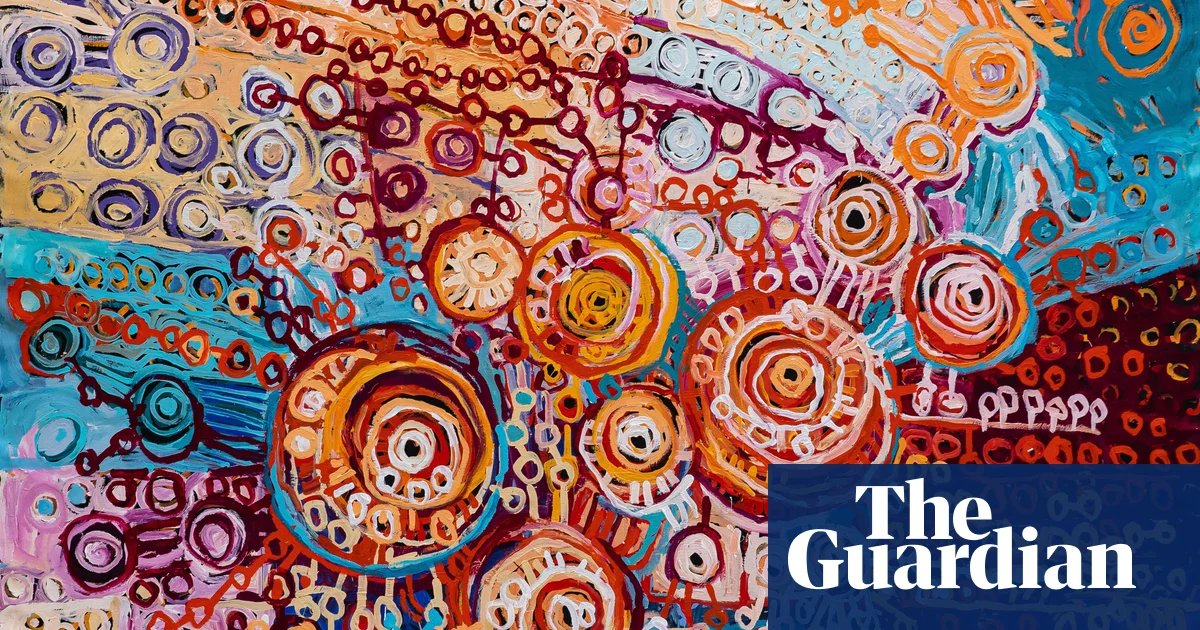
Walking through the gallery spaces, you might wonder what all the fuss was about. On the face of it, this is an entirely uncontroversial exhibition: 30 large-scale paintings of the desert country and tjukurpa – ancestral stories/cultural law – of the Aṉangu in South Australia’s north-west. To look at, the paintings are remarkable only for their size, colour and frequent beauty. Aerial views of the APY Lands show waterholes, riverbeds, spinifex and other flora; earth tunnels formed by honey ants. Some paintings show key Aṉangu tjukurpa, including the story of the Seven Sisters, and spirits, such as the mischievous “mamu”.
Together, the paintings represent an epic tribute to an epic country, and to the Aṉangu’s connection to that country. The bulk were produced during the Covid years, as the result of a collective project by arts centres in the APY Lands. Tina Baum, the head curator of First Nations art at NGA, describes herself as the “curatorial assistant” to the Aṉangu artists. “This is their vision and their dream,” she says.
The APY Lands region is a heavy hitter within Australian art, scooping up awards in the annual National Aboriginal and Torres Strait Islander Art Awards (Natsiaas) and the Art Gallery of NSW’s Wynne Prize for landscape painting, and prominently featured in the biennial First Nations exhibition Tarnanthi and the Biennale of Sydney.
Aṉangu artists “want to bring their story to other people”, says senior artist Sandra Pumani. “About your country, how you grow up, where you’re from and what story is there. You feel really happy [painting that story].”
We’re sitting in the Ngura Puḻka exhibition; nearby is Pumani’s 3m by 3m canvas showing an aerial view of the rock holes at a culturally significant site near Mimili, where she grew up. Around the corner is a painting by her aunt, the prize-winning painter Betty Kuntiwa Pumani; and a collaborative canvas that her late grandfather contributed to.
It’s not the first time most of these paintings have been at NGA: the Ngura Puḻka exhibition was almost entirely installed when it was cancelled at the last moment, in June 2023. Two months earlier, The Australian newspaper had published serious allegations about the organisation behind the exhibition, the APY Arts Centre Collective (APYACC): an Aboriginal-owned and led association of arts centres spread across the vast APY Lands, representing more than 500 Aṉangu artists.
In an article headlined “White hands on black art”, artists and present and former staff alleged that white studio assistants had painted substantial sections of works credited to Indigenous artists in the APYACC, and that they’d interfered with depictions of Aṉangu tjukurpa. Also included were stills and footage from a video filmed at Tjala Arts centre, a member of the collective, showing a white arts worker applying paint to a canvas by the acclaimed artist Yaritji Young.
APYACC rejected the allegations, and denied that its artists or their paintings had been compromised, saying in a statement at the time: “It is in no way interfering [with] the artist’s Tjukurpa [creation] or out of the ordinary for an art assistant to take part in this process … at the artist’s direction.”
But within days of The Australian’s report, NGA commissioned an independent review into the provenance of only the 28 paintings destined for its exhibition – not the conduct within the APYACC – to determine whether the artists attributed as the creators of these works had “exercised effective creative control over the creation of [them]”.
The allegations against APYACC also triggered a review led by the South Australian government, which referred its findings to the Australian Competition and Consumer Commission (ACCC) and the Office of the Registrar of Indigenous Corporations (Oric) for further investigation. The ACCC found that no consumer laws had been breached, while Oric concluded its investigation with no further action, stating that “no adverse inference” should be made from the investigation closing.
But while the investigations were pending, the Indigenous Art Code, responsible for administering a code of ethical practice within the industry, revoked APYACC’s membership. The collective’s state and government funding, totalling $380,000 in 2023, was suspended.
Meanwhile, the NGA investigation determined that the 28 paintings in Ngura Puḻka met the gallery’s provenance standards. Of these, three have since been withdrawn from the exhibition: two for personal reasons relating to a single artist; and one by Sally Scales, who has since been appointed a member of NGA’s council and chair of their First Nations advisory group, due to the new conflict of interest. A fourth painting is currently showing in another exhibition. Six new paintings have been added.
But none of the works in Ngura Puḻka will be acquired by NGA, which had initially intended to buy all 28 original paintings. They did not respond to questions from Guardian Australia about the reasons for this reversal.
APYACC says it suffered a significant financial loss as a result of The Australian’s reporting, including a downturn in sales. And while their state funding was reinstated last year, the collective believes their expulsion from the Indigenous Art Code, as a result of the allegations, has adversely affected their federal funding applications in the years since.
In a defamation suit lodged with South Australia’s supreme court, the collective is suing Nationwide News, publisher of The Australian newspaper, for $4.4m: a figure that includes the loss of the NGA sale, which they put at $1,397,000, and their lost federal funding, which they estimated at $1.07m.
All the APYACC artists I talk to ahead of the exhibition express frustration at being expelled from the Code, and the loss of federal funding; there’s a sense of aggrievement tempering their joy and pride in seeing their artworks finally installed on the gallery walls.
“They’ve had four reviews, and there were no findings that we were doing anything wrong,” says artist and APYACC board member George Cooley. “But we’re still not getting approval for any federal funding.”
We’re sitting in front of his painting of an escarpment in Coober Pedy, opal country. A miner since the age of 16, Cooley only took up painting in 2021, in his late 60s. His landscape paintings have since been selected for the Adelaide Biennial, the Wynne Prize and the Natsiaas.
“My aim is to set up a legacy for my family, for my community,” he says. “The main aim of the APY collective is to establish something so the next generation can look at and say, ‘This is mine. This is made by my people. If they can do it, I can do it.’”
He says the collective’s business model, which returns approximately 85% of income from sales directly to artists and art centres, “opened the doorway for income generation for single mums, grandparents, young people”.
Nyunmiti Burton, whose painting of the Seven Sisters story hangs in Ngura Puḻka, says she wants to share this important story about leadership and taking care of family and community: “This story is not only for Australians, but all over the world.” Painting is also a crucial source of income: “This is work I’m doing for my kids, for my family. It’s good money, to feed them.”
Burton was a key figure in The Australian’s “White hands on black art” reporting: in a video recorded by journalist Greg Bearup, she accused APYACC CEO Skye O’Meara and other white staff of inappropriate interference in artworks. Before the video was even published, she issued a letter retracting her statements.
She tells me she regrets making the video. She’d had an argument with O’Meara shortly before, she says, and was unwell: “I’ve been sorry for myself, and I’m weak, I was skinny.” She wishes the video would be taken offline. “That’s not me,” she says.
The award-winning artist and APYACC board member Frank Young, sitting in the gallery beside his wife Yaritji Young (for whom he translates), says: “Me and my wife and all the other artists, we really were sad about that video [of Yaritji’s painting].” He says that The Australian’s narrative around the video was “wrong way” and “not real”.
For Ngura Puḻka, Yaritji painted the honey ant story passed down to her by her father and grandmother; now she passes it down to her children and grandchildren, who sometimes help with the painting. I ask her and Frank how they felt when they finally saw it on the wall, after a long three years.
“We are so happy,” he says, “So proud.”
-
Ngura Puḻka is now open at the National Gallery of Australia, Canberra, until August
[ad_2]
Source link