

Fragments of Belonging: Nitin Ganatra’s First Solo Exhibition at London Art Exchange
By Jessica Warren – Independent Arts Journalist
Whispers of the 27th of September travelled through London with a quiet urgency, like a secret too precious to keep. Soho, already humming with its characteristic energy, seemed to hold an extra charge that evening. The anticipation surrounded not a play or film premiere, but an entirely different kind of debut: actor Nitin Ganatra’s first solo art exhibition, Fragments of Belonging, at the London Art Exchange.
For many, Ganatra is a familiar face, beloved for his roles on screen – from the eccentric Prince Pondicherry in Charlie and the Chocolate Factory to Masood Ahmed, one of EastEnders’ most enduring characters. His acting career has been a tapestry of diverse roles, woven with humour, depth, and humanity. Yet on this particular evening, Ganatra presented himself not as an actor but as an artist, opening his inner world to the public in a way that was as brave as it was revealing.
A Night of Firsts
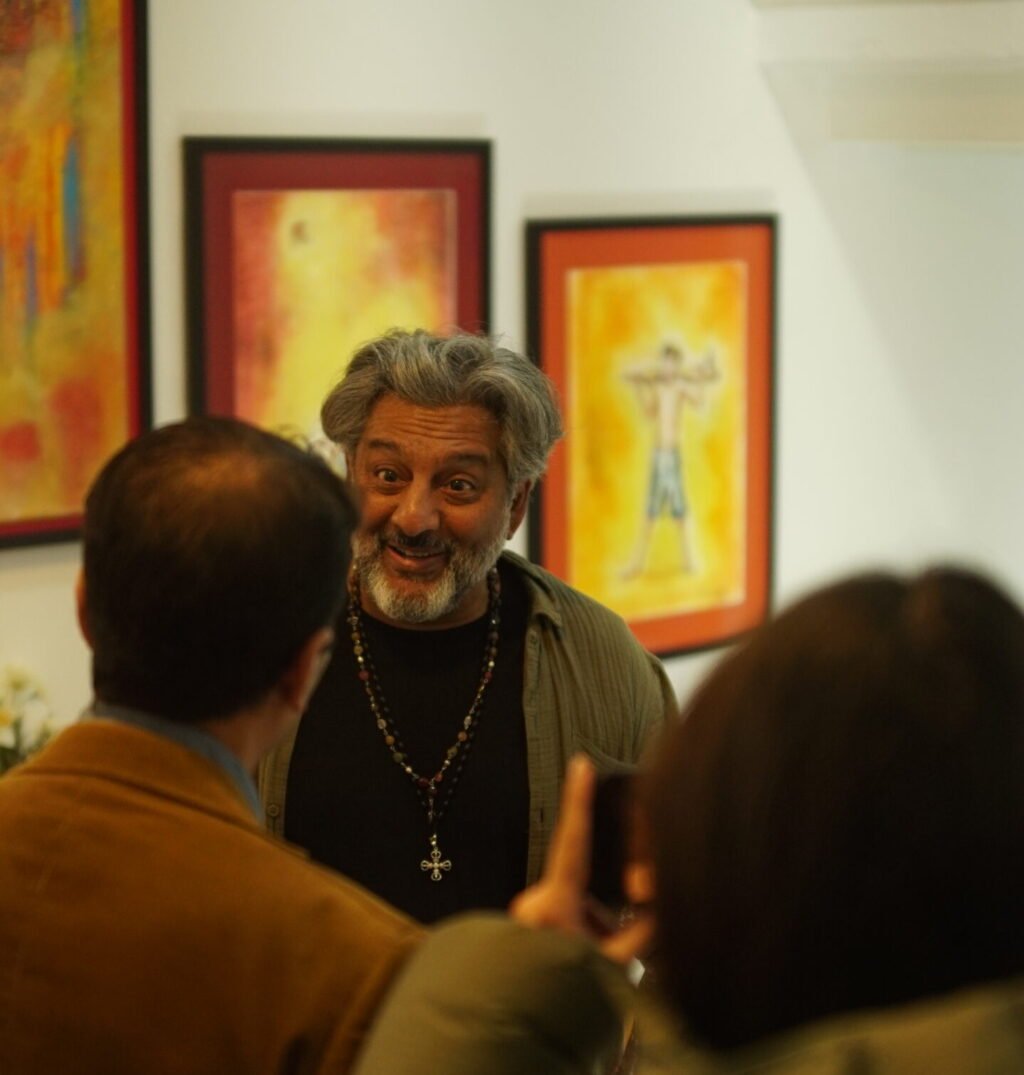
Stepping into the London Art Exchange, one was immediately met with an atmosphere that mixed intimacy and grandeur. The gallery glowed with warm light, each canvas carefully positioned, colours spilling into the room with vibrancy and purpose. Friends, family, and admirers gathered, buzzing with pride and anticipation. Conversations swirled, glasses clinked, and yet the true centrepiece was the art itself – works spanning five years of Ganatra’s creative journey.
Ganatra took the stage briefly to address his guests. Vulnerable yet confident, he spoke with candour about his personal journey – a story marked by displacement, resilience, and creativity. Born in Kenya to Indian parents and raised in Coventry, Ganatra’s upbringing was shaped by cultural intersections and the challenges of belonging. He confessed that art became his sanctuary, the one space where he could exist without restraint. The canvas, he explained, was his refuge: “No shame, no guilt, no fear – just pure expression.”
The Collections
The exhibition comprised ten collections, each piece an echo of experiences, emotions, and reflections spanning back to 2020. The works unfolded like chapters in a memoir, with colour and form narrating what words could not.
The dominant themes – nature and humanity – played against each other across the walls. Some canvases leaned into the serenity of landscapes and organic textures, while others confronted the rawness of human emotion and social existence. The collision of these themes gave the exhibition its heartbeat: a balance between external beauty and inner turmoil.
The use of bold colours and layered brushwork created a sense of urgency. Some pieces appeared contemplative, inviting the viewer into stillness, while others felt restless, as though resisting silence. Taken together, the works formed a vivid collage of Ganatra’s inner world – his fragments of belonging pieced together in oil, pigment, and canvas.
Performance and Presence
The evening was further elevated by a live dance performance, an element that tied Ganatra’s cultural heritage to the wider narrative of the exhibition. An Indian dancer graced the gallery floor, her movements steeped in tradition and vitality. Speaking to me afterwards, she shared that the timing of the exhibition coincided with Navaratri, the Hindu festival celebrating the divine feminine and spiritual triumph. This overlap deepened the performance, transforming it from entertainment into a symbolic celebration of resilience and identity.
The dance mirrored Ganatra’s own artistic message: a reclaiming of space, an assertion of voice, and a refusal to be confined by borders or expectations.
Vulnerability as Strength
Ganatra’s openness about his personal struggles added a striking dimension to the evening. He spoke of depression and how his art became a lifeline, a means of stopping himself from sinking into paralysis. In a candid admission, he described painting as not merely a creative pursuit but a survival mechanism.
This theme of vulnerability – of admitting one’s fractures – made the exhibition deeply human. While the pieces themselves dazzled with colour, texture, and imagination, the story behind them resonated on an even deeper level. They became more than artworks; they were artefacts of resilience, embodiments of an ongoing journey toward healing and self-acceptance.
Media Spotlight
Unsurprisingly, the exhibition did not go unnoticed beyond the gallery walls. The following day, BBC News featured Fragments of Belonging, highlighting it as Ganatra’s first solo exhibition. The coverage touched on his use of art as a tool against depression, amplifying the evening’s central narrative to a national audience. In doing so, it framed the exhibition not only as an artistic debut but as a cultural and personal milestone.
The BBC’s recognition underscored the significance of Ganatra’s transition from actor to artist – not as a diversion or side project, but as a serious creative endeavour.
Free to the Public
Perhaps one of the most striking aspects of Fragments of Belonging is that it remains free for the public to view until 13th October 2025 at the London Art Exchange. In a city where art often feels locked behind exclusivity, this openness reflects Ganatra’s philosophy. His art, like his story, belongs to everyone – those who feel displaced, those who seek belonging, and those who search for themselves in colours and shapes.
Closing Reflections
As I left the gallery that evening, the hum of Soho enveloped me once more, yet it felt transformed. The event had not just showcased paintings; it had celebrated vulnerability, resilience, and the power of expression. Ganatra’s exhibition was not polished perfection – nor was it meant to be. Instead, it was raw, honest, and moving.
The title Fragments of Belonging could not be more apt. Each canvas was a fragment, incomplete in isolation, but together they formed a mosaic of identity and humanity. Much like Ganatra’s life – shaped by continents, careers, and cultures – the exhibition found unity in multiplicity.
In the end, what made the evening so compelling was not just the art itself, but the reminder it offered: belonging is rarely given freely. It is built, piece by piece, through the courage to share our stories. And in this sharing, we find ourselves – not as fragments, but as part of something whole.
Fragments of Belonging by Nitin Ganatra is on view at London Art Exchange until 13th October 2025. Entry is free.


