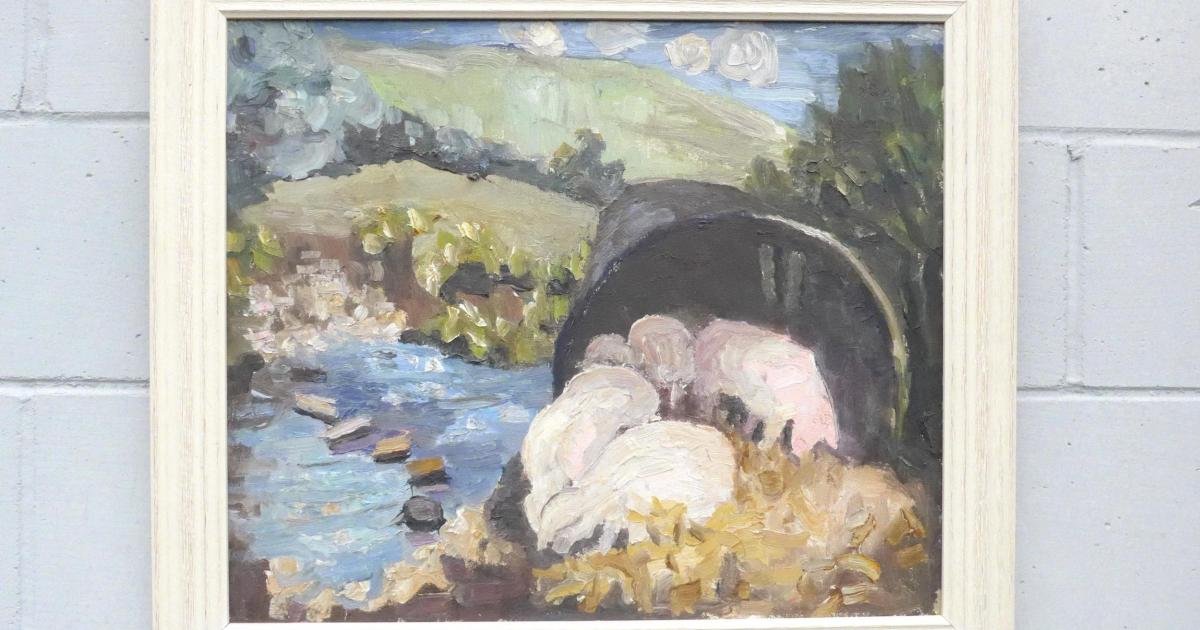

James McNeill Whistler was an old man and at the height of his creative powers when he came to Lyme Regis in the summer of 1895.
Like fishing villages everywhere Lyme had a certain charm about it, a charm Whistler would have been quick to appreciate for he had been attracted to seascapes for most of his life.
However, it was the people of Lyme who provided him with his best subjects and three portraits he did that summer remain among some of his finest productions.
By the end of the 19th century Whistler was recognised as one of the leading artists of the day. Featuring also prominently in the organisation of the art world he was a considerable influence on other contemporary artists.
He had a propensity for law suits, and is officially remembered for his fierce action against art critic John Ruskin in 1878 – Whistler ‘won’ but was only awarded a symbolic farthing damages. He wore the coin as a watch charm.
He was a man who attracted people by the brilliance of his conversation and his generally exotic lifestyle, yet repelled them by his relentless unforgiving independence of mind.
It is significant that when he published, in 1890, a collection of his literary works he entitled it ‘The Gentle Art of Making Enemies’. It was dedicated “to the rare few, who early in life, have rid themselves of the Friendship of the Many”.
Whistler was born in Massachusetts in 1834, the son of a military railway engineer, but was raised in Russia where his father was supervising the construction of the St Petersburg-Moscow railway. His first drawing lessons were at the Imperial Academy and maybe the glimpses he had as a child of the Russian court gave him the pattern for the exotic mode of life he cultivated as a man.
His health was erratic and fragile from youth onwards but despite this he was always a man of great courage. With this quality and his family background it is not surprising that he entered West Point on his return to America but eventually his outrageous conduct caused him to be expelled. He went to Paris in 1856 to train as an artist, became acquainted with great French artists like Courbet and acquired his continuing love for seascapes in Brittany.
Although he professed to hate the English – and indeed became a pro-Boer in time – he made England his homeland, although remaining an American citizen, exemplifying the belligerent contradictions that riddled his life.
He was over 50 before he married but became devoted to his wife, Trixie, and painted a famous portrait of her.
By the time Whistler arrived in Lyme Regis in the early summer of 1895 he was fully established in all his moods, talents, achievements and extravagances. It was a very difficult period for him.
His wife had been diagnosed as having cancer and his own health was failing, along with his talent. He was even more than usual in doubt about his work and wanted something to reawaken his inspiration. The Whistlers had closed their house in Paris and set off to test the medicinal properties of the sea air at Lyme.
Other famous people, as for example William Pitt the younger, had ventured there for a similar purpose before them. The reasons why Whistler chose Lyme are unknown, but one can soon conjure them up.
For one thing Whistler had always been attracted by water in various situations, right from those first seascapes he had done in France.
For years he had been fascinated by the Thames, painting it literally by day and by night in all its moods, although the most favoured time was in the gathering gloom of evening. In Venice he had found inspiration for many lithographs and etchings.
So the picturesque fishing village and watering place of Lyme – with its thatched roofs intermingled with dwellings of substance, hotels and guest houses and a famous harbour, the Cobb – would be just the place to attract him.