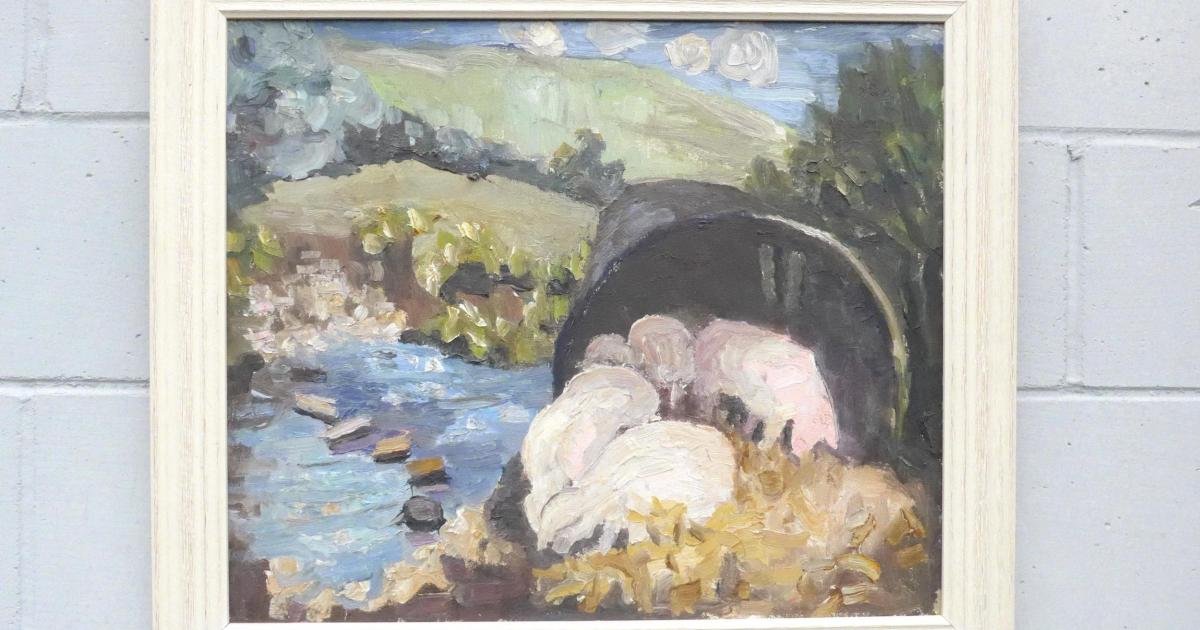

Lucy initially demonstrated impressive musical ability, and her hope was to become a concert pianist. Unfortunately, an operation she underwent while still young went wrong and left her paralysed down her right side, so she taught herself to paint with her left hand. She usually signed her work on the back of the canvas, and the child-like writing is a reminder of just what an incumbrance she had to overcome.

Before the outbreak of the First World War, Lucy briefly attended the Slade School of Fine Art, and in 1937 she joined the East Anglian School of Drawing and Painting, which was established that year in Dedham, Essex, by artists Cedric Morris and Arthur-Lett-Haines.
Dedham is famously known as the Heart of Constable Country (John Constable 1776-1837), so must have been inspirational for everyone concerned. Notable fellow artists at the school included Lucian Freud and, later, Maggi Hambling. The original building housing the school burned down in 1940, so activity moved to The Pound in Higham and later to Benton End, Hadleigh.
After her father’s death Lucy bought a house in nearby Upper Layham, where she lived until her own death in 1972.
Lucy was a lady of private means and never needed to earn a living from her art, but it was her life-long passion. She remained single and devoted herself to her local community, where she was fondly regarded as eccentric.
She was greatly influenced by Cedric Morris and Post-Impressionism, and she painted landscapes, portraits of other students and studies of her village neighbours, with her paintings hung in many of their cottages, often gifted or sold cheaply.
Although she always resided in the locality of her birth, Lucy did enjoy travelling, both in the UK and abroad. She gleaned inspiration from these trips and painted views from outside East Anglia including the Lake District, Scotland, France and wider Europe.
Lucy mainly worked in oils on small canvases, usually left unframed, but she did use watercolour and pastels, too. Her distinctive style, flair and use of colour is recorded as having ultimately attracted attention and praise from acclaimed artists such as Augustus John and Matthew Smith.
Her work was exhibited during her lifetime, there was a posthumous solo show in 1975, and examples hang in public collections in England and Scotland. Yet her work was never considered commercial until several decades after her death.
It was, and probably still is, possible to stumble upon her paintings at local village fetes and car boot sales for just a few pounds. However, the 21st century seems to have changed that: her style fits well into current tastes for fine art, and four-figure auction prices are not unusual for her works.
Animal studies are rare, but Lucy occasionally included farm animals in landscapes, and a painting of zebras was sold at auction a few years ago. The next Modern Design Sale at TW Gaze on March 19 includes an oil on canvas of a pig in an ark shelter. It is framed and ready to hang and carries a tempting estimate of £1,500-£2,000.
Please see twgaze.co.uk for all relevant details including the fully illustrated catalogue.