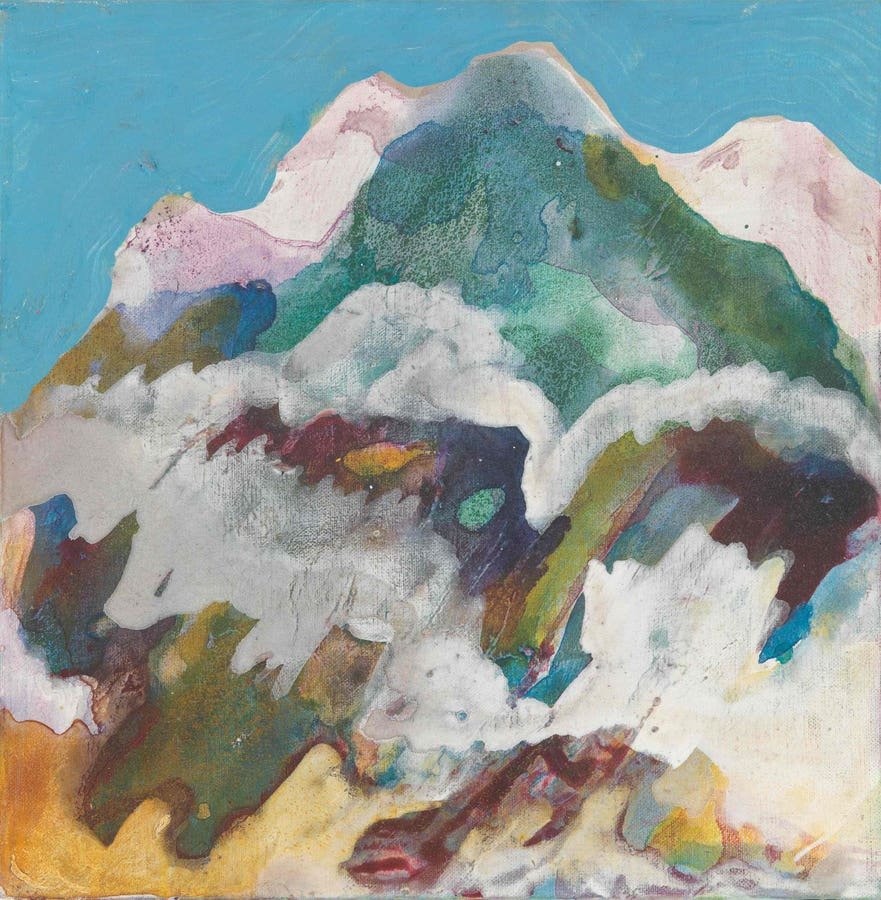
Suzanne Jackson, High Frost, 1982; the Joyner/Giuffrida Collection.
© Suzanne Jackson, courtesy the artist and Ortuzar, New York; photo: Swann Galleries
Is beauty an amenity? Extra?
Are trees and birds and flowers and music and architecture and art a bonus? Nice if you can have them, but non-essential.
Or is beauty a basic human right, more akin to housing, health care, education, clean air and water. A necessary feature for a full and happy life.
For anyone who’s lived in San Francisco, beauty is a backdrop. Sun glistening off the Bay. The Golden Gate Bridge. Tiburon and Sausalito. Muir Woods. No place is perfect–San Francisco surely is not–but in terms of beauty–natural beauty, architectural beauty, art, music–it’s ten out of ten.
Artist Suzanne Jackson (b. 1944) considers San Francisco the most beautiful city in the world. She came to San Francisco as a toddler with her family before leaving for Fairbanks at 7-years-old.
Central Alaska. Pre-statehood Alaska. Big nature. Northern lights. Moose. Caribou.
She would return to San Fran at age 17 for college and then on to a remarkable career as a painter, published poet, professional dancer, model, and scenic and costume designer for theatre productions in Los Angeles, the Bay Area, and beyond. She was a gallery owner, arts advocate, and educator. Her life intersected with some of the biggest names of 20th and early 21st century art: Charles White, Betye Saar, David Hammonds, Ruth Asawa.
Jackson returns to San Francisco for the first major museum retrospective devoted to the full breadth of her work, “Suzanne Jackson: What Is Love,” on view at the San Francisco Museum of Modern Art through March 1, 2026.
She brings beauty with her.
“For me, it’s political to make an artwork about peace and beauty,” Jackson has said previously. “I wanted people, especially Black people, to see the beauty. People need beauty. It’s a way to get people to think or consider some other ways of being.”
In a country and world now overrun by ugliness, how could more beauty hurt? More art, more trees, more music. Peace, love, and beauty, the three pillars of Jackson’s artistic practice. Attributes and conditions that shouldn’t be viewed as isolated, rather connected. From beauty comes love and from love comes peace. From love comes peace and from peace comes beauty.
What’s so funny ‘bout peace, love, and … beauty?
“I think most people come to Black art thinking they’re going to see violence,” Jackson said in a 1971 television interview for a group show in Oakland.
That largely remains the case today, particularly in photography. Black people suffering violence at the hands of police. Black people suffering the violence of poverty. Black people suffering from the ongoing ripples of enslavement, Jim Crow segregation, racial terror violence, systemic racism.
That work is necessary.
And so is Jackson’s. So is beauty.
The world needed Dorothea Lange and Georgia O’Keeffe. Harsh reality and transcendent beauty. The world needs Kara Walker and Suzanne Jackson. A violent reckoning and… gentle paintings of leaves, botanicals, birds, and beautiful Black faces. Color. Light.
Peace, love, and beauty.
Through more than 80 lyrical paintings and drawings from the 1960s to the present, “What Is Love” explores her use of color, light and structure to expand the parameters of painting and illuminate the persistence of peace, love and beauty. The exhibition title is an evolution of her 1972 book of poems and paintings, “What I Love.”
Artist/Advocate
Suzanne Jackson, In A Black Man’s Garden, 1973; courtesy Ortuzar, New York.
© Suzanne Jackson, courtesy the artist and Ortuzar, New York; photo: Timothy Doyon
“Too young to be a Beat, and too old to be a hippie,” in her own words, Jackson always seemed to be in the right place at the right time for her. That wasn’t a coincidence, it was good timing of her own making.
“Suzanne Jackson’s life has been driven by an insistent search for creative freedom and a bohemian spirit that is indebted to the San Francisco ethos in which she was raised,” Jenny Gheith, curator of the exhibition and SFMOMA Curator and Interim Head of Painting and Sculpture, said. “’What Is Love’ captures the curiosity, wonder and resilience of Jackson’s life’s work, which is marked by adventurous experimentation, a dedication to supporting other artists, and a persistent belief in the connection between all living things.”
Her lifelong dedication to supporting other artists comes to the forefront of the exhibition. It’s an amazing record.
After returning to San Francisco from Alaska in 1961 for college, living among the bohemian counterculture, studying art and theater at San Francisco State University and dancing with the Pacific Ballet, she moved to Los Angeles in 1967. There, she studied drawing with legendary Charles White and became part of a radical artist community.
At the urging of David Hammons, Jackson ran a gallery out of her L.A. studio between 1968 and 1970. At Gallery 32, Betye Saar and Senga Nengudi were among the artists featured in “The Sapphire Show: You’ve Come A Long Way Baby” (1970), credited as the first survey of African American women artists in Los Angeles.
“What Is Love” brings together artworks by Jackson’s contemporaries originally shown at Gallery 32.
Jackson, too, was painting this entire time, the late 60s and early 70s when her work achieved maturity. Many of these are the largest paintings she has made to date, treating acrylic paint like watercolor, setting down layers of washy pigment to create an ethereal, translucent quality. This era is highlighted by the magnificent In A Black Man’s Garden (1973), a large-scale triptych on view in the exhibition. Jackson has commented that the composition and scale were a way of making a statement about Black beauty and love from the perspective of a Black woman.
Jackson never ceased in her advocacy for other artists, either, bringing together nearly 180 artists for the 1972 Black Expo in San Francisco. She also served alongside Ruth Asawa, Noah Purifoy, Gary Snyder and Peter Coyote on the California Arts Council (formed in 1976) and helped secure funding for public artworks through the Comprehensive Employment and Training Act.
In the 1980s, Jackson moved between Los Angeles, the small mountain town of Idyllwild, CA, and the San Francisco Bay Area where she was caring for her aging mother. Love.
In Idyllwild, she taught painting and dance, and created smallscale studies of leaves, trees, and the mountains that surrounded her. Beauty.
In 1990 she earned an MFA in design at Yale University, the first Black woman to do so, while continuing to work full-time designing costumes and sets for the theater.
In 1996, Jackson moved to Savannah, GA to serve as a professor of painting at the Savannah College of Art and Design, passing along her wisdom to other artists. She continues to live and paint in Savannah, another of America’s most beautiful cities with its live oak trees, Spanish moss, and historic squares. Peace.
Ugliness
Suzanne Jackson, ‘What Feeds Us,’ detail, 2024–25.
Steven Probert
SFMOMA has premiered a new large-scale commission by Jackson for the exhibition, an artwork inspired by her longstanding close observations of the natural world. It is ugliness cloaked in beauty.
¿What Feeds Us? (2025) reflects on the global environmental crisis. Plastic pollution. The use of our lakes and rivers and oceans as garbage dumps.
This large-scale installation integrates organic materials such as moss and tree bark with plastic and trash. Garden support frames, acrylic detritus, produce bag netting, ribbon, straw, structured wicker, textile swatches, blanket lining, bells, acrylic house-paint scrapings, Styrofoam–a scourge–egg crate pieces, curtain lace, decorator’s moss, repurposed two-by-fours and plastic crate supports, decorator’s eucalyptus leaves, and found materials such as African fabric scraps, Indian sari curtains, Korean and Japanese papers.
“Originally, the idea was about butterflies and nature,” Jackson explained at a press preview for the exhibition.
Beauty.
“Something for me needed to be more relevant to the times,” she continued. “I started seeing documentaries about all of our plastic and trash going on to other people’s islands. Most of what’s on that commission is my own. When you open packages every day, we’re opening trash. Then I learned that (our junk) cars and refrigerators were going to other countries.”
Ugly.
As much as Jackson aspires to peace, love, and beauty, she recognizes that is not always the world we live in.
Following its presentation at SFMOMA, the exhibition will travel to the Walker Art Center in Minneapolis (May 14– August 23, 2026) and Museum of Fine Arts, Boston (September 26, 2026-February 7, 2027).