

This month marks the 115th year of International Women’s Day, and celebrates women’s achievement, raises awareness, and works towards gender equality.
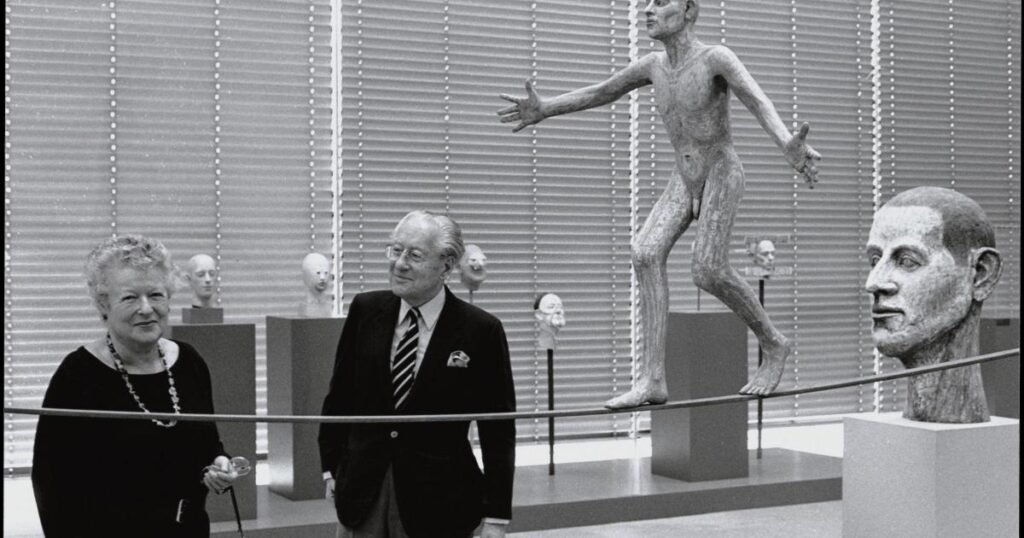
So, where to start? Well, in order to celebrate the breadth of women who make up the world-class collection of the Sainsbury Centre, we must first start with its co-founder, Lady Lisa Sainsbury.
A pioneering patron of the arts, Lisa married Robert Sainsbury (later Sir Robert Sainsbury) in 1937 and their collecting grew together, building a world-class global art collection spanning over 5,000 years.
Upon her passing aged 101 in 2014, The Times reported that she was “remembered by her friends as a serious, rather austere, person who would give great thought to the matter in hand before acting”.
Offering artists financial support as well as friendship, Lisa, along with her husband, became one of the most pioneering British art collectors of the 20th century.
It was testament to their relationships that Francis Bacon made portraits of both Robert and Lisa, Henry Moore was godfather to their son David, and Alberto Giacometti drew portraits of their children.
Lisa amassed an impressive collection of Lucie Rie buttons, one such example of her passion for ceramics, and the couple proudly stuck to only collecting things they loved and which their gut told them to.
The Sainsbury Centre holds a significant collection of work by Dame Elizabeth Frink (1930-1993).
Frink’s artistic career was launched aged 22 with her first solo show, and the artist went on to become one of few prominent female sculptors in mid-century Britain, in what was a male-dominated field.
She was selected as one of five women featured on British postage stamps in 1996.
Barbara Hepworth’s Discs in Echelon, version 2 sits in the Living Area of the Sainsbury Centre on long loan from the Hepworth Estate.
An artist, sculpture and mother of four (three being triplets), Hepworth is a household name for British art.
As well as her success as an artist, she promoted European modernism, abstraction, and Constructivism between 1933 and 1937 and in 1949 set up the Penwith Society of Arts with Ben Nicholson in Cornwall.
More recently, through the work of the Sainsbury Centre’s head of exhibitions, Tania Moore, and head of living art, Rosy Gray, more works by female artists have been acquired for the collection.
Martine Gutierrez, Leilah Babirye, and Somaya Critchlow are some of the names which now sit at home in the growing collection.
Leilah Babirye represents the queer communities of her native Uganda and New York.
Babirye received asylum in New York when she was forced to leave Uganda in 2015 for her activism due to the homophobic laws.
In sculpture and on paper, Babirye creates representations of LGBTQI+ people expressing their gender and sexuality freely.
Yemaya ‘Goddess of the Living Ocean’ is one of five works from Martine Gutierrez’s Demons series, made for her celebrated publication Indigenous Woman (2018).
Indigenous Woman used the language of fashion and advertising to subvert received ideas about ethnic and sexual identity.
Indigenous Woman adopts the format of Andy Warhol’s Interview magazine, but in Gutierrez’s version, its 124 pages are given over to the ‘celebration of Mayan Indian heritage, the navigation of contemporary indigeneity, and the ever-evolving self-image’, as she explains in her editor’s note.
Somaya Critchlow’s practice began in self-portraiture and now sees her creating fictional characters often inspired by women seen in popular culture, whether reality TV or music videos.
The painting in the Sainsbury Centre collection depicts a nude woman wearing a glamorous blonde wig.
She rests her head on her shoulder with her hand on her hip in a mannerism that is clearly posed for the viewer whilst she confidently returns their gaze.
Though Critchlow’s practice is based on simply painting what she knows, she acknowledges that painting Black women is, in itself, a political act.
This list is by no means extensive, and no small paragraph will do justice to these female powerhouses, but this is a small song singing about the power of women in art.
And whilst I discourage you from waiting until March 8 to celebrate the women around you, make sure you do so extra loudly on this day.