
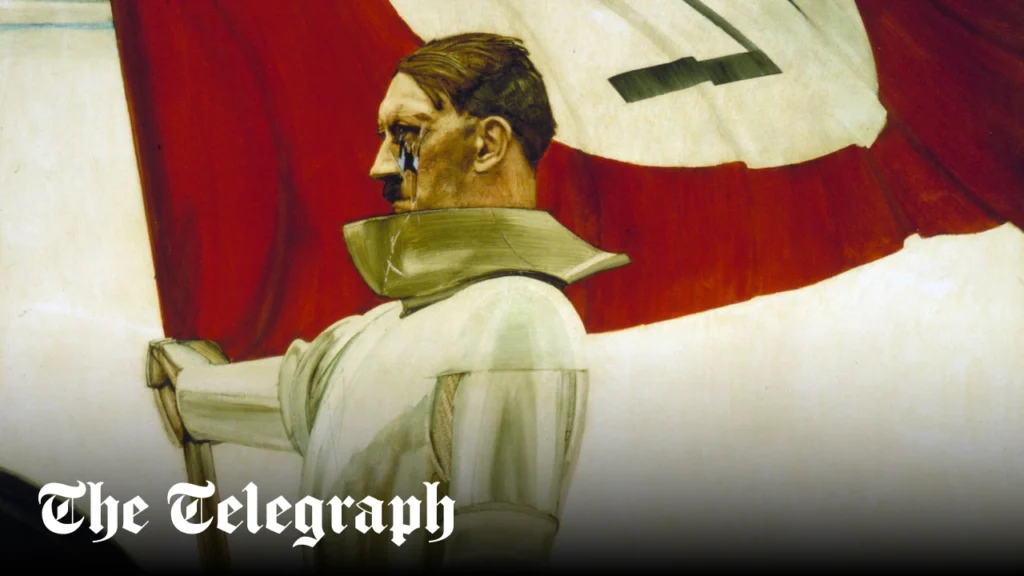
Martens is certain it was commissioned in response to Picasso’s Guernica (1937), painted after the Luftwaffe’s bombing of the town in support of Franco’s Nationalists.
“It was commissioned three or four weeks after Picasso showed his work at the Paris World Exhibition. That is not a coincidence. Guernica and Almería were bombed six days apart, with civilians killed in both attacks. It was hung while still wet at the Great German Art Exhibition, after the opening, so it was not in the catalogue. But I found it in the archives in Germany. Hitler notes in his list that he bought it for 8,500 Reichsmark.
“It took me two years and a new curator before [the Maritime Museum] changed the description on their website, which now reflects my suggestion.” Does he think the painting should be returned? “I don’t care that much,” he says. “But it should be in Germany. It is stolen.”
Morowitz is not in favour of hiding Third Reich art away – “you create this kind of forbidden aura around it” – but stresses that it needs to be shown responsibly. She also takes issue with the idea that only five per cent of it is propaganda.
“The majority of works, for example, that were shown at the Great German Art exhibitions each year were not explicitly propagandistic. They were genre scenes. They were landscapes. They were family scenes. But to say that a scene of blonde, braided peasants around a table during the Third Reich doesn’t carry, let’s call it an ideological message rather than a propagandistic one, is a very non-contextual way of seeing it.”
The other major holdings of Third Reich art are in two public collections: the German Historical Museum and the Pinakothek [der Moderne museum in Munich]. “It’s very difficult to get hold of works from the period” because almost of all it – perhaps 98 per cent, Martens believes – has been destroyed since the Potsdam agreement of 1945, in which the Allies set out a framework for the de-Nazification of post-war Germany. “There were fears that Nazism would come back to life. I understand that. But there is hardly anything left.”
Martens says he has bought everything from the GDK exhibitions that has come on to the market in recent years. He once travelled to northern Canada after receiving a letter from a man who wrote: “I understand you are the first one who likes the sculptures of my father…”
It was the son of a prominent Third Reich sculptor whose classical works had appeared at the GDK on several occasions. Martens reached the remote location by seaplane, acquired all eight pieces and had to persuade a local fisherman to ferry the largest – a 75kg bronze sculpture – back to a point from which it could be couriered to Europe.
He does not expect the discovery of any further major pieces, such as the two life-size horses by the Austrian-German sculptor Josef Thorak that once stood outside the New Reich Chancellery and were recovered by German police in 2015.
“There is still a sculpture owned by Hitler in the UK,” Martens says – the life-size marble Sandalenbinder (Sandal Binder) by Fritz Röll, bought at auction in London in 2008.