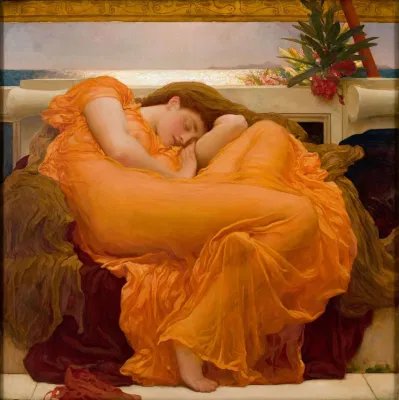
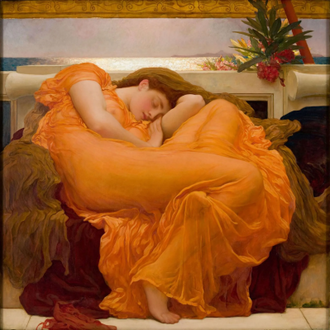
Flaming June, Lord Leighton © Museo de Arte de Ponce, Puerto Rico; Luis A Ferré Foundation, Inc.
Source: Christian Art
Gospel of 7 February 2026
Mark 6:30-34
At that time: The Apostles returned to Jesus and told him all that they had done and taught. And he said to them, ‘Come away by yourselves to a desolate place and rest a while.’ For many were coming and going, and they had no leisure even to eat. And they went away in the boat to a desolate place by themselves. Now many saw them going and recognised them, and they ran there on foot from all the towns and got there ahead of them. When he went ashore he saw a great crowd, and he had compassion on them, because they were like sheep without a shepherd. And he began to teach them many things.
Reflection on the painting
Today’s Gospel reading highlights the importance Jesus placed on rest. After a period of intense mission work, Jesus led his disciples to a secluded place to rest. Despite the abundance of work that awaited them, Jesus knew that taking time to step back from their duties was essential. Our lives too should be more than just constant labour. In fact, the value of rest is emphasised from the very beginning of the Bible. In the first chapter of Genesis, we read that God rested on the seventh day after creating the world in six days. As beings made in God’s image, we need periods of rest alongside our work. Rest allows us to reflect, appreciate our blessings, and observe God’s work in our lives. Being too busy all the time might make us lose sight of God.
Flaming June, painted by Frederic, Lord Leighton in 1895, is a quintessential example of Victorian neoclassical art. The painting depicts a beautiful young woman, draped in a vibrant, semi-transparent orange gown, asleep on a marble bench by the sea. She has come away to a lonely place to rest. Her serene pose and the meticulous rendering of the folds of her dress capture a dream-like quality. The brilliance of the orange gown contrasts sharply with the cool marble background and the deep blue sea. The laurel leaves that frame her head suggest a classical reference to ancient Greece, reinforcing the timeless quality of the scene.
The representation of “Flaming June” goes beyond mere aesthetics; it embodies the Victorian ideal of beauty and femininity. The exact inspiration for the painting remains a subject of speculation, but it is widely believed that Leighton intended to capture the fleeting beauty of a moment of rest, frozen in time. The theme of sleep, often associated with death in art history, underscores the transient nature of existence. The peaceful, almost death-like slumber of the woman can be interpreted as a metaphor for the temporary nature of beauty and life itself.
LINKS
Christian Art: https://christian.art/
Today’s reading: https://christian.art/daily-gospel-reading/mark-6-30-34-2026/