

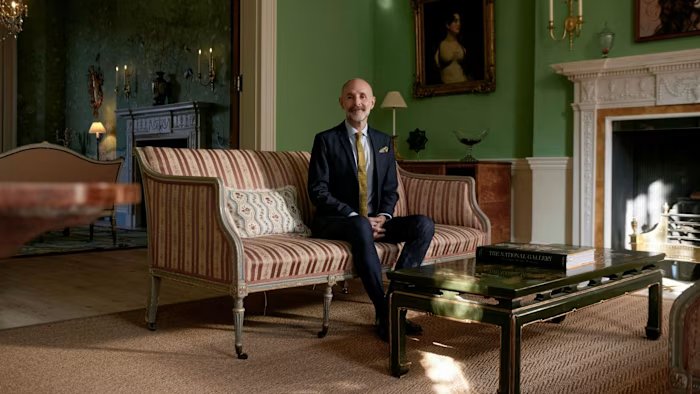
There are moments in the Marylebone home of artist Glenn Brown when a costume seems called for. The painter, who rose to prominence in the 1990s alongside the so-called Young British Artists, lives in a Georgian town house of period-drama proportions. While a great sack-back gown wouldn’t go amiss, Brown himself, in his skinny-fit suit and statement moustache, also appears somehow tethered to a bygone era.
He bought the property in 2018 with his husband Edgar Laguinia. It was a project. What from the outside was an elegant six-storey home was, on the inside, a series of inelegantly partitioned spaces. Over the years they had served as offices and doctors’ surgeries, with a lift shaft wedged into the central stairwell.
But when it came to making decisions about the three-year overhaul, it was neither Brown nor Laguinia that led the way. “The house did,” says Brown, friendly and matter-of-fact. “It told us what to do.”

The result is a faithful restoration of late 18th-century grandeur. In some places, layers of paint have been scraped back to uncover and then recreate the original hues. Doors have been painted with a faux wood-grain effect, to resemble mahogany and satinwood — as was the vogue then. Plug sockets are now hidden in the floor and light switches are as invisible as possible.
When the house itself hasn’t provided clues as to how it looked 200 years ago, they’ve turned to the National Trust or other Georgian properties for reference. The blue paint on the banister, for example, was inspired by Somerset House, while the staircase itself was based on the one at the Sir John Soane’s Museum. “Our architect [Emma Whitworth at Whitworth Howell] got told off for measuring it,” smiles Brown.
In the dining room, a Georgian mural lurked underneath multiple applications of wallpapers: “It’s probably Italian, with dragons and plants and grotesques, but it had been too badly damaged to restore,” says Brown. “We couldn’t possibly paint over it, though, because I’ve got too much respect for it.” Instead they opted for a curtain.


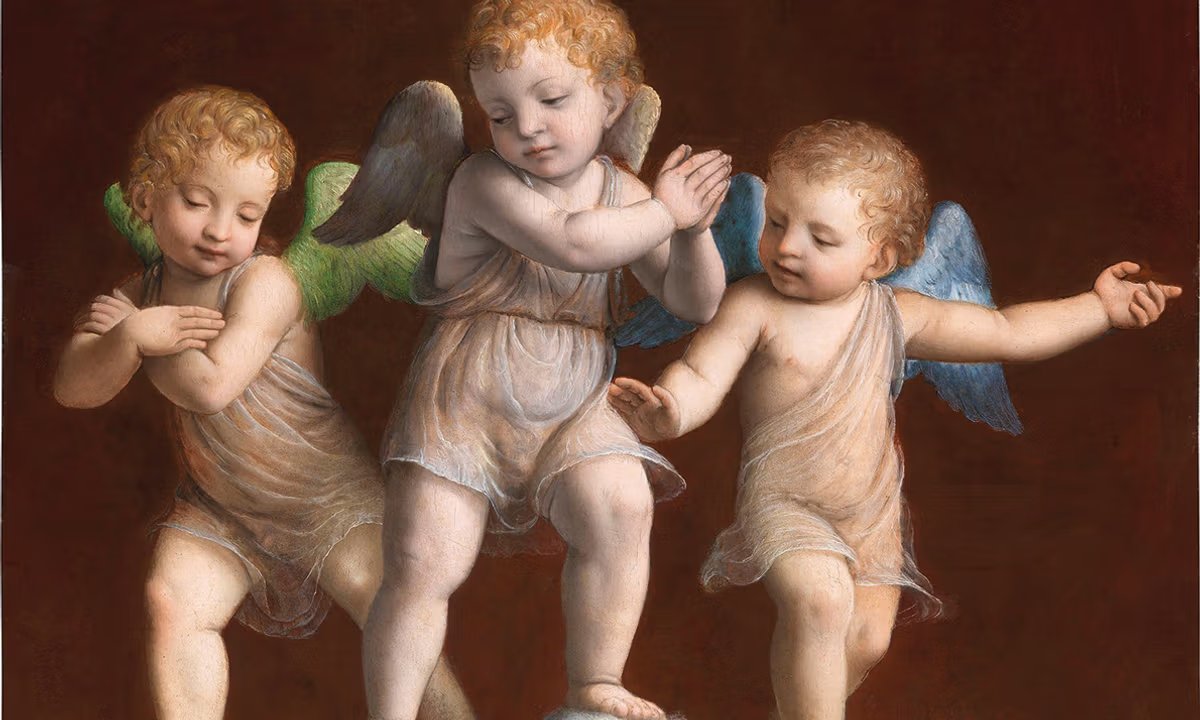
Historical reverence is at the heart of Brown’s artistic practice. His paintings always begin with a study of an existing artwork. It could be a 16th-century engraving by Dutch master Hendrick Goltzius; a painting by 18th-century Venetian Giovanni Battista Tiepolo; or an early 20th-century drawing by English artist and occultist Austin Osman Spare. They are then menacingly transformed with lurid colours and sinewy brushstrokes. Skin and hair often seem eerily alive.
“With a lot of my paintings, I want people to think that they’re changing from one thing to another, that everything is moving,” explains Brown, whose work has been the subject of multiple solo shows with Gagosian gallery (most recently at Frieze Masters), as well as at institutions such as Amsterdam’s Rembrandt House and the British Museum. Since 2022, he and Laguinia have also run their own London museum. The Brown Collection, nearby in Marylebone, brings together Brown’s works and those by other artists. It also runs events — from life-drawing classes to a programme of artist talks.

“The collection is mostly historic — a lot of 17th and 18th-century paintings, prints and drawings — but there are contemporary artists that we love too,” he says. Hoi Polloi, the current exhibition, is a smartly curated ode to “the people”, from Dutch mannerism up to Brown and his contemporaries Anya Gallaccio and Gillian Wearing. “You can tell stories by putting works together,” says Brown. “That’s what we do in the collection.”
It’s also what he and Laguinia, a former product designer who now directs The Brown Collection, do at home, where “the painting spreads into the room and the room spreads into the painting”. In the first-floor living room, for example, the birds in De Gournay’s rambling Chinoiserie wallpaper are in conversation with a vast and energetic abstract canvas by contemporary artist Fiona Rae. On top of the curtain-clad dining-room walls, there are paintings by British post-Impressionist Walter Sickert and surrealist Grace Pailthorpe. “She was a surgeon, then a psychoanalyst; she was a genius,” says Brown enthusiastically. “All her work is stream of consciousness.”


As we walk through the home, each and every artwork elicits a passionate appraisal. In the study, a tiny and fantastically detailed Hendrick Goltzius engraving “is one of the masterpieces of mankind”, says Brown. The room’s pink paint colour, meanwhile, was recently recreated for Brown’s show at the Freud Museum. “It’s Dulux; it just has a number,” he says of the shade. “It’s not called dead salmon — or live salmon — or anything like that.”
“Glenn has an instinct for colours,” adds Laguinia. “And he is a fiend on the internet. He paints, then he looks at auction sites.”
Nearly all the furniture is antique — from the Georgian chandeliers to the four-poster beds. While one Georgian settee previously belonged to American philanthropist Drue Heinz (“as in baked beans”), a mirror in the downstairs loo came from a sale of Peter Stringfellow’s effects. “We like old toilets and fixtures,” laughs Laguinia, highlighting one of their sources: Mongers Architectural Salvage in Hingham, Norfolk, near to where Brown grew up.

The couple met through friends more than 20 years ago. A typical day begins with breakfast together: sometimes in the basement kitchen, a space where “you’re supposed to imagine that you’re in the 1790s”, says Laguinia. They’ve maintained the original fireplace — “that was the Gaggenau of the time,” says Brown — while the electric hob can be removed from the worktop to preserve the period feel. “We both like cooking,” says Laguinia. “He does the healthy stuff. I do the unhealthy stuff.”
There’s also a second kitchen on the top floor of the house — a surprising 1960s restyle by the previous owner, architect John Harris, best known as the creator of the first city master plan for Dubai in 1960, and also responsible for the glass-walled, terracotta-tiled corridor running the length of the courtyard garden downstairs.


The loft space is “like a time capsule”, says Laguinia. “At night it’s a cocktail lounge.” They’ve leaned into the retro vibe with mid-century furnishings. Coffee and cocktail tables, cast in cement with stones and metal pieces, are by Dutch designer Paul Kingma, and set, on my visit, with 1960s Gio Ponti tableware — plus croissants and homemade jam: fig, quince and plum.
For most of the day Brown is busy painting at his Shoreditch studio. He works alone from around 10am, “and I try to be home by midnight”. When he finishes a painting it is often hung at home by way of evaluation: “It has to compete with what’s around it and if it can’t, it’s not good enough.”
There’s one space in the house, however, that is dramatically devoid of artwork: the hallway, which is instead densely hung with empty antique picture frames. “It’s a slightly disrespectful place to put a painting, because it’s a place of passing through, but it was a good place to put frames,” says Brown, whose collection spans a 17th-century Florentine behemoth made for the Medici family to a Georgian design by British architect William Kent.

As well as their London base, the couple own a manor house in the Suffolk countryside that dates back to 1679, and which was their first foray into historic renovation. “It’s fun,” says Laguinia of the process. He sings the praises of builder James Whitworth, who they worked with on both their London home and The Brown Collection. But they will not, asserts Brown, be taking on another fixer-upper. When the chance arose last year to take on “something twice as big, Glenn didn’t even want to see it”, says Laguinia. “I couldn’t let it go, though, so I recommended it to some friends — and they bought it.”
A smaller-scale project is, however, in the works: a domed-ceiling shell grotto on the grounds of their Suffolk home. While Laguinia is currently making porcelain animals to add to the shell-encrusted walls, Brown is working on three paintings for the space, which will also be shown at Number One Royal Crescent in Bath as part of a multi-venue exhibition opening on May 22. The motivation behind this folly is simple, says Laguinia: “That’s what people did in the 1730s, so that’s what we did.”
‘Hoi Polloi’ is at The Brown Collection until August 8 2026; the-brown-collection.co.uk
Find out about our latest stories first — follow @ft_houseandhome on Instagram


