

JTA — After studying the world’s oldest synagogue paintings for nearly a decade, Jill Joshowitz had accepted that she might never be able to stand before them as they remained locked away in Syria amid its civil war.
Jewish sites and synagogues suffered lootings and bombardment over the course of the war, which followed the emigration of virtually all Syrian Jews. Could the paintings have even survived?
“I spent almost a decade of my life researching and writing about these paintings, and because they were stored in Syria, I never thought that I would really have an opportunity in my lifetime, as a Jewish scholar and researcher, to see these paintings,” said Joshowitz, a historian of Jewish visual culture based in Pittsburgh.
“I didn’t really know what the status was. Obviously there was this horrific civil war, and so I really didn’t know what to expect,” she added. “Nobody in my social network knew anything about the fate, what had happened, to these paintings over the course of the Syrian civil war.”
On Tuesday, Joshowitz learned the astonishing answer. Not only had the paintings survived, but they had been preserved in their original arrangement, the way they first appeared more than 1,700 years ago.
The answer was revealed when she arrived at the National Museum in Damascus alongside a delegation of Jewish scholars and leaders, in a trip made possible by the fall of the Bashar al-Assad regime.
The trip, which was chronicled in The Times of Israel by its founding editor David Horovitz, was facilitated by Rabbi Asher Lopatin, the director of community relations for the Jewish Federation of Ann Arbor in Michigan, and Joe Jajati, the grandson of a former leader of Syria’s Jewish community who founded the Syrian Mosaic Foundation.
Lopatin had visited Damascus on a similar journey in February, just two months after the fall of the Assad regime made Jewish travel to the country possible again. The group was the first Jewish delegation to visit Syria in over three decades.
While his group had visited the National Museum in Damascus at the time, they had not seen the Dura Europos paintings, which are the earliest and largest known collection of synagogue paintings in the world.
The Dura Europos synagogue was painted around 244 CE but was filled with dirt just a decade later by the Roman garrison stationed in the town along the Euphrates to help fortify the city ahead of an invasion.
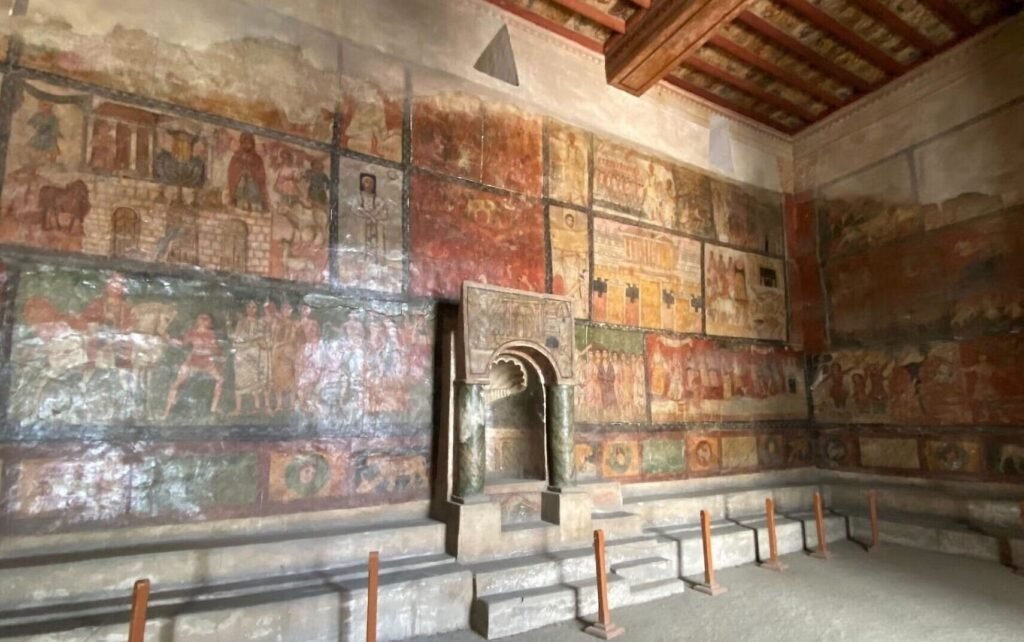
After the city was destroyed, the synagogue was lost to time until it was excavated in the 1930s, where archeologists discovered that the layers of earth had preserved its extensive wall paintings of biblical figures and scenes. The paintings were later moved to the National Museum in Damascus and are housed in a replica of the ancient synagogue where they were created.
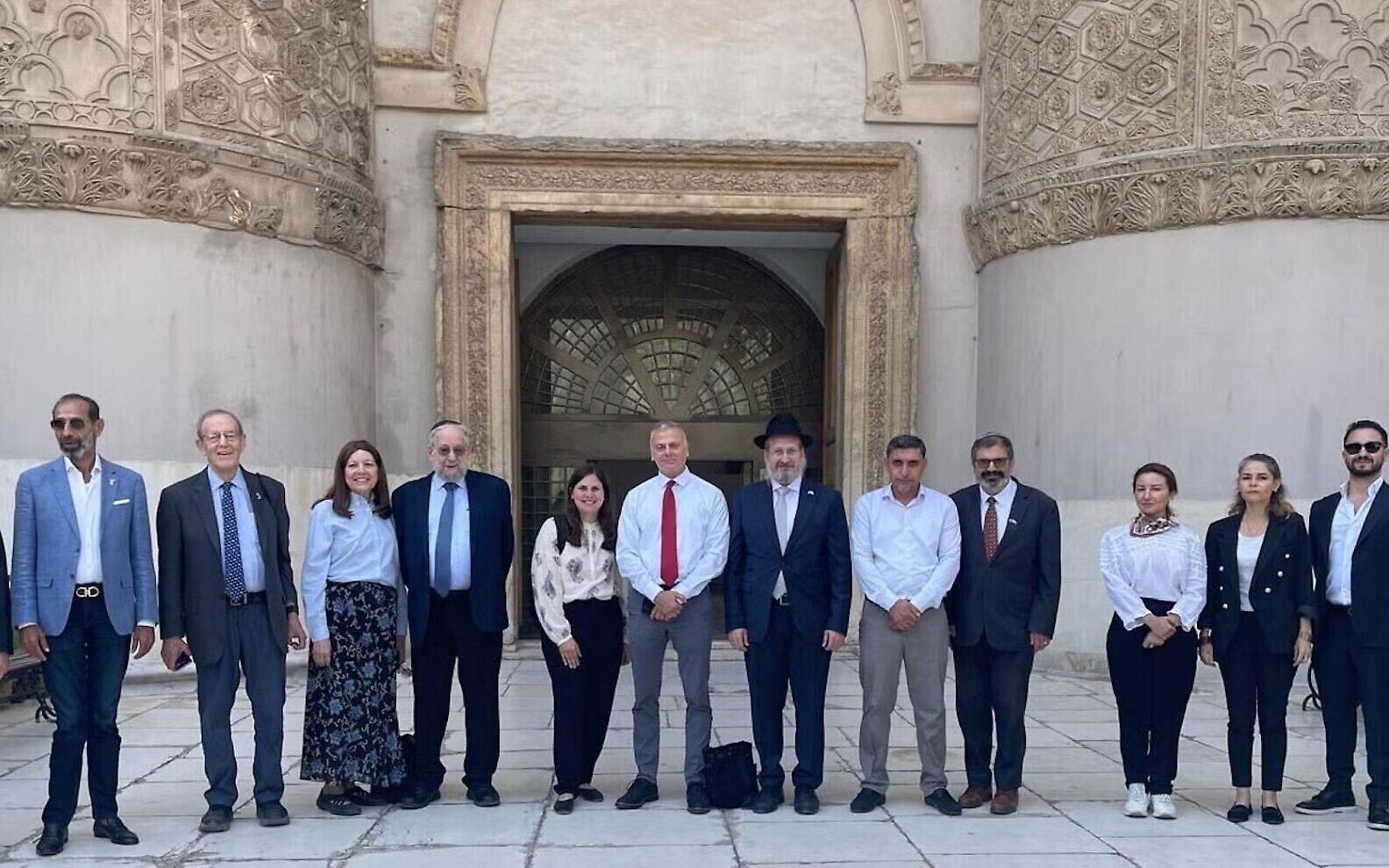
A group of Jewish scholars and leaders, with representatives from the National Museum of Damascus, outside the museum on Sept. 16, 2025. (Courtesy Asher Lopatin via JTA)
After hearing about his February trip, Joshowitz — who received a doctorate in Judaic studies from New York University in 2023 after studying biblical art of the eastern Mediterranean — reached out to Lopatin. She was hoping to learn what the status of the paintings were ahead of a planned talk about the paintings at the University of California, Irvine this fall.
But instead of simply arranging an introduction to curators and researchers at the National Museum in Damascus, Lopatin went a step further: He invited her to join him on an upcoming trip to Syria to see the works firsthand.
The trip took place this week. Reaching the National Museum via a convoy of blue SUVs, the group was greeted by a group of curators and researchers from the museum who led them through the heavy wooden doors of the replica of the Dura Europos synagogue.
With sunlight streaming through the replica synagogue’s newly-opened doors, Joshowitz and her team pored over the seven-meter high frescoes depicting a wide array of biblical stories: Moses at the burning bush, the prophet Samuel anointing King David, Abraham and the binding of Isaac and Mordecai riding on a horse led by Haman.
“It was just thrilling to see these paintings that I had studied and thought about for so long,” said Joshowitz. “I just had the best time sharing this knowledge that I’ve been kind of building up, but never really had an opportunity to share with people in the space.”
After only being able to study the paintings through photographs from the 1930s and 1950s, Joshowitz said that they were more vibrant in person. She learned that paintings had at some point been covered in varnish to protect them.