

Flowers often depicted in Minoan and Egyptian art were powerful symbols of life, the afterlife, and rebirth, according to a study of Aegean art. These artistic representations were not merely decorative; they carried deeper cultural and spiritual meanings, linking the natural world to human existence and religious practice. Through these floral images, ancient civilizations expressed ideas about the cycles of life, mortality, and renewal.
In a study entitled “Human Life Hidden in the Symbol of a Flower. Between the Minoan World and Egypt,” researcher Monika Wesołowska-Mazurowska argues that floral symbolism appearing in several frescoes and other artifacts was a defining element of Minoan identity. By embedding flowers into art and ritual objects, the Minoans communicated social, religious, and cosmological concepts, showing that these blooms were far more than simple ornamentation.
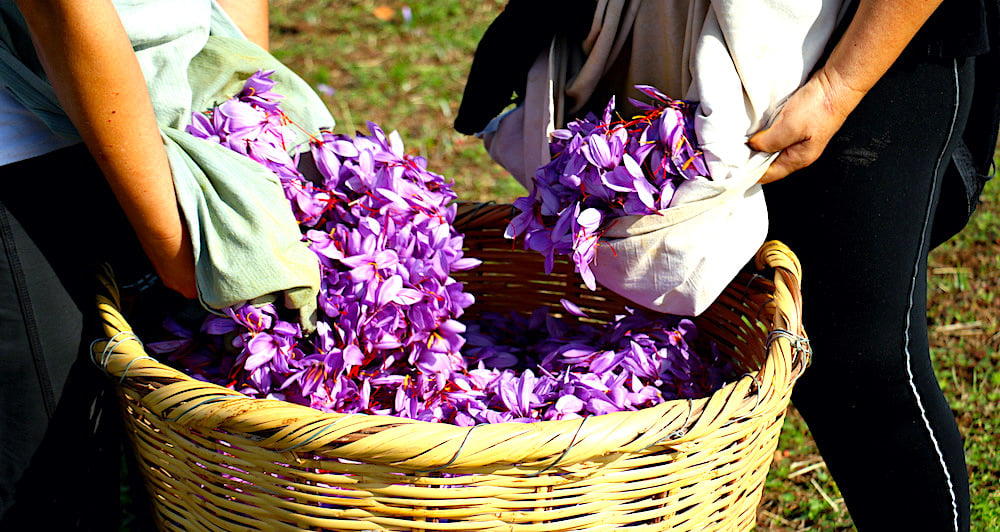
One of the most popular flowers in Aegean art is the crocus (Crocus sativus), also known as saffron. The iconographic evidence of this flower frequently appears in sacral contexts. Crocuses could serve as offerings to a priestess or goddess, appear as ornaments on altars, decorate offering tables, or be incorporated into pendants and other ritual objects. Their repeated presence in such contexts suggests that crocuses were closely associated with spiritual life, divine favor, and perhaps even the hope of renewal or rebirth.
The depiction of flowers was not limited to Minoan art. In Egypt, flowers also held deep religious significance. The lotus, in particular, was regarded as a plant of regeneration because it emerges anew from the water each day. There were two main types of lotus in Egyptian symbolism: blue and white, representing death and rebirth, respectively. This dual symbolism connected the flower directly to the human life cycle and the eternal patterns of nature, reinforcing the sacred link between the natural and spiritual worlds.
In the Egyptian Book of the Dead, the following spell is found: “I am this pure lotus that went forth from the sunshine.” This passage illustrates how a flower could be interpreted as a metaphor for human life itself, embodying the journey from birth through death and the hope for renewal beyond it. Through such imagery, both Minoan and Egyptian art show that flowers were more than aesthetic elements—they were profound symbols of existence, spirituality, and continuity.
Flowers and plants as popular motifs in Minoan art
Flowers and plants are among the most popular motifs depicted in Minoan art. They appear in frescoes, ceramics, votive objects, and other materials, serving not merely as decoration but as symbols imbued with cultural and spiritual significance. Scholars argue that floral symbolism was a defining element of Minoan identity, reflecting both aesthetic preferences and deeper social or religious meanings.
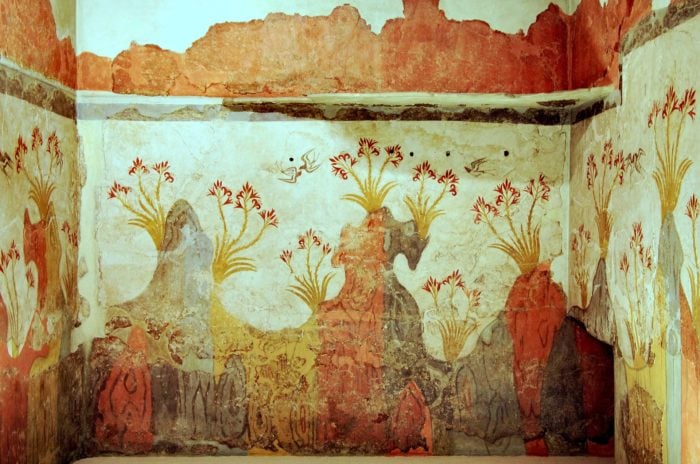
The most prominent flower depicted in Aegean art is the crocus. This flower produces one of the most valuable spices, saffron, and for the Minoans it carried sacred significance as well. Beyond its ritual and symbolic value, the commercial use of saffron added practical and economic importance to the crocus, especially during the Mycenaean period when trade and spice use expanded.
The crocus and its saffron spice had multiple properties. They were valued not only for their medicinal properties but also for pain relief, dyeing textiles, and culinary applications. Studies have shown that saffron was utilized as a remedy for several ailments and was believed to have properties that could prolong life. In addition, saffron enhanced the flavor of dishes and beverages, served as a dye for fabrics, and was even used in some perfumes, making it a versatile and highly prized resource in Minoan society.
It can be said, therefore, that the crocus was an integral part of Minoan culture and identity, especially among women, who appear closely connected to floral symbolism in ritual and domestic contexts. Its presence in art and daily life underscores the flower’s role not only as a sacred symbol but also as a marker of status, utility, and cultural continuity.
The crocus flower motif and how it evolved: From Egyptian to Minoan art
For quite some time, archaeological discussions about the crocus in the Minoan world focused on interpreting frescoes and other artistic representations. The earliest depictions of the crocus flower date to around 2100–1925 BC and 1925–1875 BC, appearing on an early Kamares cup found in Knossos. Another example is a hole-mouthed vessel discovered in the Kamares Cave, both of which portray the flower in strikingly naturalistic detail.
Minoan cups and mugs! Kamares ware found at Knossos, Crete and dating to the Proto-Palatial period (1900-1700 BCE). Heraklion Museum, Crete. Photo source: The Kosmos Society https://t.co/9Vmj6zGPG0 pic.twitter.com/w3F01LOqTv
— Angela O’Brien (@GrecianGirly) June 18, 2022
In these early examples, the crocus flowers are depicted with remarkable realism, including the three stigmata that characterize the plant. By 1700–1625 BC, the crocus motif continued to be rendered naturally on ceramics and frescoes, reflecting the Minoans’ careful observation of nature and their ability to translate it into artistic form.
Evidence from a conical rhyton (ceremonial drinking or pouring vessel) found in Palaiokastro indicates that between 1625 and 1470 BC, the crocus flower motif reached its artistic peak. By 1420–1330 BC, the motif became less common as a decorative element, though the crocus ideogram persisted in Linear B script, suggesting that the flower retained symbolic significance even as its visual prominence declined.
Minoan rhyton for pouring libations, in the shape of a bull’s head. From the Palace of Knossos, Crete. Dated ca. 1550-1500 BCE. Made of black steatite, jasper, and mother-of-pearl. Heraklion Archaeological Museum, Crete. 📷 My own. https://t.co/q7fIGdUk5F pic.twitter.com/GoU8QthS7Y
— Angela O’Brien (@GrecianGirly) June 4, 2023
Researchers have categorized the crocus motif into four main types: 1) with human figures, as seen in Knossos, Agia Triada, and Akrotiri; 2) with animals, documented in Knossos, Akrotiri, and one example from Agia Triada; 3) as bodily decoration, primarily in Akrotiri; and 4) without identifiable context, appearing at sites such as Knossos, Tylissos, Akrotiri, Pylos, and Tiryns. This classification highlights the versatility of the crocus motif in Minoan artistic expression and its integration into multiple aspects of daily and ritual life.
Saffron, the valuable product of the crocus flower—especially the sterile domesticated variety Crocus sativus L.—was extremely expensive. It has been estimated that around four hundred people were needed to produce just one kilogram (2.2 pounds) of this spice. The cultivation and processing of saffron were therefore a highly lucrative enterprise with great importance in Minoan industry, medicine, and religious practice.
The vibrant yellow of the spice was associated not only with wealth and property but also with the divine. Greek heroes and heroines, as well as gods and goddesses, were frequently described as wearing saffron-colored garments, underscoring the flower’s cultural and symbolic significance across both sacred and secular spheres.
Saffron production
Archaeological discoveries at Akrotiri provide valuable insight into the production of saffron. In the upper part of the Xeste 3 building, the fresco known as The Saffron Gatherers was found. This depicts two girls picking crocus flowers among a rocky landscape, offering a rare glimpse into both the labor and ritual significance of saffron harvesting.
Saffron gathering appears to have been a social event of particular importance rather than an isolated activity. The scene carries a distinctly ritual character: some of the crocus flowers, carefully collected in baskets, are apparently reserved for the goddess. This suggests that the act of harvesting was imbued with religious meaning and linked to broader ceremonial practices.
English archaeologist Arthur Evans argued that saffron was an attribute of the Great Goddess, the principal Minoan deity associated with fertility and nature, who oversaw the saffron industry on Crete. This interpretation is supported by other scholars, including Spyridon Marinatos and Christos Doumas, who also emphasized the ritual significance of the fresco. According to these experts, the cultivation and collection of saffron were not purely economic activities but were intimately tied to sacred observances.
Archaeologist Nanno Marinatos offers a further interpretation, suggesting that The Saffron Gatherers fresco represents a Spring Festival celebrating the rebirth of nature, while also hinting at blood sacrifice. The scenes may depict rites of passage in which young girls mature, highlighting the symbolic role of saffron as a medicine for menstrual cramps.
Classicist Anne Chapin identifies the girl in the fresco as a teenager, while theologian Ellen Davis interprets the depiction of blood as an allusion to the loss of virginity as a girl transitions into womanhood. Together, these interpretations reveal that saffron harvesting on Minoan Crete combined practical, medicinal, and deeply symbolic dimensions, reflecting the intersection of daily life, ritual, and cultural values.

The floral motif in Egyptian art
The use of floral motifs was not limited to Minoan art; flowers were also highly significant in Ancient Egyptian culture. While the Minoans favored the crocus, the Egyptians revered the lotus, a flower they believed possessed regenerative qualities. The lotus held a central place in Egyptian iconography and religious symbolism. Although rare in Minoan art—and sometimes substituted by the crocus—the lotus occasionally appears in Aegean motifs, reflecting cross-cultural artistic influences.
The lotus was especially important in Egyptian beliefs because it symbolized regeneration and the cycle of life. Emerging from water each day, the flower represented rebirth and renewal. Egyptians distinguished between two types of lotus: blue and white, which symbolized death and rebirth, respectively. Through this duality, the lotus became a visual shorthand for the human life cycle, connecting natural phenomena to spiritual and cosmological concepts.
In Egyptian art, the lotus was often used as a metaphor for divine emergence and creation. From the lotus bud, the young god Re could appear, symbolizing birth and the renewal of life. In some cases, a blue lotus might be depicted rising with the head of a specific individual, such as the object found in Tutankhamun’s tomb, interpreted as signifying the pharaoh’s resurrection. These representations reinforced the lotus as a symbol of continuity, divine favor, and eternal life.
The Book of the Dead includes the spell “for being transformed into a Lotus,” highlighting the flower’s deep connection to beliefs about life after death. When the lotus hid beneath the water at night, it symbolized death; when it emerged in the morning, it represented rebirth. Through such imagery, the lotus became a vital motif in Egyptian art, serving as a powerful emblem of mortality, regeneration, and the promise of eternal life.
The lotus and the Old Kingdom
Egyptians viewed the lotus flower as sacred as early as the Old Kingdom, when it appeared in relation to Horus in the Pyramid Texts and the Coffin Texts. In these ancient writings, the lotus is frequently presented as a symbol of rebirth, as seen in representations within the tombs of Nefertum and Kaha at Saqqara. The flower’s association with renewal and life persisted across multiple burial sites, underscoring its centrality to Egyptian religious thought.
Similar examples can be found in other tombs at Saqqara, including those of Hetepka and Mererouka, and in the tomb of Iymera at Giza, where the lotus motif consistently conveys themes of regeneration and the cyclical nature of life. After the Amarna period, the lotus also became associated with the god Re, further emphasizing its connection not only to rebirth but to life itself. In Egyptian art, the lotus often serves as a visual vehicle for divine emergence, with the head of a young god rising from the flower, echoing the motif’s symbolic function in the natural and spiritual world.
Like the crocus in the Minoan world, the lotus had practical uses as well. All parts of the plant (Nelumbo nucifera) are edible: protein-rich bread could be made from its seeds, while the heart of the seeds was used in traditional Chinese and Indian medicine. The flower was therefore both a sacred symbol and a valuable resource, linking the spiritual and practical aspects of life.
The lotus was also associated with perfumes, though in a different context than the Minoans. The god Nefertum, a deity of perfumes, was said to be born from the bud of the blue lotus that emerged from the waters of Nun at the beginning of creation. This sacred lotus was also connected to Tutankhamun, further reinforcing the flower’s divine status and its enduring significance in Egyptian art, religion, and daily life.
Was the flower motif adopted into Minoan culture from Egypt?
A number of scholars argue that the floral motif, particularly those featuring lily and ivy designs, may have been introduced to Minoan culture from Egypt. However, it is notable that the lotus—so central to Egyptian art and religious symbolism—is very rarely depicted in the Aegean, with only a few examples identified. This suggests that while Minoan artists may have been aware of Egyptian floral motifs, they adopted and adapted them selectively, often emphasizing different flowers or combining influences with local traditions.
At Phylakopi, located on the northern coast of the Aegean island of Milos, archaeologists have discovered four objects adorned with floral motifs. Scholars generally agree that these decorations depict the lotus or a flower closely resembling it, indicating some level of cross-cultural artistic influence.
Among the finds at Phylakopi are stone blossom bowls thought to have been inspired by the lotus. Additionally, two ceramic pedestal bowls from the site feature lotus-like motifs. These decorations include large petals surrounding a central receptacle, with one bowl displaying a rosette pattern in which petals radiate outward from a dotted circle that adorns the central dome. Such details demonstrate the careful attention Minoan artists paid to floral imagery and their interest in both aesthetic and symbolic forms.
Researchers caution, however, that establishing a direct link between Minoan and Egyptian art in terms of semiology and symbolism is challenging. Papyrus, lotus, crocus, and lily are all distinct flowers in reality, but their visual artistic representations are remarkably similar. This means that scholars must exercise caution when interpreting the meaning and origin of floral motifs in Minoan art, recognizing both potential influences and local adaptations.
The Saffron Gatherers
The fresco discovered in Xeste 3 at Akrotiri on the island of Thera (modern Santorini) has been the subject of varied interpretations among scholars regarding the flowers being harvested. It has been unofficially named The Saffron Gatherers. While some researchers identify the flowers as crocus, others have questioned this interpretation and proposed alternatives. There is, however, no conclusive evidence that Thera or other Mediterranean cultures at the time produced or exported saffron, adding to the debate about the fresco’s precise meaning.
A complicating factor is that Crocus sativus L., the species from which saffron is derived, blooms in the autumn rather than the spring. This raises questions about whether the fresco depicts a springtime scene, as often believed. It is possible that the crocus shown is a spring variant, but the specific type is difficult to determine from the artwork alone, leaving room for interpretation.
Some researchers have proposed a symbolic reading influenced by Egyptian beliefs. The fresco may represent a feast celebrating life, with the yellow color of the flowers symbolizing the sun. The figures in the scene appear to undergo a transformation: they symbolically “die” and are reborn as new human beings, suggesting a rite of passage and the cyclical nature of life. In this view, the fresco conveys not just agricultural activity but also deeper spiritual and cultural themes.
Wesołowska-Mazurowska concludes that the fresco hides a representation of human life behind the flower symbol, regardless of whether the flower is definitively identified as crocus or papyrus. The precise botanical identification is less important than the meaning: flowers in art primarily serve as symbols.
One plausible explanation is that the traditional crocus iconography on Crete may have drawn inspiration from the lotus flower in Egyptian art, which similarly conveyed themes of regeneration and renewal. This interpretation highlights the shared symbolic language of flowers in the ancient Mediterranean world, connecting life, death, and rebirth across cultures.