
As a female, queer artist working in the years before and after the Second World War, Finnish artist and Moomins creator Tove Jansson (1914-2001) was compelled to carve out a unique career as a painter, illustrator and, later, author. Her fantastical, rich aesthetic was reflected in her vibrant personality, both of which came together in her rich body of work, which encompasses texts, illustrations and paintings.
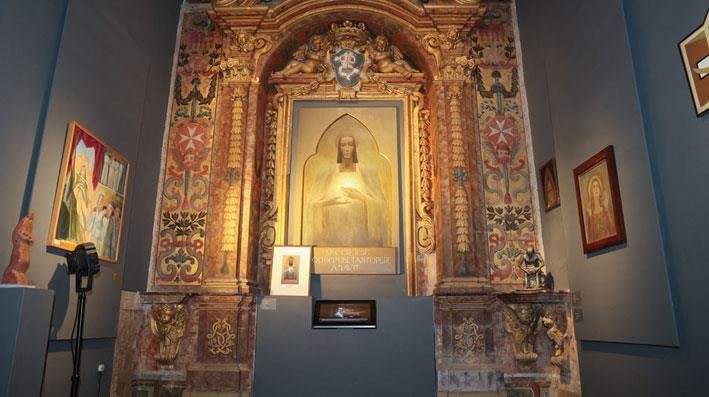
Jansson’s eclectic body of work is now the subject of a new Paris exhibition, ‘Houses of Tove Jansson’, curated by art institution The Community. Produced both with Jansson’s estate and Moomin Characters, the retrospective examines Jansson’s life and oeuvre and, for the first time, considers her work alongside contemporary artists.
‘Houses of Tove Jansson’, Paris

Tove Jansson, Little My Paperdoll, Undated. Mixed technique
(Image credit: Tove Jansson. ©Moomin Characters)
‘Tove started to exhibit her work and receive commissions gradually towards the end of the 1930s,’ say curators Tuukka Laurila and Sini Rinne-Kanto. ‘She also did many illustration works in order to gain enough money to live. However, the constant critique and the strictures of the art world and the war gave her the impulse to focus on the first Moomin book. As the Moomin books started to have success, she wanted to focus on them to be independent financially.
‘It is interesting to observe this trajectory – she aspired to be a fine artist (and succeeded in it!) but turned towards other modes of expression after facing some [disappointments]. The Moomin books gave her a certain freedom and independence, a unique space in which she was free to explore her dreams and to do whatever she wanted.’

Tove Jansson, In the heat of the stove, 1953. Oil
(Image credit: ©Tove Jansson Estate)
Her personal life constantly informed her work, with characters in the Moomin books often plucked from her close circle. ‘Before meeting Pietilä [her life partner Tuulikki Pietilä] Jansson had already started to explore queerness, having had several same-sex relationships during and after the war, notably with the theatre director Vivica Bandler (1917-2004),’ Laurila and Rinne-Kanto add. ‘Jansson worked with Bandler on the first Moomin play, Comet in Moominland, shown at Helsinki’s Swedish Theatre in 1949. The two were the inspiration behind the respective characters of Thingumy and Bob, who first appeared in Trollkarlens hatt (Finn Family Moomintroll) (1948), carrying a strange suitcase and speaking a secret language of their own.’
Personal artefacts in the exhibition give a context to Jansson’s work, which is rooted in her home in downtown Helsinki, her favourite city of Paris, and in the isolated Klovharun Island in southern Finland. ‘We have included for example films, audio recordings, photographs, drawings and diaries that Tove and her partner Tuulikki Pietilä made either during their numerous journeys or in their solitary island Klovharun. They might seem mundane but they open up new perspectives in their lives and works. And understanding this attitude they had in life was important for us in the process – seeing that everything was made into art around them is so inspiring.’

Tove Jansson, Unnamed, 1971. Ink
(Image credit: ©Tove Jansson Estate)
The development of Jansson’s distinctive style is traced from her early self-portraits through to these documentations, also taking in early illustrations for books including Alice in Wonderland and The Hobbit and her classic Nordic novel. Say the curators: ‘Her later books Den ärliga bedragaren (True Deceiver) (1982) and Rent Spel (Fair Play) (1989) both demonstrate the considerable development of her literary tone: the hint of darkness that was earlier present in her children’s books through tangible disasters and threats is now expressed through more complex characters and literary strategies. The exhibition seeks to convey this development also by sharing stories of Tove’s life, essentially what inspired Tove to make these works.’

Tove Jansson, Recluse, 1935. Pastel on paper
(Image credit: ©Tove Jansson Estate)
In this exhibition, Jansson’s works are showcased alongside artists including Anne Bourse, Emma Kohlmann, Ida Ekblad, Vidya Gastaldon and Carlotta Bailly-Borg. Moomin Characters has also marked the retrospective with one-of-a-kind capsule collections created in collaboration with D’heygere, Vitelli, Ana Kraš x CC Tapis and Sabine Marcelis. Say Laurila and Rinne-Kanto: ‘“Houses of Tove Jansson” seeks to offer an all-encompassing view on Tove’s life and work, and this is why it’s so important – and an honour – for us to show these more personal aspects for the visitors.’
The exhibition takes place 29 September – 29 October 2023 in a former printshop, at Espace Mont-Louis, 8 Impasse de Mont Louis in the 11th arrondissement of Paris
‘Houses of Tove Jansson’ will be free but require registration. For more information, visit housesoftovejansson.com

Tove Jansson, Little My Paperdoll, Undated. Mixed technique
(Image credit: Tove Jansson. ©Moomin Characters)