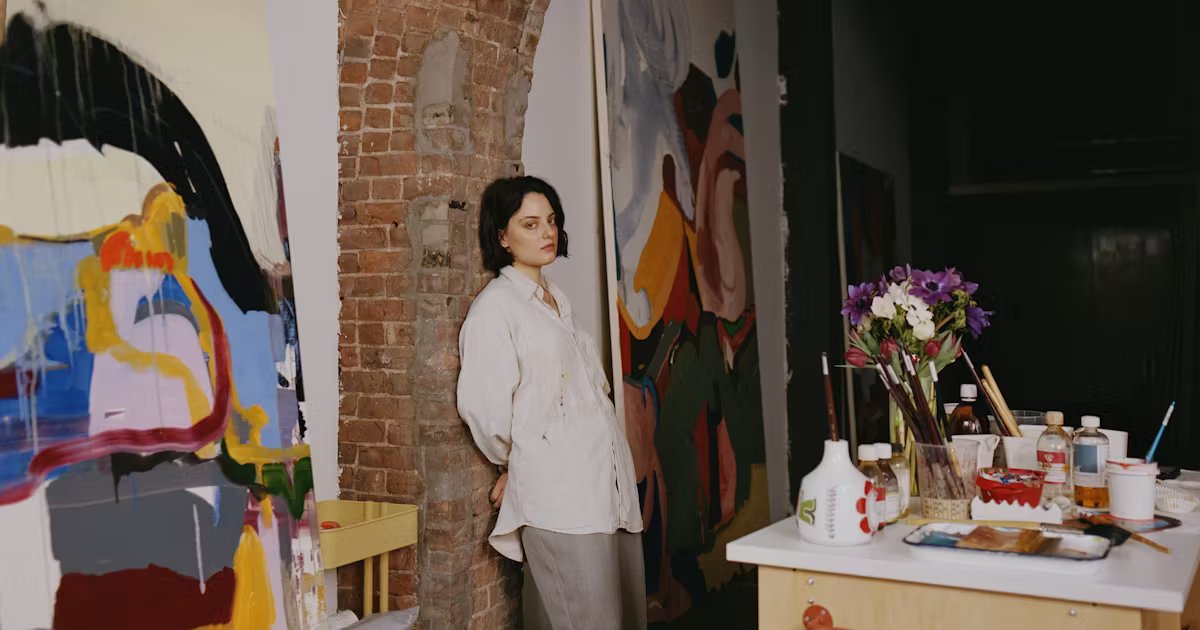

Laska, Kira Freije’s glossy black labrador, enthusiastically greets me at the door to the artist’s east London studio. Freije, make-up free, dressed in a vintage T-shirt and jeans, appears behind. “Sorry! I hope you like dogs?” Her manner is warm, self-effacing and light, a soft counterpoint to the metal bodies and limbs strewn around her: half-formed torsos, fragments of hands and feet, metal faces in contorted expressions, scraps of vintage fabric strewn on unfinished welded skeletons. One, stretched across an un-upholstered sofa, holds a large glass bird in its hand (Freije works closely with a glass-blower). Yet, despite this frankly quite strange scene, the space doesn’t feel macabre, rather oddly inviting, tender, domestic even.

Niall Hodson
Born in 1985 in London, Freije first studied at The Ruskin School of Art in Oxford, before attending London’s Royal Academy. “I suppose everything began there,” she says while offering me fresh papaya and sweet pastries. “At Ruskin, I had this incredible grounding in art history, but it overwhelmed me – it wasn’t surprising or exciting me. At the Academy, I finally had time to fail and come back up again. That’s when I started to find this voice.”
Since graduating in 2016, that voice has led her to exhibit her metal sculptures across Europe and beyond. Unspeak the Chorus, her biggest show to date, opens at The Hepworth Wakefield next week. It’s a title she lifted from a 2023 work centred around two ghoulish metal figures. “It just felt so pertinent. We’re living in such devastating times,” she says, though she doesn’t necessarily consider her work political. “I hope it’s human.” Still, her depictions are rarely “whole”. “The hands and feet are always my own,” she explains. “The faces belong to people important to me: my mum, my partner, my childhood best friend.” There is a quietness to these works, their gazes averted, their bodies poised somewhere between presence and absence. “It’s never really about their face,” she says. “What matters is the urge that made me want them there. And a possibility of embodiment – that you, as the viewer, might find yourself within it.”

