
Two words often recur in writings about Robert Rauschenberg: “collaboration” and “permission”. The first is self-explanatory: far from wishing to be the solitary artist alone in his studio, Rauschenberg relished the challenge of working with others. “I’ve always been attracted and tempted into nearly any situation where the final work was the result of more than one person’s doing,” he said in 1977. “That’s why I like dance, music, theatre and that’s why I like printmaking, because none of these things can exist as solo endeavours.”
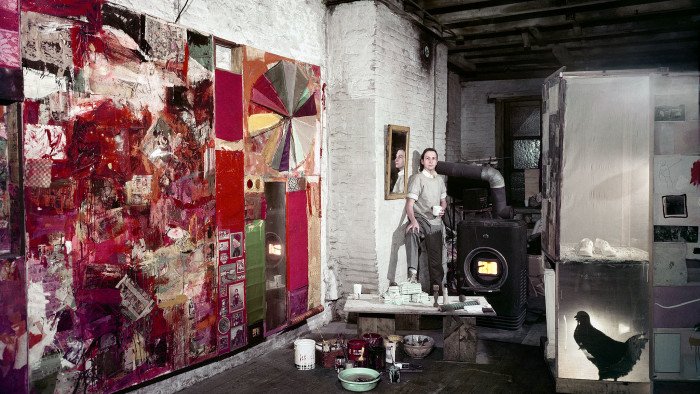
What he liked was putting things together — whether it was objects or people, integrating them, or their works, into his own, but maintaining their individuality. It might be the music of John Cage or the choreography of Merce Cunningham — his two closest early collaborators. It might be found objects from the street, the thrift shop, a radio, a pair of office cooling fans; all of which he incorporated into his works. In the mid-1950s he began to construct “Combines”, works in which the surface of his paintings were built up with an accretion of objects from the outside world — “gifts from the street”, he called them. First they adhered to the surface, and then they extended out from it. They could be as mundane as a chair or as exotic as a stuffed goat (“Monogram”, 1955-59). Sometimes panels were added, turning the canvas into a three-dimensional object that could be walked or even danced through, as in his 1964 work with Cunningham Minutiae, set to music by Cage. Thus the Combines moved — as Michael Craig-Martin notes below — into the space normally occupied by the viewer.
Today it is a given that the stuff of everyday life is potential material from which art is made but in this Rauschenberg was an important catalyst. His intention — as he put it in his now-famous quote — was to work “in that gap between art and life”. “I don’t want a picture to look like something it isn’t,” he told the New Yorker writer Calvin Tomkins. “I want it to look like something it is. And I think that a picture looks more like the real world when it’s made out of the real world.” When people use the word “permission” in talking about Rauschenberg, it is often in the context of the liberating effect his art had on the generations that followed him.

Next month, a full Rauschenberg retrospective opens at Tate Modern. When his first UK retrospective opened at the Whitechapel Gallery in London in 1964, the same year he won the Grand Prize at the Venice Biennale, it was so popular the gallery had to take on extra staff to control the crowds.
. . .
He was born in Port Arthur, Texas, in 1925. He liked to say that he and Janis Joplin were the only two people ever to get out of there (see Carolee Schneemann’s story below). In a working life that spanned six decades, Rauschenberg exhibited a protean ability to move between genres, mastering new techniques, materials and, later, new technologies, that took him from monochrome paintings in the early 1950s — white canvases that acted like screens, reflecting the light and shadows of the environment around them — to his adoption of digital processing in the 1990s that he worked with until his death, aged 82, in 2008.
It was John Cage who had given him permission to follow his own path. They met in 1949 when Rauschenberg was a student at Black Mountain College in North Carolina. “Cage had a fantastic influence on my thinking,” he later told the US art critic Barbara Rose. “He gave me permission to go on thinking . . . he was the only one who gave me permission to continue my own thoughts.”

It worked both ways: three years after they met, Cage wrote 4’ 33”, his most famous piece, silent except for ambient sound. “What pushed me into it,” Cage said in 1973, “was not guts but the example of Robert Rauschenberg. His white paintings.”
Rauschenberg had gone to Black Mountain in 1948, after a year at the Kansas City Art Institute and an abortive venture to Paris on the GI Bill. (He thought Paris was where he should go to become an artist but it was, as he said later, “right place, wrong time”.) In 1950 he married another Black Mountain student, Susan Weil, but they divorced in 1952 after the birth of their son Christopher. In 1952, Rauschenberg travelled to Italy with the artist Cy Twombly, and in 1953 moved into a studio in the Lower East Side of Manhattan. That year he met Jasper Johns, and the two became close friends. From the mid-1950s Rauschenberg became increasingly involved with dance, designing sets, costumes and choreography for companies including Cunningham’s and Judson Dance Theater, based at the Judson Memorial Church in Greenwich Village. In 1963 he performed in his own dance work, Pelican, on roller skates, at The Popular Image exhibition in Washington DC. In 1970 he moved to Captiva Island, Florida, which was his main base for the rest of his life.

To his paintings, photographs, collages, sculpture, silkscreens and fabric pieces (the Hoarfrosts, 1974-76, and the Jammers, 1975-76), he added works in cardboard and metal, though not moving film. He was interested in science and mathematics and, in 1967, co-founded E.A.T — Experiments in Art and Technology — with the Swedish engineer Billy Kluver, inviting artists and scientists to work together; by 1970 it had more than 5,000 members. Rauschenberg spent much of the 1980s, and a lot of his own money, on another ambitious enterprise: ROCI, the Rauschenberg Overseas Culture Interchange (also the name of his pet turtle), which he initiated after his first trip to China in 1982. Specifically aimed at countries where freedom of expression was under threat, it was nevertheless criticised by some as an exercise in self-promotion (Rauschenberg made new works in each country, leaving one behind as a gift, then moving to the next, where he made new works and exhibited what had been made thus far). By the end of the decade, ROCI had been to 10 countries, including Chile, China, Cuba and the Soviet Union, introducing the idea of contemporary American art to places that for much of the 20th century had been closed to its influence.

Although Rauschenberg shared some of the techniques of Pop art, as he inherited some of the gestures of abstract expressionism, his work belonged to neither movement. Rauschenberg’s work, as Achim Borchardt-Hume, director of exhibitions at Tate Modern and co-curator (with Leah Dickerman, MoMA, New York) of the retrospective, points out, was “void of ironic detachment”. He was an enthusiast. “For him, the experiences of art and life were intimately entwined,” Borchardt-Hume writes. “This is not to say that he wanted to make art that was autobiographical . . . he wanted his work to create a confluence between art, life and the world that could be generously shared with the viewer.”
The liberating effect of Rauschenberg’s approach to art — as Antony Gormley points out — has passed down through generations. Here five contemporary artists, whose works are very different from one another, give some idea of what Rauschenberg means to them.
————
Carolee Schneemann

is an American painter, dancer and performance artist. In the 1960s she was one of the first artists to use her own body to explore issues of gender and sexuality.
It was the early 1960s. I was living in New York in a furrier loft on 29th Street and we were exploring, my partner the composer James Tenney and I. We were finding all these artists connected to each other in the city. Jim was very friendly with John Cage and through John I met Bob, and Merce [Cunningham] — we would go mushroom picking, all of us — and they became very attached to my work. Merce because of my affiliation with Judson Dance, John because of music, and Rauschenberg — a young artist — they wanted me to meet him because of the organic sensibility of my collages.
I was a true acolyte, and we became friends over time, sharing our birthdays, celebrating our concept of Libras as generous and gracious and fun.
Bob gave parties whenever he sold a work. He would invite all the artist friends and have a banquet on top of his paint table, with wonderful things to eat and drink and smoke — and music. We danced constantly. Few of the artists were trained as dancers but it was a time when dancers created works in which artists could participate.
Bob was an initiator — of impulse, intuition and visionary certainty. And, as we all know, he became this indelible influence. Artists today using so-called intermedia, using their bodies, mixing materials — this all has a route back to Rauschenberg.
There are many Rauschenberg stories and I’ll tell you my favourite one.
I was sitting at the bar at Max’s Kansas City with Janis Joplin. And I realised that Bob and Janis are both from Port Arthur, Texas. Janis is very taciturn, she’s not chatty, we’re drinking whisky and hanging out. And in comes Bob, and he sees us. And he looks [at Janis] very stunned and very excited and comes over, whispers in my ear, and says, “You’re sitting with Janis!” I said, “Yes, yes.” He says, “Oh, she’s so wonderful. Please invite her back over to my table, I’ll buy you all drinks and anything you want to eat.” I said, “Great. Wonderful”, and I said, “Janis, that’s my friend the artist Robert Rauschenberg. He wants us to come over to his table and he’ll buy us drinks.” And she says, “Sure, fine.” So we go over, and Bob’s all excited, and he says “I’m so thrilled to meet you . . . I really love your work.” And she turns to me and she says, “Who is this dude? What’s his deal?”
————
Antony Gormley

is a British artist whose sculptures, installations and public artworks investigate the relationship of the human body to space.
I think the real influence for me is the liberational spirit that Rauschenberg had: the reaction against formalism, his complete inclusiveness. And for me he was the great collaborator with dance, an inspiration for my collaborations with dancers such as Sidi Larbi Cherkaoui or Akram Khan.
Rauschenberg’s relationship with Cunningham and Cage is one of the great stories of contemporary art. That image of Rauschenberg himself, on roller skates, pulling that parachute or umbrella [in Rauschenberg’s dance work Pelican, 1963], is a completely undying image of direct experience, of the way that technology has changed movement, and how the language of angels can be grounded in urban experience.
It was his ability to make combinations — obviously, that was his great revelation in the Combines — that you can put anything in, on or by a painting, which completely re-roots it in the real world. So the eagle, the stuffed goat, the chair, the bed . . . I think he learnt from Duchamp, but he reinvented the “ready-made” as simply a medium, part of the palette of possible ingredients, with the potential of integration.
Those three, Cage, Cunningham, Rauschenberg, remain a touchstone of a radical belief in art’s ability to change both itself and us. I think they gave art an energy and an openness, an appreciation of life as a resource — you know Rauschenberg’s “the gap between art and life” — recognising that art was actually a way of life. The spirit that those three artists represent is the most precious in postwar American art, more precious in a way than the Moses-like diktats of [Clement] Greenberg or [Barnett] Newman . . . it is so embracing and open — no pretensions, no absolutes.
I appreciate the subtlety of the later work. The things that I came back to from India [in 1973, after spending two years studying Buddhism and Vipassanā meditation] were the Hoarfrosts. I love Rauschenberg’s intuitive relationship with materials, his feeling for the texture and lightness of cloth, the way he transferred those degraded images on to transparent material. I immediately recognised in them the palimpsest function of memory. We take for granted the way in which images overlay and overlap each other, but the way they coexist in the memory — that’s very much in there.
————
David Salle

is an American artist who works in painting, printmaking, photography, set design and film-making. He also writes about art. (The following exchange was conducted by email.)
When were you first aware of Rauschenberg’s work?
I knew his work from magazines when I was young, in my teens. That was in the late 1960s, when the silkscreen paintings were new. At the time, his work had the feeling of current events. For a long time, he had the equivalent of perfect pitch. Every juxtaposition he made was the right one; it was as if he couldn’t do anything wrong. After a certain point, the feeling changes; the work from the mid-1970s on, which relies more on his own photographs, feels more like a travelogue, or a biographical novel.
What is it about his work that appeals to you?
Bob’s attitude to life was large, and not easily summed up — or passed on. It was him. I’ve always found his work to be very high style and elegant. Of course the attitude is in the work, but for all the famous blurring, or even erasure of the divide between art and life, I think his work is all art; he was an incredibly refined artist.
What are the strongest characteristics that strike you about him as an artist?
Bob was a compositional artist, an arranger and orchestrater, as well as an improviser, a performer. I relate to those things, as a matter of temperament as well as practice. He couldn’t draw but could put things together in such a way as to make you weep. He forged a new connection between pictorial structure and the image, and also between what the camera registers and what can be done with a brush.
He was a relational artist: he generally resolved his work into a unified whole. He once told me he could fix any painting with two pencil lines, which in his case was probably true. It implied that a painting has an ideal state, and that he, Bob, could push it in that direction. Whether he could or not is not important; the point is that he conceived of a painting that way.
When you look at the art world now, where do you see his influence?
Influence is hard to chart with any accuracy. Some of the work now looks very distant; it was made, after all, a fairly long time ago, and his aesthetic roots reached back to an even earlier time. The seeds of any radical style are sown in the previous decades. Bob came out of 1930s and 1940s people, Hans Hofmann, Albers and, of course, de Kooning, among others. But the reciprocity between image and pure painting is something that keeps on giving. The back and forth of it, and the energy and conviction with which he went about it — it was his nature.
Bob’s influence shows up in the work of anyone using structure and composition. Now the idea of juxtaposing unlike things — images, objects, whatnot — is a commonplace, but Bob’s Combine paintings and also some of the silkscreen paintings reach a level that is unsurpassed. There are all different ways to put things together — it’s a matter of temperament. Bob’s type of combinatory energy had no violence in it — just generosity and grace. Some of the Combines are just tops. I can imagine when artists of that time first saw “Monogram”, they must have felt like throwing in the towel.
————
Michael Craig-Martin

is a conceptual artist, painter, printmaker and sculptor. Born in Dublin, he grew up in the US and has lived in Britain since 1966. In the 1980s and 1990s he was an influential teacher at Goldsmiths College, London.
I was looking at the Combine paintings again and thinking about them, and it seemed clear to me that Rauschenberg really was art’s greatest collagist. These works start fundamentally as paintings and then explode out into the world. His brilliance is as a composer — he’s able to take different and often contradictory objects and images and put them together to create a wholly coherent visual image. He will use screen-printed images of famous people and events — Kennedy, a space capsule, a sports star, a figure from an Old Master painting; together with raw paint, found objects, found images, stuffed animals. There is nothing he cannot absorb, and the result is paintings of exceptional visual dynamics. They are extrovert works, exciting to look at, full of energy. So it makes sense why he is seen as so important, so influential now.
What Rauschenberg is doing is asking you to use your eyes and your brain to look at something one way, and then at something right next to it that has to be understood in a completely different way. I don’t think there was anybody before him who made that kind of demand on the viewer.
His art always takes into account the role of the viewer, the observer. Rauschenberg is one of the first people whose work so clearly engages with the viewer in this way. By having the objects coming out from the painting, rather than the person entering the space of the painting, the painting is entering the space of the viewer.
The reason I use the colour as I do is to increase the physical presence of the work I make. I’m trying to make the whole thing not just visual but physical. And Rauschenberg’s work is also both highly visual and extremely physical. The idea that putting into paintings things that move, things that make sounds — this is a voluptuous idea of the physical world. His paintings try to take account of all the senses.
I saw an exhibition about 25 years ago at the Whitney Museum [in New York] of just the screen-printed paintings from the early 1960s, and many were enormous, maybe 20 feet wide. It was just this one period of screen-printed paintings, and they were overwhelmingly wonderful. If he had never done anything else — they were triumphant.
————
Philippe Parreno

is a French artist. In 2012 he created an installation for the exhibition Dancing around the Bride: Cage, Cunningham, Johns, Rauschenberg, and Duchamp, at the Philadelphia Museum of Art. It came to the Barbican in London in 2013. Parreno’s “Anywhen” is this year’s Hyundai commission for the Turbine Hall at Tate Modern, London.
One of the first solo shows I ever did was at the Musée d’Art Moderne in Paris in 2001. I screened a one-minute film called “El Sueño de una Cosa” (The Dream of a Thing), and I screened it on the seven panels of Rauschenberg’s “White Painting” (1951). A series of blinds obscured the room, and they opened to reveal the painting as a screen. So I reactivated the original script of Rauschenberg painting. Now we see it as a monochrome canvas, but he intended it as a surface that would reflect the world around it.
I am haunted by Rauschenberg, because it’s spectral. I spent a lot of time in the museum of Philadelphia looking at the paintings. Then at the Barbican I spent another two weeks with them. And what moved me, and what still moves me today, is that the work is an experiment. It is always experimentally based. It’s fragile . . . So for me that’s Rauschenberg — the idea that things are not done, they’re not given, they have to be reinvented. And in many ways, even today, his work has to be reinvented.
The idea of taking time and reworking it was definitely something that I took from that group — from Rauschenberg, Jasper Johns and John Cage — who rediscovered Duchamp. The last show that John Cage did — in fact, he died before the opening — was in Los Angeles, where every day the position of the works was changed according to a throw of the dice. That generation was working with the importance of chance, randomness. It was much discussed in mathematics and physics at the time. Duchamp was fascinated by the fourth dimension and so was Rauschenberg — he had his relationship with science, with projects like E.A.T.
I am still negotiating my position as an artist, and I feel Rauschenberg was on that same journey of constant renegotiation. So when you talk about his works from a certain “period”, I think it’s a bad word for it. Rauschenberg doesn’t do periods. I think all the experimental pieces that he produced at Black Mountain, really they constitute the art of his practice. He put it on the table completely, fully at Black Mountain, and then he renegotiated it all his life. He was always looking for future traces; for what will still resonate in a work after the performative act has been played out.
For all those reasons, I think Rauschenberg’s work is tragic. It is crossed by all these images, events, it is haunted by the present. But it’s also permeable, porous. It’s not fixed to any one point in time. The tragedy comes from the fact that there is a moment for an artist when an infinite possibility of things can happen — you have the dice in your hand, and then you throw the dice, and it’s gone. It’s over. It has to be reduced to what it is. And then you have to suspend the act again . . . Rauschenberg for me is a bit like that. Each time he comes out with a new series of works, it’s another throw of the dice. Everything is suspended and is possible — and then it’s gone.
“Robert Rauschenberg” is at Tate Modern, December 1-April 2 2017; tate.org.uk. David Salle’s new book, “How To See: Looking, Talking and Thinking about Art” is published by WW Norton (£20)
Photographs: Dan Budnik; Robert Rauschenberg Foundation; Museum Ludwig, Cologne; Peter Moore/ Barbara Moore; Getty; Nathan Keay/Museum of Contemporary Art Chicago

