At 1952 Africa Gallery in Lekki, Lagos, the word ‘legacy’ takes on a new meaning. Rather than evoking traditional notions of solemnity and commemoration, the exhibition LEGACY presents a vibrant and provocative exploration of art and identity.
Featuring past winners of the Life In My City Art Festival (LIMCAF), the show promises to challenge expectations and push boundaries, amid making lasting impressions on the Nigerian art scene with its diverse range of mediums and themes.
Also, the exhibition, which opens at 1952 Africa Gallery on Saturday, September 20, 2025, presents a distinctive take on the traditional alumni show. Featuring nearly 60 works by LIMCAF’s past top winners, it showcases a diverse range of artistic expressions. Rather than resting on past achievements, the artists use their experiences as a foundation for exploring new ideas and perspectives. The show’s tone is dynamic and uncompromising, reflecting the artists’ engagement with the world around them. Through their works, they challenge and provoke, rather than simply celebrating past successes. According to Ayo Adewunmi, art director, LIMCAF, the initiative aims “to promote art as a tool for youth empowerment and national development,” underscoring the organisation’s commitment to harnessing art for social impact.
Starting with Okechukwu Eze’s work, they are notable for their experimental approach to figuration. His canvases feature distorted forms and unstable compositions, creating a sense of tension and uncertainty. The fragmented and disjointed nature of his pieces invites viewers to contemplate the fragility of representation and the impermanence of memory. Eze’s artistic approach reflects a dynamic and probing engagement with the human experience.
Next is Ngozi-Omeje Ezema’s ceramic installations, which showcase a bold and unconventional approach to the medium. Her works feature irregular forms and dynamic compositions that challenge traditional notions of ceramics. By situating the pieces in a way that interacts with the viewer’s space, Ezema creates an immersive experience. Her artistic approach reinterprets the medium’s historical significance, presenting clay as a versatile and expressive material.
Then there is Chichetam Okoronta, whose route into art runs against expectation. Despite formal training in information technology, he finds himself fashioning charcoal sticks and pencils into extensions of his own inquiry, producing images that oscillate between surrealism and realism. His drawings probe the intricacies of the human mind and identity, taking scars, cracks, and fractures as metaphors for resilience and fragility. Bodies appear fissured, like repaired ceramics, suggesting that both flesh and clay are vessels—containers of memory, trauma and endurance. The result is work that carries its philosophy on the surface: identity not as seamless mask but as patched, fractured skin. In Okoronta’s hands, legacy is something both breakable and enduring, an archive that survives precisely through its scars.
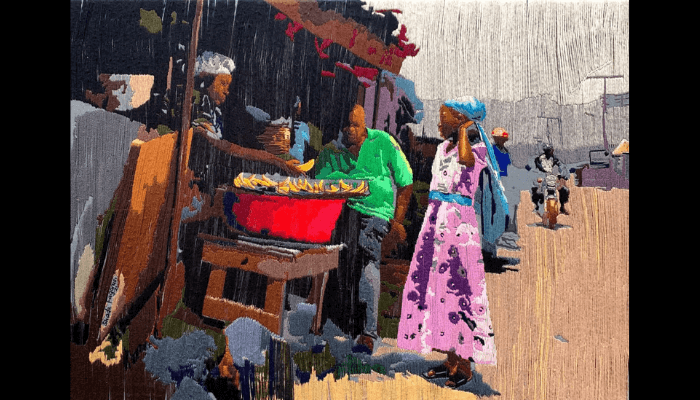
Shade Fagorusi takes another path entirely, threading memory into fabric one stitch at a time. Her practice centres on hand-stitched embroidery, using vertical stitch techniques to render human presence through the language of thread. The medium becomes both boundary and bridge—lines that conceal as much as they reveal. Influenced by a childhood steeped in fabric reuse and storytelling, she often works on unconventional surfaces—cement sacks, sugar sacks, damask, asooke—turning the very stuff of domesticity into terrain for art. Her embroidered portraits, layered over painted acrylic backgrounds, interrupt the gaze with insistent stitched lines, suggesting layered narratives and silenced histories, particularly within female experience. If Ezema’s clay mutters and Eze’s figures glitch, Fagorusi’s thread hums—a quiet but unyielding reminder that identity is stitched together from fragments, and that memory is a fabric that frays even as it binds.
And then comes Lucky Ezah, a sculptor and multimedia artist who seems most at home when coaxing life out of materials that already bear their own histories. He works with naturally shaped woods, metals and found objects, assembling them into forms that double as both emotional register and social commentary. A product of IMT Enugu, now a studio artist, Ezah treats art as a vehicle for voice—for speaking to issues that concern humanity, whether “beautiful or ugly, happy or sad.” His sculptures do not flatter; they confront. Each gnarled timber, each burnished fragment of metal feels less like decoration than testimony, carrying the grain of survival and the rust of memory. If Eze’s canvases warn viewers that memory glitches and Fagorusi’s stitches remind us of silenced histories, Ezah’s assemblages insist that the world’s debris itself can testify, that what is discarded still carries weight. His legacy, then, is not monumental permanence but eloquent salvage, an art of lending voice to what might otherwise remain mute.
Through its display of a diverse range of artistic practices united by their willingness to challenge and provoke, the show’s dynamic and often discordant atmosphere reflects the artists’ engagement with complex ideas and perspectives. Rather than celebrating a fixed legacy, the exhibition emphasises the importance of reinvention and creative disruption. By pushing boundaries and challenging conventions, the artists demonstrate that legacy is not a static concept, but a dynamic and evolving force. The exhibition’s approach to legacy is characterised by experimentation, innovation, and a refusal to settle for established norms.