


Editor’s note: This story is an excerpt from WBUR’s weekly arts and culture newsletter, The ARTery. If you like what you read and want it in your inbox, sign up here.
Last year, the Isabella Stewart Gardner Museum approached me to work on a project about Boston artist Allan Rohan Crite. One of the leading Black artists of the 20th century, Crite was well known for his oil paintings and drawings depicting everyday life and neighborhoods in the city.
The Gardner and the Boston Athenaeum planned concurrent exhibits in 2025 showcasing the late artist’s life and work. The Gardner asked me to conduct interviews with people who knew and worked with Crite for the exhibition catalogue. I grew up seeing Crite’s paintings but didn’t know much about the man behind the work, so I was thrilled to be able to dive in deeper.
Over 12 months of reporting, I sat down and interviewed 10 of Crite’s friends and mentees, including artists Susan Thompson, Johnetta Tinker, Napoleon Jones-Henderson, Edmund Barry Gaither (curator and director emeritus of the National Center of Afro-American Artists in Roxbury) and professor and activist Ted Landsmark.
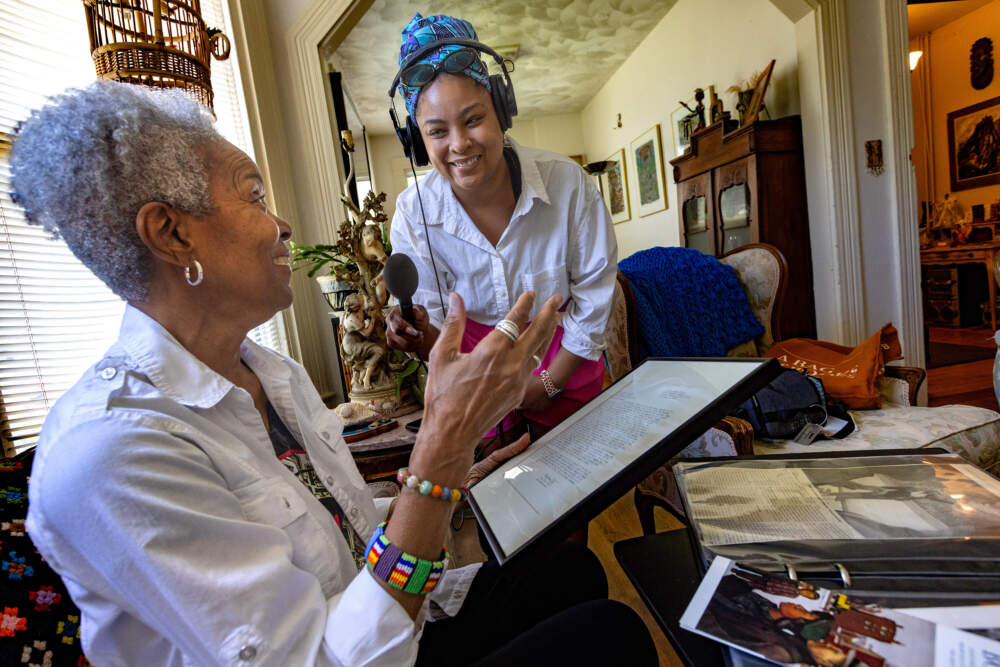
Excerpts of these interviews are featured throughout the show’s catalogue, published by Princeton University Press, called “Allan Rohan Crite: Neighborhood Liturgy.” The topics tackle his significance as an artist, his deep curiosity about the world around him and the issues facing Boston. These exchanges are also the foundation of my three stories about Crite for WBUR.
I learned so much about Crite during these interviews. He was so much more than the talented artist who created oil paintings of the South End, where he spent his entire life. Crite wanted his art to be accessible to anyone who wanted to engage with it.
“From the beginning, the very beginning, he was interested in making his art available to ordinary people. He was not interested in making it precious and difficult to access,” Gaither told me. “So he made work on his own machine that he controlled and where he could produce work much more cheaply than if he were tied to a regular professional art press.”
Crite was ahead of his time. He was creating and reimagining divine figures as Black in the 1940s, long before the “Black is Beautiful” movement took hold in America. He was a deep thinker who had strong opinions on things like gentrification (which he called “urban removal”) and the interconnected cultures of people of color across the globe.
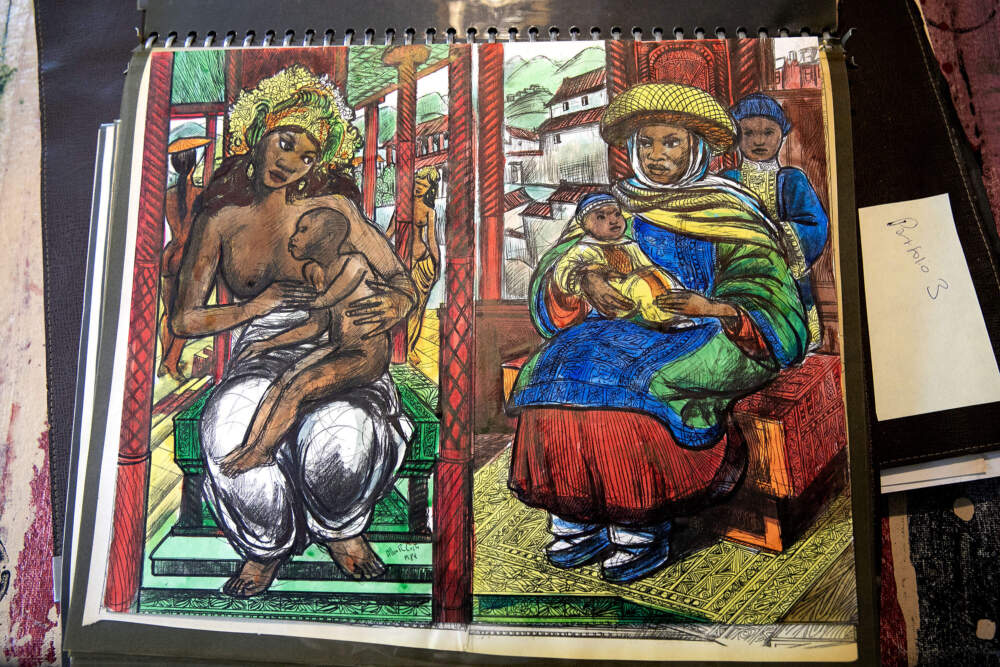
Although he was known for his family-oriented oil paintings and religious watercolors, which were acquired by various museums including the Smithsonian, Crite also created what some might call “erotic art.” He called it “human art” and was even censored for these works. He penned theories about the role of sex and love in our society and their impacts on our culture. He challenged convention and stood steadfast in his opinion on abortion, declaring that a woman had a right to choose what to do with her body.
As he got older, his artistic mediums changed. He used magic markers and pens to create books akin to graphic novels. He also believed in the democratization of art and wanted to make his work more accessible. He would print multiples of his works using his lithograph machine and hand them out to family and friends.
Crite also opened his home to the community. Boston activist and mayoral candidate Mel King ran the Rainbow Coalition campaign from the storefront of Crite’s house. Groups of children would visit his home on field trips and he’d show them how to use his printing press. There was an effort to turn his home into a museum, but it never fully came to fruition.
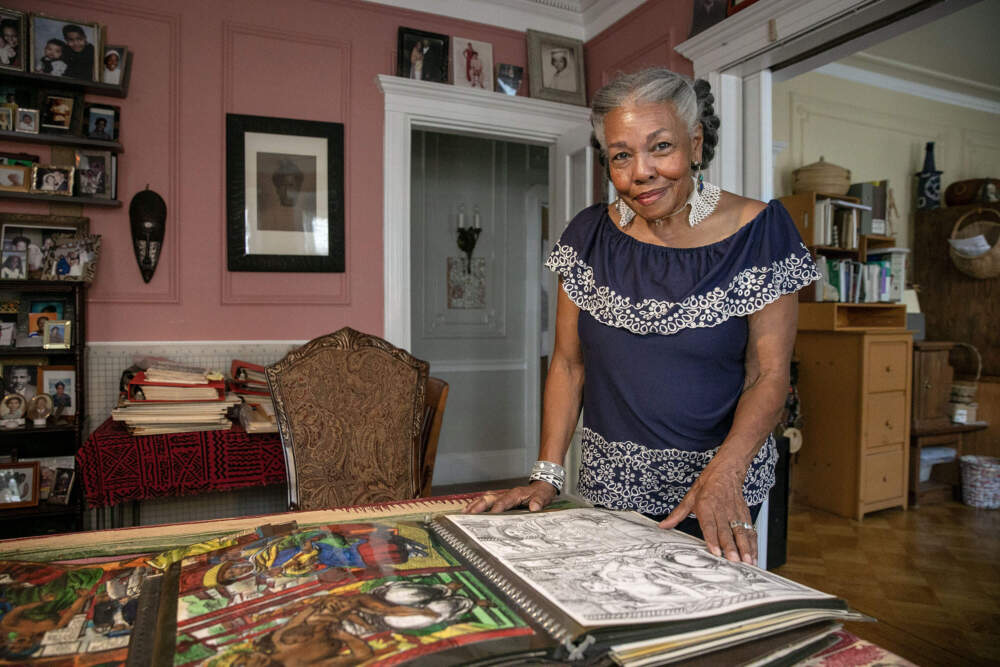
Artist Susan Thompson remembers the wonder she felt when she visited Crite at his home.
“When you walked into that house, it was like, ‘where am I?’ You’re transported to another world because the whole place was plastered with art from floor to ceiling, and three floors of it,” she recalled.
A throughline in the interviews was the community that Crite built. Beyond his art, the connections he made are an enduring part of his legacy.
Learn more about this pioneering artist in my three-part series exploring his portrayals of Black life, his relationship with religion and the human form, and the vibrant community he nurtured.