

Ninety-five years ago, on August 7, 1930, one of Azerbaijan’s
outstanding artists was born-Togrul Narimanbayov,
Azernews reports.
Narimanbayov wasn’t just a painter; he was a phenomenon. With a
style that merged emotional depth, national identity, and bold
color harmonies, he carved a space for himself in the pantheon of
world art.
His works have graced galleries and museums across Europe,
America, and Asia, earning admiration from Paris to New York,
Prague to Moscow.
Born into an intellectually rich family with deep roots in
Shusha, Togrul inherited a unique blend of Eastern spirit and
Western influence. His father, Farman Narimanbayov, had studied
electrical engineering at the University of Toulouse, while his
mother, Irma Lia Rude, was a French fashion designer.
Togrul’s father, like many Azerbaijanis educated in Europe, was
subjected to repression. He was arrested and sent into exile to
Siberia.
His mother, who never renounced her French citizenship, was
separated from her children and deported to Samarkand.
This early trauma left a lasting imprint on Narimanbekov, but it
did not break him. Instead, it fueled his determination to create,
to express, and to connect.
He found refuge in the world of art, first at the Azerbaijan
State Art School named after Azim Azimzade, and later at the
Vilnius Institute of Art in Lithuania, where he also studied
classical vocal performance at the conservatory.
Few artists possess the ability to master multiple disciplines,
but Narimanbayov did just that.
He was a gifted opera singer with a rich baritone, performing
arias from Italian operas with professional finesse.
“If I hadn’t become a painter,” he once said, “I would have
likely been a sculptor or a vocalist. But painting lets me speak in
a language that is both visual and eternal.”
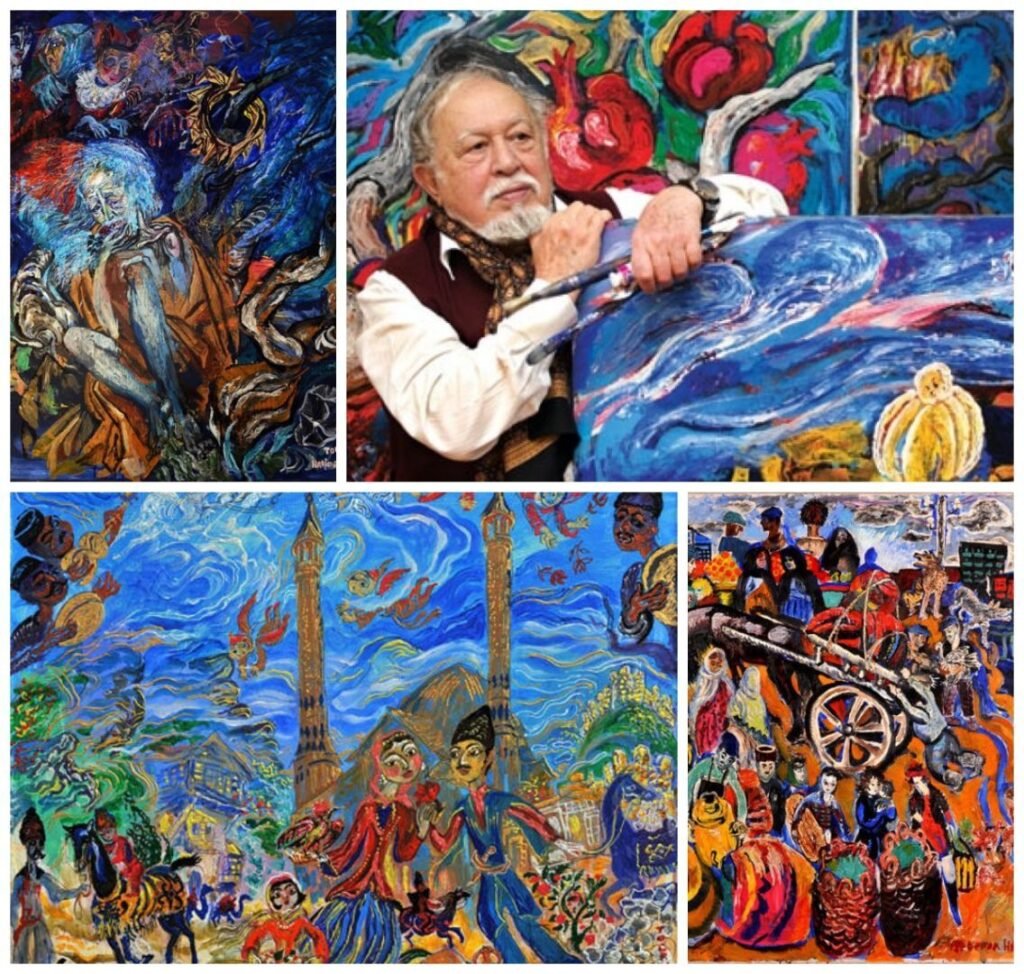
His work spanned monumental painting, portraiture, landscape,
and theatrical design, always marked by a distinctive emotional
expressiveness.
His canvases burst with life, passion, and movement. Among the
most recognizable symbols in his work was the pomegranate, a motif
he carried from Goychay to global art capitals, weaving together
themes of identity, continuity, and cultural pride.
Narimanbayov’s contributions did not go unnoticed. By the age of
33, he was already named a People’s Artist of Azerbaijan.
He won two State Prizesfor his scenic designs of Fikrat Amirov’s
“Nasimi Dastan” in 1974 and “One Thousand and One Nights” in
1980.
His work earned him entries in prestigious international
publications, including the French “Encyclopedia of Modern Art”,
making him the only Azerbaijani artist featured in its pages.
In the years following Azerbaijan’s independence, he was honored
with the Istiglal (Independence) Order in 2000 and the Sharaf
(Honor) Order in 2010.
That same year, President Ilham Aliyev ordered that
Narimanbayov’s 80th birthday be marked with official celebrations
both in Azerbaijan and abroad.
Togrul Narimanbayov passed away in Paris on June 2, 2013, and
was laid to rest at the historic Passy Cemetery.
Yet, in many ways, he never left.
His art continues to live, breathe, and inspire. In every
brushstroke, you can feel the pain of exile, the joy of reunion,
the pride of nationhood, and the universality of the human
spirit.