


Spanish authorities are investigating a man for pouring water over 6,000-year-old cave paintings in an attempt to take clearer photographs of the prehistoric paintings to share on Facebook. He was discovered by law enforcement in May after agents were made aware of photographs of the wet cave paintings that had been publicly shared and geotagged on the social media site.
The alleged perpetrator, a 39-year-old resident of Los Villares, is being investigated by Spain’s Nature Protection Service, a division of the Guardia Civil national police force. He is suspected of committing crimes against a Site of Cultural Interest as defined by Spanish heritage law. The affected rock art was in the Sierra Sur of Jaén, one of 69 sites in the region that was declared a UNESCO World Heritage Site in 1998.
Cave paintings in that region were mostly made on limestone, which contains water-soluble salts. When water is applied, it makes these salts dissolve so that, when the water later evaporates, the salts precipitate on the surface, creating a pale crust over the top of the paintings. This process can also affect the pigment, causing permanent damage the artwork.
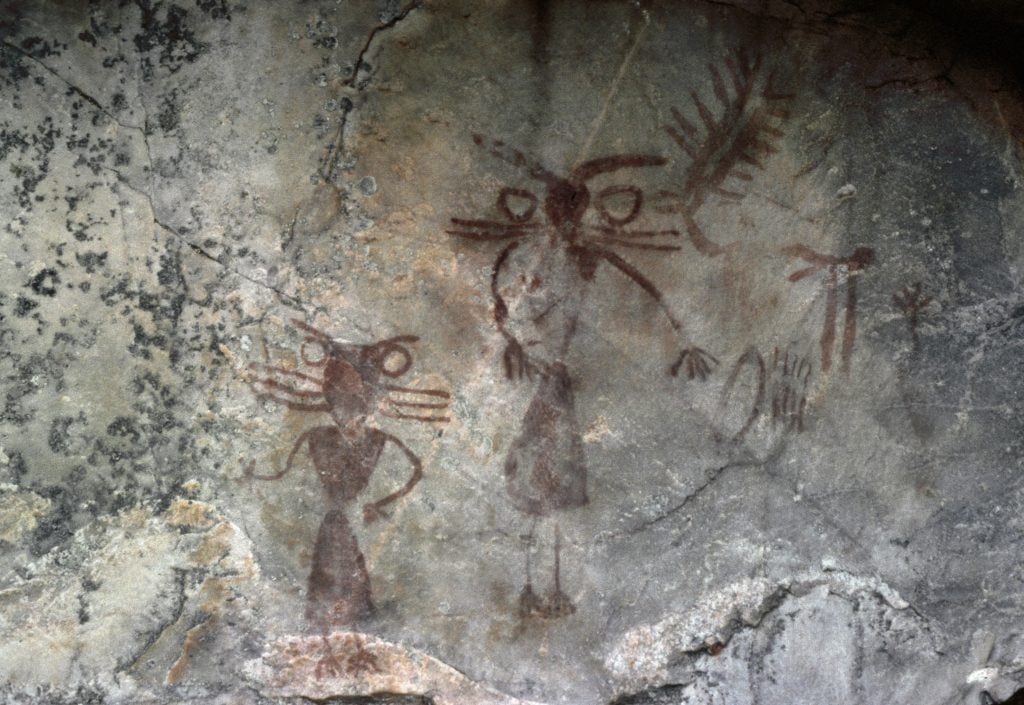
Detail of female figures with ornaments and deer, known as “The Priestesses,” province of Jaén, Andalucia, Spain. The schematic paintings were vandalized in 2022 and had to be restored. Photo: PHAS/Universal Images Group via Getty Images.
According to a report in El País, the province of Jaén in Andalusia, southern Spain, has been particularly vulnerable to vandalism in recent years. It attributed this to “the difficult accessibility of these cavities, in scattered places and rocky areas,” and said local mayors are demanding better protections.
Manuel Fernández, the mayor of Aldeaquemada, a city near Sierra Sur of Jaén, said “we do not have the means to place a guard at each site.”
Three years ago, graffiti was found sprayed over the precious Vacas del Retamoso schematic rock art in Despeñaperros Natural Park, Santa Elena, also in the province of Jaén. The vandals targeted an image of two human figures wearing masks in a probable funerary ritual that is known as The Priestesses.
At the time, the municipality’s mayor said: “They damaged the most emblematic cave painting and the main symbol of identity of our natural park, a painting with thousands of years of history.”
Follow Artnet News on Facebook: